Zing Forum

Reading

ArchiveOS: An Agent Orchestration and Memory System for Collaborative AI Development

ArchiveOS is an agent orchestration and memory system designed specifically for managing collaborative AI development workflows, providing a structured collaboration framework for complex AI projects.

AI智能体智能体编排多智能体协作记忆系统ArchiveOSAI开发工作流协作AI智能体架构
Published 2026-05-21 16:14Recent activity 2026-05-21 16:21Estimated read 7 min
ArchiveOS: An Agent Orchestration and Memory System for Collaborative AI Development
1

Section 01

Main Floor: Core Overview of the ArchiveOS Project

ArchiveOS is an open-source AI agent orchestration and memory system designed specifically for managing collaborative AI development workflows, providing a structured collaboration framework for complex AI projects. It aims to address core challenges in multi-agent systems: agent coordination, information sharing management, long-term memory and context continuity maintenance, and supports multiple collaboration modes and application scenarios.


2

Section 02

Project Background and Core Challenges

With the rapid development of AI agent technology, a single agent can no longer meet the needs of complex tasks, and multi-agent collaboration has become a research and application hotspot. ArchiveOS was born in this context, aiming to address three core challenges in multi-agent systems through systematic architecture design: effectively coordinating the work of multiple agents, managing information sharing between agents, and maintaining long-term memory and context continuity.

3

Section 03

Core Architecture and Functional Design

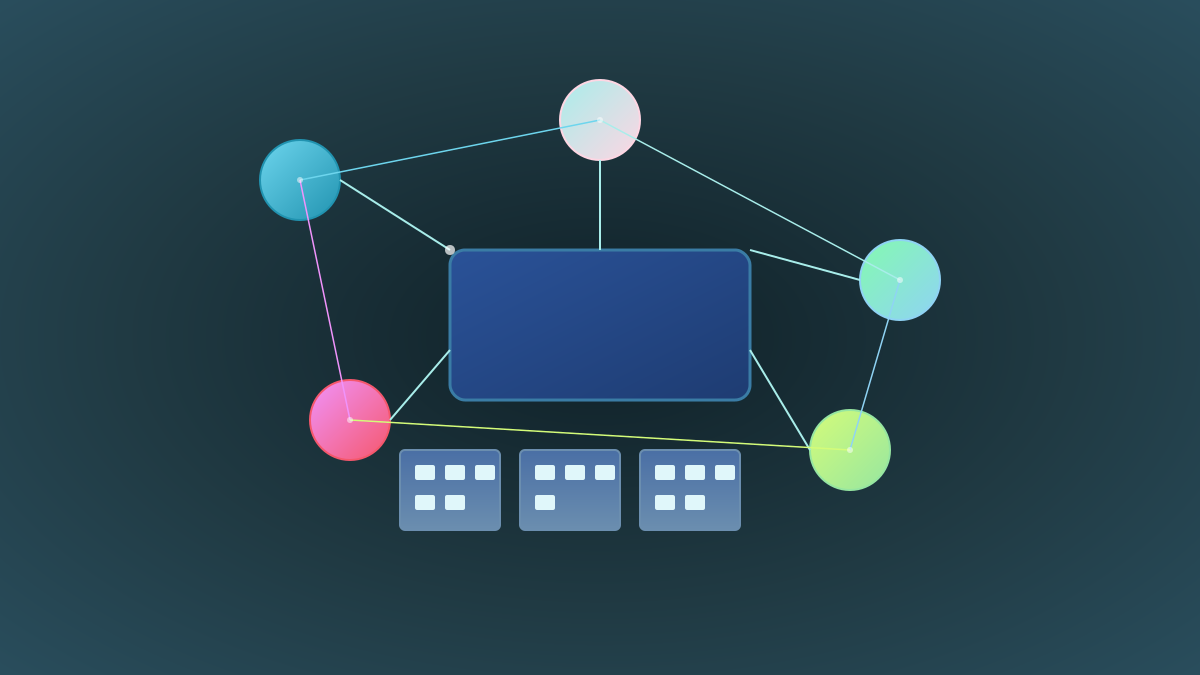
ArchiveOS is built around three core pillars:

  1. Orchestration Mechanism: Supports agent registration and scheduling, task decomposition and allocation, complex workflow management (sequential/parallel/conditional branching), load balancing, and fault recovery;
  2. Memory System: Includes short-term working memory (session context), long-term semantic memory (cross-session knowledge retrieval), shared memory space (agent information exchange), and memory persistence (system restart recovery);
  3. Collaboration Modes: Provides three modes: master-slave collaboration (centralized decision-making), peer-to-peer collaboration (negotiation and consensus), and pipeline mode (process-oriented processing).
4

Section 04

Technical Implementation Details

According to GitHub repository information, ArchiveOS adopts best practices for modern AI system design:

  • Modular Architecture: Components such as the orchestration engine, memory storage, and agent interfaces are loosely coupled, facilitating independent development and replacement;
  • API-First Design: Provides clear interfaces to support external system integration and expansion;
  • Scalability: Supports horizontal scaling and distributed collaboration, adapting to large-scale production environments;
  • Configuration-Driven: Defines agent roles, workflow rules, and memory strategies through configuration files, lowering the barrier to use.
5

Section 05

Application Scenarios and Value

ArchiveOS is suitable for various collaborative AI development scenarios:

  • Software development teams: AI assistants collaborate to complete code generation, review, and testing;
  • Content creation studios: Research, writing, and editing agents collaborate to generate content;
  • Data analysis teams: Agents divide work to handle data cleaning, feature engineering, and model training;
  • Customer service systems: Front-end dialogue, back-end support, and knowledge base agents form a multi-level service system.
6

Section 06

Comparison with Existing Technologies

ArchiveOS has a different positioning from similar projects:

  • Compared to AutoGPT: Emphasizes structured collaboration more, suitable for scenarios with clear division of labor and process control;
  • Compared to MetaGPT: Provides a general orchestration framework, not limited to the software development field;
  • Compared to CrewAI: More in-depth in memory management, supporting complex long-term memory and knowledge sharing needs.
7

Section 07

Development Prospects and Challenges

ArchiveOS represents an important attempt in the evolution of AI from single-agent intelligence to swarm intelligence, embodying a new paradigm where structured collaboration expands the boundaries of individual intelligence. However, it faces challenges:

  • Standardization needs: Industry standards are required for agent communication protocols and capability description formats;
  • Security and permissions: Need to design security mechanisms for the flow of sensitive information;
  • Interpretability: Need to track the decision-making process of multi-agents to improve the transparency of output logic;
  • Performance optimization: Need to reduce communication overhead, memory retrieval latency, and orchestration computing costs.

