Zing Forum

Reading

Apollo: Efficient Training of Multimodal Models via Spatiotemporal Resource Reuse

Apollo is an innovative multimodal model training system that enables multiple MM modules to share GPU resources through spatiotemporal resource reuse technology, achieving up to 1.31x training acceleration while maintaining training quality.

Apollo多模态训练GPU资源复用时空复用深度学习系统训练加速显存优化CUDA调度
Published 2026-05-19 01:44Recent activity 2026-05-19 12:27Estimated read 8 min
Apollo: Efficient Training of Multimodal Models via Spatiotemporal Resource Reuse
1

Section 01

Apollo: Efficient Training of Multimodal Models via Spatiotemporal Resource Reuse (Introduction)

Apollo is an innovative multimodal model training system. To address the low GPU resource utilization issue in multimodal model training, it proposes spatiotemporal resource reuse technology, allowing multiple MM modules to run simultaneously on the same GPU and enabling parallel computing through fine-grained resource quota control. While maintaining training quality, it can achieve up to 1.31x training acceleration, effectively optimizing memory and computing resource utilization.


2

Section 02

Efficiency Dilemma in Multimodal Model Training (Background)

With the widespread application of large multimodal models in computer vision, natural language processing, and other fields, their modular design (e.g., visual encoders, text encoders) provides strong expressive power, but low GPU resource utilization has become a core issue: a single module cannot fully utilize GPU resources, and GPUs often remain in an inefficient state during serial execution. Traditional time reuse schemes execute modules sequentially, leading to resource waste—other resources are idle when a module is running, and computing units cannot be fully loaded when parallelism is insufficient.

3

Section 03

Spatiotemporal Resource Reuse: Apollo's Core Innovative Idea

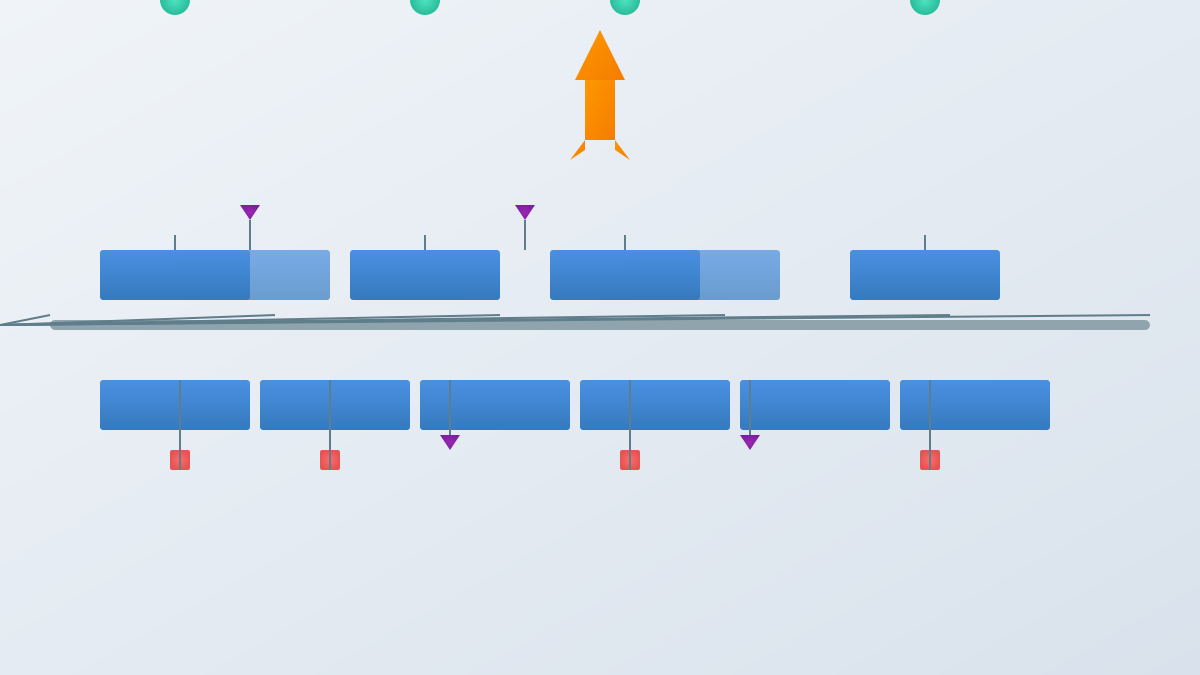
Apollo's core innovation is the spatiotemporal resource reuse paradigm, inspired by operating system multitask scheduling. Unlike time reuse, it allows multiple multimodal modules to run simultaneously on the same GPU, enabling parallel computing through fine-grained resource quota control. Its advantages include: computational parallelism (other modules use idle computing units while a module waits for memory), memory reuse (staggering peaks to optimize overall memory usage), and pipeline efficiency (overlapping data transfer and computation to reduce waiting time).

4

Section 04

Detailed Architecture of the Apollo System

The Apollo system consists of three core components:

  1. Flexible and lightweight execution engine: Supports arbitrary resource quotas, enabling simultaneous operation of multiple modules through CUDA stream-level scheduling, memory virtualization (dynamic allocation and recycling), and low-overhead monitoring.
  2. Accurate performance prediction model: Combines analytical modeling and empirical modeling, taking module computing characteristics, resource quotas, and co-location competition as inputs to predict execution time and bottlenecks.
  3. Efficient deployment planning heuristic algorithm: Solves the optimal resource allocation scheme through greedy initial allocation, iterative optimization, load balancing heuristics, and fast convergence.
5

Section 05

Experimental Validation: Training Acceleration and Model Adaptation Performance

Experimental validation shows that Apollo achieves up to 1.31x training acceleration compared to traditional time reuse schemes (reducing time by about 24%), and computing unit utilization increases from 60% to over 80%. Performance across different models: Visual-language models (e.g., CLIP-style) show the most significant acceleration, while unified generative models (e.g., GPT-4V-style) have moderate but considerable effects. Features of resource allocation strategies: dynamic adjustment (across different training phases), load awareness (temporary resource adjustment), and long-tail optimization (allocating more resources to long-execution modules).

6

Section 06

Technical Challenges and Solutions

Challenges and solutions in Apollo's implementation:

  1. Resource isolation and interference control: Reduce inter-module competition through hard resource quota limits and soft isolation mechanisms.
  2. Synchronization overhead management: Adopt delayed synchronization and batch synchronization strategies to reduce unnecessary synchronization points.
  3. Performance model accuracy: Improve prediction accuracy by continuously collecting actual data and adjusting model parameters via an online calibration mechanism.
7

Section 07

Industry Significance and Application Prospects of Apollo

Industry significance of Apollo:

  1. Training cost optimization: 24% acceleration saves computing resources and reduces large-scale training costs.
  2. Model iteration acceleration: Shortens experiment cycles and supports more hyperparameter and architecture experiments.
  3. Enlightenment for edge deployment: The spatiotemporal reuse idea can provide references for running multiple AI tasks on edge devices.
  4. Open-source ecosystem contribution: The team plans to open-source core components to promote the development and standardization of multimodal training technology.
8

Section 08

Limitations and Future Directions

Current limitations of Apollo: Generalization constraints (optimized for specific multimodal architectures), insufficient cross-node expansion (focused on single GPU), room for improvement in dynamic adaptability (for drastic changes in model characteristics), and limited support for heterogeneous hardware (mainly NVIDIA GPUs). Future directions: Introduce intelligent online learning mechanisms to automatically learn optimal resource allocation strategies, reduce reliance on manual tuning, and expand support for multi-GPU/nodes and heterogeneous hardware.

