Zing Forum

Reading

AI Engineering Project Template: Four-Agent TDD Workflow and Real-Time Documentation Guidance System

A startup template for AI engineering projects that integrates a four-agent TDD workflow and a real-time documentation system, helping teams quickly establish standardized AI development processes.

AI 工程TDD项目模板智能体实时文档工作流开发规范开源
Published 2026-05-12 22:45Recent activity 2026-05-12 22:53Estimated read 7 min
AI Engineering Project Template: Four-Agent TDD Workflow and Real-Time Documentation Guidance System
1

Section 01

AI Engineering Project Template: Guide to Four-Agent TDD Workflow and Real-Time Documentation Guidance System

ai-project-template is a startup template for AI engineering projects, integrating a four-agent TDD workflow and a real-time documentation guidance system. It aims to solve problems in AI engineering practice such as inconsistent project structures, unstandardized development processes, and disconnection between documentation and code, helping teams quickly establish standardized AI development processes.


2

Section 02

Pain Points in AI Engineering Practice and Project Background

In AI engineering practice, teams often face problems like inconsistent project structures, unstandardized development processes, and disconnection between documentation and code. This project provides an out-of-the-box solution, helping AI engineering teams quickly start standardized development by integrating a four-agent TDD workflow and a real-time documentation system.

3

Section 03

Core Methods: Four-Agent TDD Workflow and Real-Time Documentation System

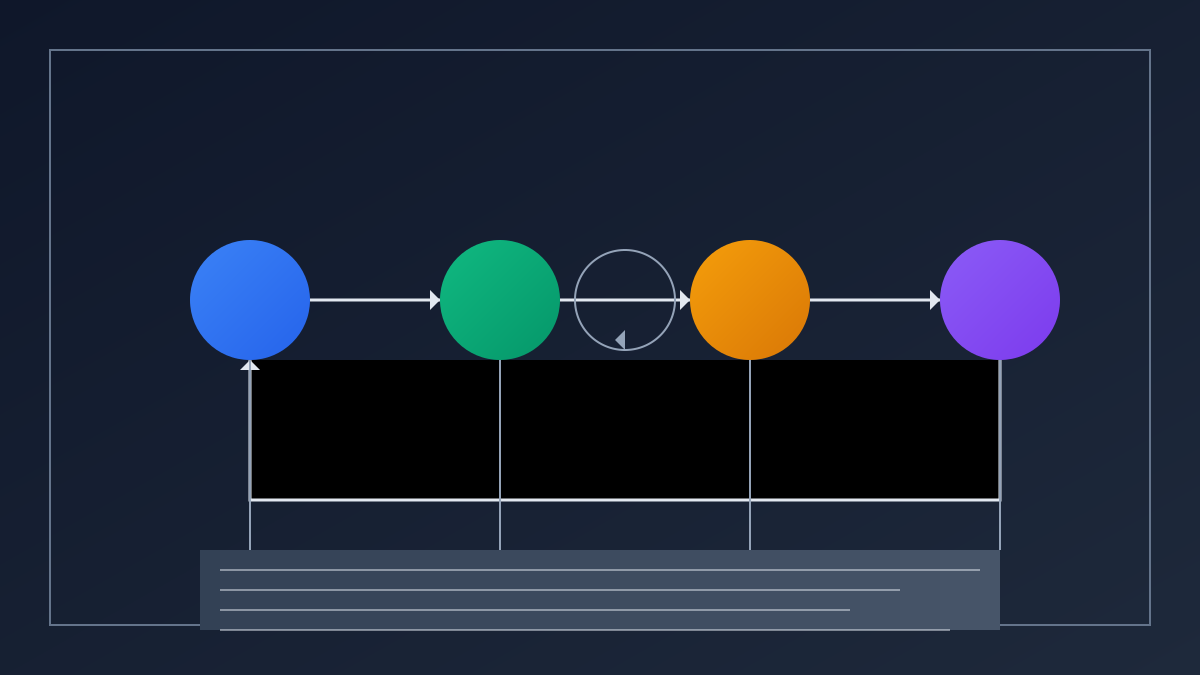
Four-Agent Workflow Architecture

  1. Requirements Analysis Agent: Understands user requirements, converts to technical specifications, outputs structured requirement documents
  2. Architecture Design Agent: Formulates technical solutions, evaluates model selection, data pipeline, etc., outputs architecture decision records and system design documents
  3. Code Implementation Agent: Follows TDD principles, generates test cases first then writes code, supports multiple languages and AI frameworks
  4. Quality Assurance Agent: Responsible for code review, test execution, performance evaluation, outputs quality reports and feeds back issues

Real-Time Documentation System

Adopts the concept of real-time documentation; documents are automatically updated as code evolves to maintain consistency with implementation. Documentation is included in version control, supporting automatic generation of API documents, architecture diagrams, data dictionaries, etc., and integrates automatic deployment of documentation sites.

4

Section 04

Template Structure and Key Features

Project Scaffolding

Provides a complete directory structure: src/ (source code), tests/ (test code), docs/ (documentation), data/ (data), configs/ (configuration), scripts/ (automation scripts)

Dependency Management

Integrates Poetry/uv configuration and Dockerfile, supports multi-environment configuration

CI/CD Pipeline

Built-in GitHub Actions workflow, supporting automated testing, code style checking, type checking, security scanning, and automatic documentation deployment

Development Environment Configuration

Provides DevContainer configuration, supports VS Code one-click launch of a consistent development environment, including pre-installed tools, recommended extensions, etc.

5

Section 05

Workflow Execution Details and Collaboration Mode

Iterative Development Cycle

  1. Requirement clarification → 2. Solution design →3. Test-first →4. Coding implementation →5. Refactoring optimization →6. Quality verification →7. Feedback iteration

Human-Machine Collaboration Mode

Agents handle repetitive tasks; humans focus on creative and strategic work. Key decision points require human confirmation, and complex issues need human intervention.

6

Section 06

Applicable Scenarios and Technical Selection Considerations

Applicable Scenarios

  • AI research teams: Provide engineering foundations, focus on algorithm innovation
  • Startups: Quickly establish engineering standards, avoid early technical debt
  • Enterprise AI teams: Unify project structures and processes, reduce onboarding costs

Technical Selection Considerations

  • TDD: Addresses AI project uncertainty, timely detection of data drift and model degradation
  • Multi-agent: Division of labor is close to human teams, easy to debug and optimize
  • Real-time documentation: Precipitates AI project knowledge, avoids knowledge loss
7

Section 07

Future Evolution Directions and Project Summary

Future Evolution Directions

  1. Smarter requirement analysis: Automatically generate user stories and acceptance criteria from natural language
  2. Richer architecture patterns: Preset architecture templates for RAG, Agent, multimodal systems, etc.
  3. More complete quality gates: Introduce model interpretability, fairness assessment, adversarial robustness testing

Summary

This project is not just a code template but also a set of engineering practice methodologies. Through the four-agent TDD workflow and real-time documentation system, it helps teams establish order amid the complexity of AI development, improve development efficiency and code quality, and is an open-source project worth trying.

