Zing Forum

Reading

AI-SchemaGen: An Intelligent Structured Conversion Tool for PDFs Based on Large Language Models

AI-SchemaGen is a lightweight AI tool that uses large language models and smol-agents to automatically convert PDF documents into structured XML files, enabling accurate data extraction and formatting.

PDF解析XML转换大语言模型smol-agents文档结构化AI工具数据提取
Published 2026-04-05 02:43Recent activity 2026-04-05 02:47Estimated read 7 min
AI-SchemaGen: An Intelligent Structured Conversion Tool for PDFs Based on Large Language Models
1

Section 01

[Introduction] AI-SchemaGen: An LLM-Based Intelligent Structured Conversion Tool for PDFs

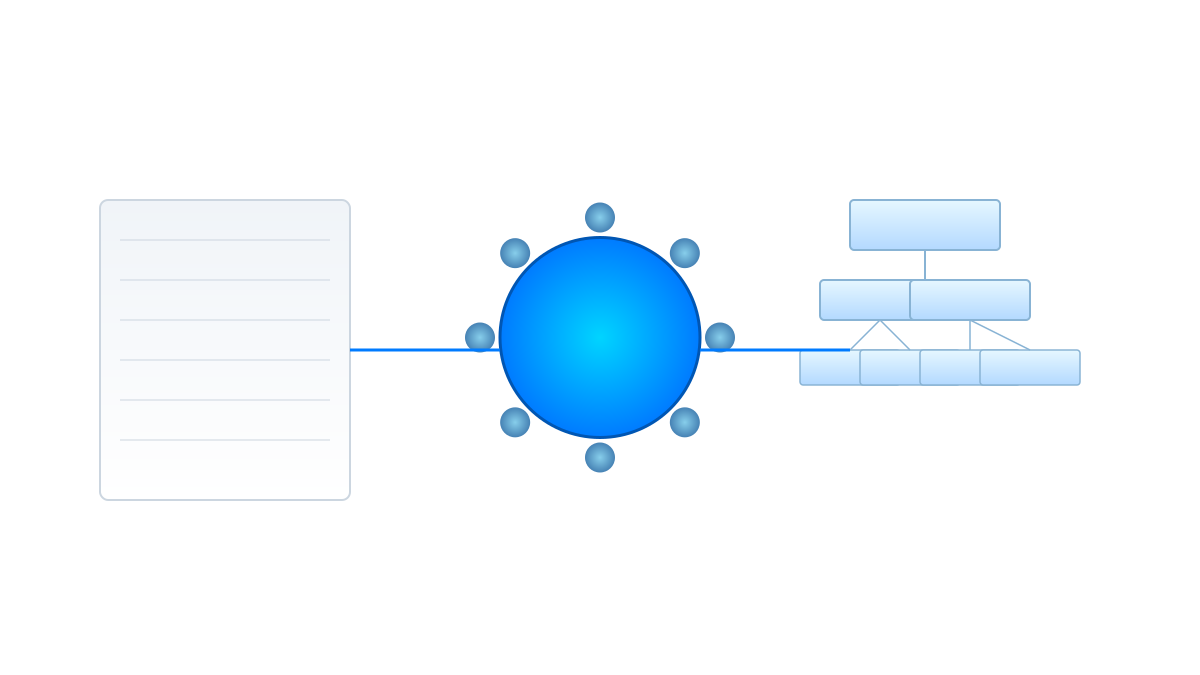
AI-SchemaGen is an open-source lightweight AI tool developed by Yasir-Khan-7. It combines the semantic understanding capabilities of large language models (LLMs) with the task orchestration capabilities of the smol-agents framework to automatically convert PDF documents into structured XML files. This tool addresses the pain points of traditional PDF parsing, which relies on fixed templates and struggles with complex layouts. It offers advantages such as flexibility, accuracy, and ease of use, making it suitable for document processing scenarios in multiple industries including finance, law, and scientific research.


2

Section 02

Background and Problems: Industry Pain Points in Structured PDF Extraction

In the field of enterprise data processing and document management, PDFs are widely used due to their cross-platform compatibility and layout stability. However, their unstructured nature makes data extraction difficult. Traditional PDF parsing tools rely on fixed templates or rule engines, which struggle to handle documents with variable layouts and complex formats. With the maturity of LLM technology, AI-powered intelligent document parsing has become a new solution direction.

3

Section 03

Core Technical Mechanism: Collaborative Process of LLM + smol-agents

LLM-Based Content Understanding

After the system extracts text from the PDF, it uses LLMs to analyze the semantic structure, identify elements such as titles, paragraphs, and tables along with their hierarchical relationships, adapt to diverse layouts, and eliminate the need for fixed templates.

smol-agents Task Orchestration

The smol-agents framework is used to decompose the document processing flow into reusable agent tasks such as content extraction, structure analysis, and XML generation. The modular design enhances maintainability and scalability.

Structured XML Output

The processed content generates standard XML files that retain the original document's hierarchical structure and add semantic tags, facilitating parsing, storage, and integration by downstream systems.

4

Section 04

Practical Application Scenarios: Efficient Document Processing Across Industries

AI-SchemaGen can be applied to multiple business scenarios:

  • Finance: Convert PDF invoices and reports into structured data to support automated auditing and analysis;
  • Law: Structure contracts and judgment documents to enable fast retrieval and content comparison;
  • Scientific Research: Convert academic papers and research reports into machine-readable formats to assist in literature reviews and knowledge graph construction;
  • Enterprise Batch Processing: Reduce manual data entry workload and improve data processing efficiency and accuracy.
5

Section 05

Technical Features and Advantages: Core Value Beyond Traditional Solutions

Compared to traditional PDF parsing solutions, AI-SchemaGen's advantages include:

  1. Flexibility: No need to maintain complex parsing rules, adaptable to diverse document types;
  2. Accuracy: LLM semantic understanding capabilities handle ambiguous or non-standard content;
  3. Ease of Use: Lightweight architecture lowers the threshold for deployment and use;
  4. Open-Source and Extensible: Users can customize and extend functions according to their needs.
6

Section 06

Usage and Deployment: Convenient Experience with Lightweight Architecture

The usage process is simple: users provide the PDF to be processed, and the system automatically completes the entire process from content extraction to XML generation. For deployment, the lightweight architecture supports running on ordinary computing resources without complex distributed deployment; batch processing scenarios can implement automated pipelines through scripts or API calls.

7

Section 07

Summary and Outlook: The Future of AI-Driven Document Processing

AI-SchemaGen combines LLMs and agent frameworks to provide new ideas for structured PDF conversion, playing an important role in enterprise digital transformation. With the advancement of LLM technology and the growth of document processing needs, such tools will be more widely applied. For developers and data engineers, this project serves as a reference example of applying cutting-edge AI technology to practical scenarios.

