Zing Forum

Reading

AI Agent Ecosystem Panorama Guide: A Systematic Practical Handbook from Architecture to Implementation

An in-depth analysis of the agent-playbook project, a carefully curated panorama of the AI Agent ecosystem covering core components such as orchestrators, runtimes, memory systems, MCP servers, workflows, evaluation systems, and development tools, providing systematic practical references for developers and architects.

AI AgentMulti-AgentAgent OrchestrationMCP ProtocolAgent MemoryLLM ApplicationAgent FrameworkLangChainAutoGenAI Architecture
Published 2026-05-19 08:44Recent activity 2026-05-19 08:48Estimated read 8 min
AI Agent Ecosystem Panorama Guide: A Systematic Practical Handbook from Architecture to Implementation
1

Section 01

AI Agent Ecosystem Panorama Guide: Core Introduction to the agent-playbook Project

The agent-playbook project is a carefully curated panorama of the AI Agent ecosystem, covering core components such as orchestrators, runtimes, memory systems, MCP servers, workflows, evaluation systems, and development tools. It provides systematic practical references for developers and architects, helping them address the complexity challenges brought by the rapid development of the AI Agent field.


2

Section 02

Complexity Challenges of the AI Agent Ecosystem and the Birth of the Playbook

With the improvement of LLM capabilities, AI Agents have become core architectural components in practical applications. However, new frameworks, tools, and protocols emerge in an endless stream, making it difficult for developers to grasp the full picture. The giljae/agent-playbook project came into being—it is not just a resource list, but a systematic "tactical manual" that draws a complete map for the modern AI Agent ecosystem.

3

Section 03

Core Dimensions and Layered Architecture of Agent Playbook

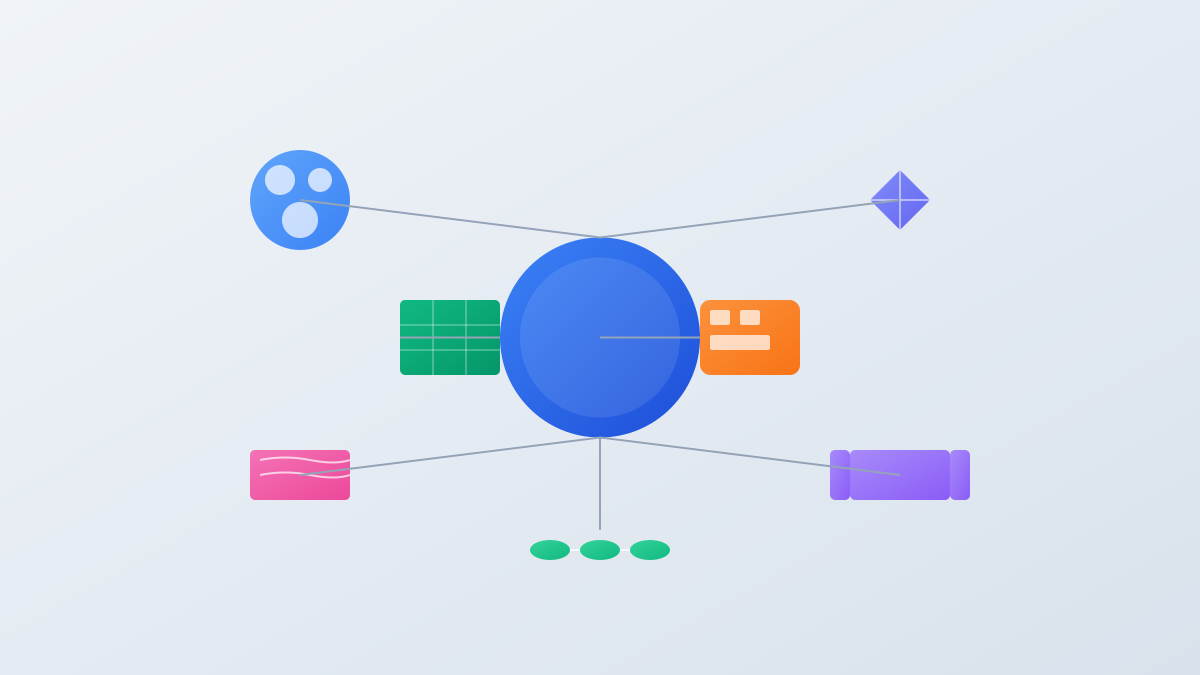
Agent Playbook is an open-source curated resource library that uses structured classification to divide the ecosystem into seven core dimensions: 1. Orchestrators (coordinating multi-agent collaboration); 2. Runtimes (underlying execution environment); 3. Memory systems (persistent context and long-term memory); 4. MCP servers (tool endpoints following the Model Context Protocol); 5. Workflows (predefined collaboration patterns); 6. Evaluation systems (performance evaluation methods); 7. Development tools (efficiency-enhancing auxiliary tools). This classification reflects the layered thinking of Agent architecture and forms a complete development closed loop.

4

Section 04

Orchestrators and Runtimes: Command and Execution Foundation for Multi-Agent Collaboration

Orchestrators: Multi-agent collaboration has become an industry consensus. The included representatives are AutoGen (Microsoft, conversational programming paradigm, integrating code execution, LLM reasoning, and human feedback), CrewAI (declarative development, abstraction of roles/tasks/tools), LangGraph (LangChain extension, graph structure modeling for state transitions), and emerging projects like PraisonAI, AgentScope, and CAMEL.

Runtimes: It is the "nervous system" of Agents, responsible for converting decisions into actions and external interactions. The OpenAI Agents SDK provides advanced features such as type safety and streaming responses; open-source projects like Agent Runtime and AgentStack explore general and scalable abstractions; tools like Browser Use and Stagehand mark the evolution of runtimes toward end-to-end interactions.

5

Section 05

Memory Systems and MCP Protocol: Memory and Sensory Extension of Agents

Memory Systems: It solves the stateless limitation of early LLMs, enabling Agents to maintain user preferences, accumulate knowledge, and achieve long-term planning. The included solutions are Mem0 (personalized memory extraction), Zep (enterprise-level memory service), Chroma/Pinecone (vector databases supporting semantic memory), and MemGPT exploring heuristic memory management mechanisms.

MCP Protocol: An open standard proposed by Anthropic, establishing a unified protocol for communication between LLMs and tools. The included MCP servers cover development tools (GitHub, GitLab), data services (PostgreSQL), productivity tools (Slack, Notion), search and knowledge (Brave Search, Arxiv), etc., expanding the capability boundaries of Agents.

6

Section 06

Workflows and Evaluation: Reliability Assurance from Demo to Production

Workflows: It includes various verified collaboration patterns, such as the supervisor mode (central Agent coordinating expert Agents), polling mode (Agents relaying in sequence), and parallel mode (multiple Agents processing subtasks simultaneously).

Evaluation: It covers end-to-end evaluation methods. AgentEval and AgentBench provide standardized benchmarks; tools like LangSmith and Phoenix help observe actual operation performance; adversarial evaluation (red team Agents attacking the main Agent) has become a standard configuration for high-reliability systems.

7

Section 07

Practical Insights: Usage Recommendations for Different Roles

Value for different roles:

  • Architects: Focus on orchestrators and runtimes, understand the trade-offs of architectural patterns;
  • Application developers: Use memory systems and MCP servers to quickly build prototypes, and refer to workflow best practices;
  • Researchers: Gain inspiration from evaluation systems and cutting-edge projects;
  • Technical decision-makers: Understand the ecosystem maturity curve, and judge the timing and method of introducing Agent technology.
8

Section 08

Evolution Direction and Summary of the Agent Ecosystem

Trends of the Agent ecosystem: 1. Accelerated standardization (popularization of MCP protocol reduces integration complexity); 2. Multimodal fusion (expansion to vision, voice, etc.); 3. Edge deployment (lightweight runtimes supporting terminal devices); 4. Autonomous evolution (self-improving Agents moving toward applications). Developers need to establish systematic cognition and understand that Agents are complex engineering problems involving system architecture, human-computer interaction, and security/trustworthiness to maintain competitiveness.

