Zing Forum

Reading

End-to-End AI Development Workflow: A Multi-Agent Collaborative Code Review and Security Audit System

This article introduces a complete AI development workflow plugin based on Claude Code, which automates the entire process from ticket management to multi-agent code review, security audit, and automatic PR creation, demonstrating the practical application of long-running AI agents in software development.

AI开发工作流多智能体代码审查安全审计Claude Code自动化PR智能体协作
Published 2026-05-18 17:18Recent activity 2026-05-19 17:23Estimated read 9 min
End-to-End AI Development Workflow: A Multi-Agent Collaborative Code Review and Security Audit System
1

Section 01

Introduction: End-to-End AI Development Workflow—Multi-Agent Collaborative Code Review and Security Audit System

This article introduces the simple-workflow plugin based on Claude Code, which automates the entire process from ticket management to multi-agent code review, security audit, and automatic PR creation, demonstrating the practical application of long-running AI agents in software development. Built on the Harness framework, this system addresses the context loss issue of single-point AI tools and drives the transformation of AI-powered software development paradigms.


2

Section 02

Evolutionary Background of AI-Driven Software Development

The software development field is undergoing an AI-driven transformation, but most AI tools remain at the "single-point assistance" level. Developers need to switch tools frequently, leading to context loss and limited efficiency improvement. A true transformation requires systematic workflow reconstruction, enabling AI to coordinate multi-agents, manage the complete process, and maintain cross-session context continuity. The simple-workflow project is the practice of this vision.

3

Section 03

System Architecture and Overview of Core Modules

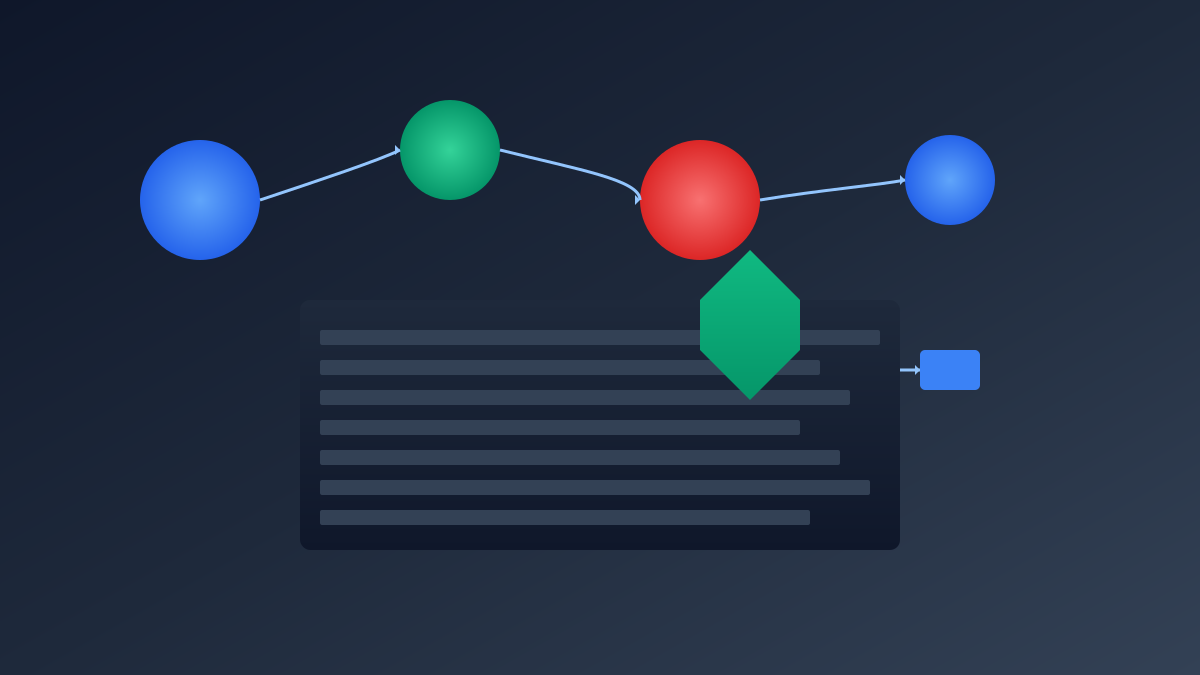
simple-workflow is a Claude Code plugin based on the Harness framework, which is designed specifically for long-running AI agents and provides strict context management and cross-session learning capabilities. The system includes four core modules:

  • Ticket Management Module: Receives, classifies, and prioritizes development tasks, integrates Jira/GitHub Issues to synchronize status;
  • Multi-Agent Code Review Module: Introduces multiple specialized review agents covering dimensions such as code style and architecture design;
  • Security Audit Module: Identifies code security vulnerabilities and risks, integrates static analysis tools and AI reasoning;
  • Automatic PR Creation Module: Packages the reviewed code into a PR, generates a description document, and assigns reviewers.
4

Section 04

Multi-Agent Collaboration Mechanism

The multi-agent architecture is the core design concept of the system, which decomposes complex tasks into specialized agents:

  • Coordination Agent: Responsible for task allocation and result aggregation, breaks down large tasks into professional agents and integrates outputs;
  • Professional Agents: Include code style, architecture, performance, security, and testing agents, each focusing on specific review dimensions; Agents communicate via a structured message protocol, and the coordination agent ensures correct information flow, avoiding duplication or omission.
5

Section 05

Context Management and Cross-Session Learning

The Harness framework provides powerful context management capabilities:

  • Strict Context Management: Structurally stores intermediate results, decision history, and external dependencies to ensure agents get the required information and avoid context overflow;
  • Cross-Session Continuity: Supports state persistence, allowing workflows to progress across multiple interactions, and agents learn and improve from past sessions;
  • Knowledge Accumulation Mechanism: Automatically records problem patterns, best practices, and team preferences to form a knowledge base, improving review quality and team adaptability.
6

Section 06

Deep Integration of Security Audit

The security audit module practices the "shift-left security" concept, identifying and fixing security issues early in development, combining multiple technologies:

  • Static Application Security Testing (SAST): Integrates leading static analysis tools to scan for known vulnerabilities;
  • Dependency Vulnerability Scanning: Checks for vulnerabilities in third-party libraries and recommends upgrades or replacements;
  • AI Semantic Analysis: Identifies complex business logic vulnerabilities (e.g., permission bypass, race conditions);
  • Secret Detection: Scans for sensitive information leaks;
  • Compliance Check: Evaluates code compliance with standards like OWASP Top10 and CWE; The output includes a list of issues, risk assessment, repair suggestions, and reference resources.
7

Section 07

Automated PR Workflow

After passing the review, the system automatically completes the PR creation process:

  • Generate PR Description: Based on code changes and review history, including change motivation, implementation details, and test results;
  • Select Reviewers: Intelligently recommend based on code domain and team members' professional directions;
  • Link Tickets: Establish a connection between the PR and the original ticket, update status;
  • Run CI/CD: Trigger continuous integration to ensure no existing functions are broken;
  • Notify Relevant Personnel: Notify the team of the new PR creation via the messaging system; This automation reduces developers' administrative burden, allowing them to focus on creative work.
8

Section 08

Practical Recommendations and Future Outlook

Practical Recommendations:

  • Gradual Adoption: Start with a single module and expand gradually;
  • Customize Agents: Customize review agents according to the team's tech stack;
  • Human-AI Collaboration: Use AI as a supplement, retain human final decision-making power;
  • Continuous Optimization: Review results, collect team feedback to adjust standards;
  • Security Boundaries: Clarify AI permissions, sensitive operations require manual review; Future Outlook: As multi-agent collaboration and context management technologies mature, more intelligent task decomposition, precise review suggestions, and seamless human-AI collaboration will be achieved, driving fundamental improvements in software development efficiency and quality.

