Zing Forum

Reading

Engineering Practice of AI Coding Agents: From Workflow Router to Composable Skills

The open-source project agent-engineering-skills proposes an engineering methodology for AI coding agents. By leveraging specification-driven development, CI/CD, and documented skills, it aims to build reusable and maintainable intelligent agent systems.

AI coding agentWorkflow Routerspec-driven developmentCI/CDcomposable skillsagent engineering
Published 2026-05-17 16:44Recent activity 2026-05-17 17:27Estimated read 6 min
Engineering Practice of AI Coding Agents: From Workflow Router to Composable Skills
1

Section 01

Introduction: Core Methodology for AI Coding Agent Engineering

The open-source project agent-engineering-skills proposes an engineering methodology for AI coding agents, aiming to address the issues of current AI coding tools lacking engineering support and being difficult to maintain and extend. At its core, it builds composable skills through the Workflow Router pattern, combined with specification-driven development, CI/CD, and documented skills, to achieve reusable, maintainable, and sustainable evolution of intelligent agent systems.


2

Section 02

Background: Industrialization Challenges of AI Coding Agents

With the development of AI coding assistants like GitHub Copilot, Cursor, and Devin, AI agents are evolving toward production-grade. However, key issues stand out: How to make AI coding agents as maintainable, scalable, and collaborative as traditional software? Most current tools are "intelligent individual weapons" that lack engineering methodology support, making them unsustainable as project scales grow and team collaboration increases.

3

Section 03

Core Concepts and Architectural Foundation: Workflow Router Pattern

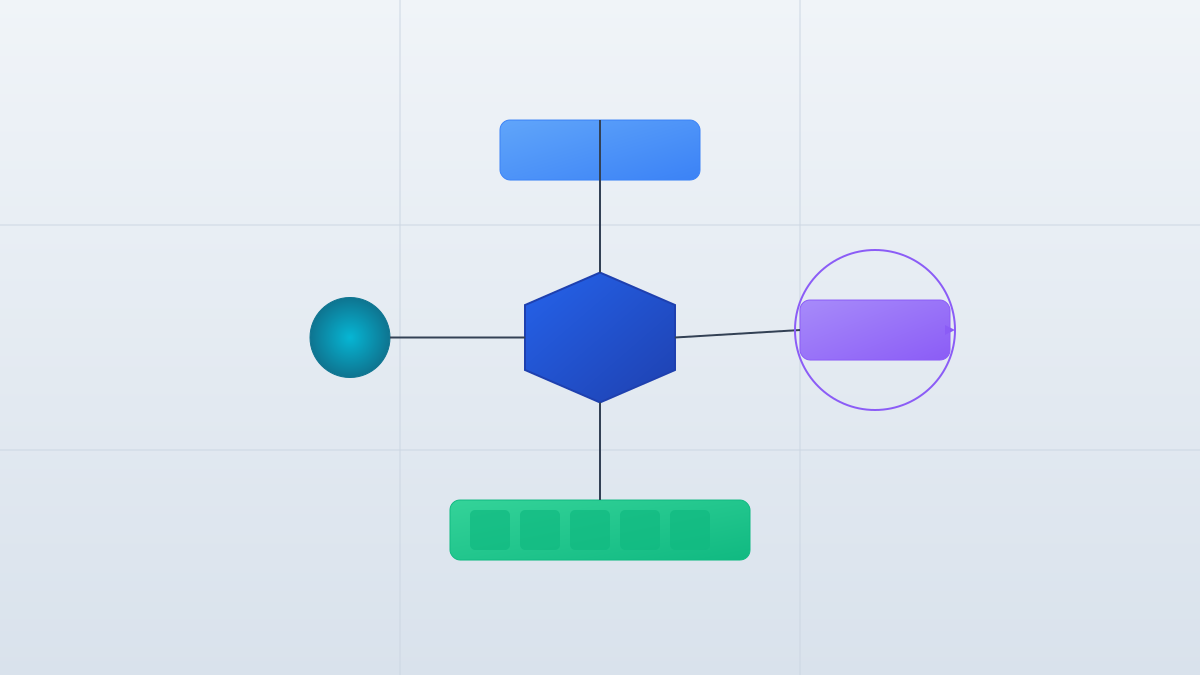
The core concept of agent-engineering-skills is to introduce software engineering best practices into AI agent development, enabling AI coding agents to have clear interfaces, standardized documentation, comprehensive testing, and evolution capabilities. The architecture is based on the Workflow Router pattern: decomposing complex tasks into independent skill units, and the Router routes requests to appropriate skills/combinations based on context. Advantages include modularity, composability, scalability, and observability. Compared with the traditional "large prompt" pattern, it solves the problems of version control, testing, and collaboration.

4

Section 04

Engineering Practices: Specification-Driven, CI/CD, and Documentation as Code

  1. Specification-driven development: Before implementing a skill, it is necessary to define functional specifications (input/output, boundaries), interface contracts (interaction methods, error handling), and testing specifications (unit/integration tests); 2. CI/CD process: Automated testing pipelines (unit/integration/regression/performance tests), version management and release, multi-environment configuration management; 3. Documentation as code: Structured documentation (functions, examples, configurations), executable documentation (runnable example code), automatically generated documentation (from code/specifications).
5

Section 05

Skill Ecosystem and Practical Application Scenarios

Skill ecosystem vision: Share skills to repositories, discover existing skills, combine skills into workflows, customize and extend existing skills (similar to software package management). Practical value applies to: Enterprise-level AI agent development, multi-agent collaboration systems, long-term maintenance projects, compliance-sensitive scenarios (finance/healthcare).

6

Section 06

Comparison with Existing Tools and Future Outlook

Comparison: 1. With GitHub Copilot/Cursor: Complementary— the former provides real-time coding assistance, while the latter offers engineering methodology; 2. With LangChain/LlamaIndex: Framework vs. methodology;3. With Devin: Autonomous vs. controllable and maintainable. Future directions: Develop supporting toolchains (CLI, IDE plugins), establish community skill repositories, deeply integrate mainstream AI frameworks, and create domain-specific methodologies.

7

Section 07

Conclusion: Engineering is the Cornerstone of Sustainable Development for AI Agents

AI coding agents are changing the way software is developed, but sustainable expansion requires applying software engineering wisdom. agent-engineering-skills embodies this effort— concepts like modularity, specification-driven development, CI/CD, and documentation-first will become industry standards. The basic principles of engineering are the cornerstone of building reliable systems, providing a reference framework for AI agent development teams.

