Zing Forum

Reading

Ternary Cognitive Architecture: Constraining Autonomous Decision-Making of AI Agents with Physical Friction

This article proposes the Ternary Cognitive Architecture (TCA), which introduces spatiotemporal constraints and cognitive friction from the physical world into the design of AI agents. Using nonlinear filtering, Riemannian geometric routing, and optimal control theory, it addresses issues such as overthinking, tool abuse, and fragile decision-making in traditional LLM agents in complex environments.


认知架构智能体决策物理约束最优控制信息价值自主系统
Published 2026-04-01 01:30Recent activity 2026-04-01 10:18Estimated read 7 min
Ternary Cognitive Architecture: Constraining Autonomous Decision-Making of AI Agents with Physical Friction
1

Section 01

Ternary Cognitive Architecture: Constraining Autonomous Decision-Making of AI Agents with Physical Friction (Introduction)

This article proposes the Ternary Cognitive Architecture (TCA), which introduces spatiotemporal constraints and cognitive friction from the physical world into the design of AI agents. Using nonlinear filtering, Riemannian geometric routing, and optimal control theory, it addresses issues such as overthinking, tool abuse, and fragile decision-making in traditional LLM agents in complex environments.

2

Section 02

Background: The 'Cognitive Weightlessness' Dilemma of Traditional Agents

Current LLM-driven autonomous AI agents face the 'cognitive weightlessness' dilemma—lacking inherent physical constraints, they are unaware of network topology, time rhythm, and cognitive boundaries. This leads to three failure modes: tool abuse during congestion, overthinking under time decay, and fragile behavior with ambiguous evidence. Traditional heuristic agent loops (e.g., ReAct) are essentially massless symbolic operations, lacking the physical awareness required for real-world decision-making.

3

Section 03

Core Idea: Physicalization of Cognitive Friction and Three Dimensions

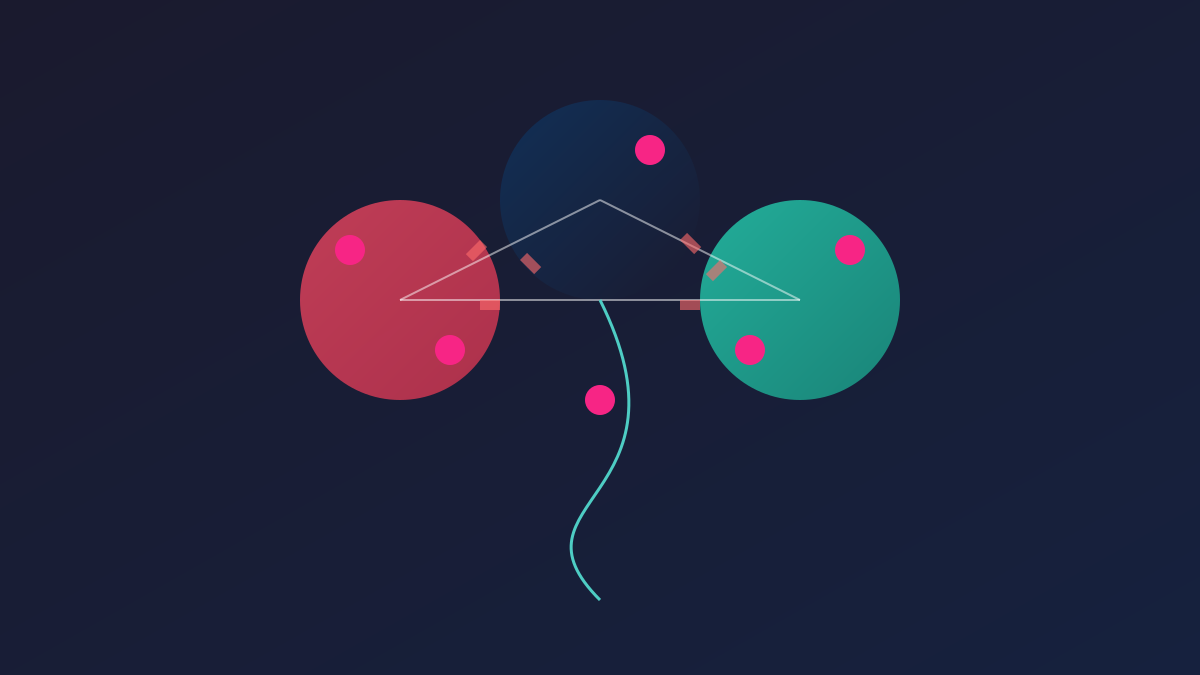
The core idea of TCA is to anchor agent reasoning in the continuous-time physical world (with strict mathematical modeling). The 'ternary' refers to three coupled dimensions: spatial dimension (network topological position and information path dependence), temporal dimension (decision time cost and impact of delayed utility), and cognitive dimension (boundary of knowledge uncertainty and stopping time for information collection). Together, these three form the 'cognitive friction' that agents must overcome to act.

4

Section 04

Theoretical Foundation: Integrated Application of Three Mathematical Tools

TCA integrates three mathematical fields: 1. Nonlinear filtering theory: dynamically updates the environmental probability distribution, quantifies uncertainty, and provides a basis for stopping observation; 2. Riemannian geometric routing: uses geometric structures to describe the path dependence of information propagation—congested nodes increase the 'curvature' of information acquisition and cognitive friction; 3. Optimal control theory: models decision-making as a stochastic control problem, balancing the value of information collection and action benefits. The innovation lies in treating information acquisition as a control variable.

5

Section 05

Key Innovation: Net Utility-Based Stopping Condition

Traditional agents use heuristic stopping rules (fixed steps/confidence thresholds). TCA proposes a stopping boundary based on belief-dependent information value: it continuously calculates the expected information gain from continued observation, the time cost of delayed decision-making, and the expected utility difference between the current and optimal actions. When the marginal benefit of continued deliberation ≤ the delay cost, it stops deliberation and acts. This condition is formalized via the HJB equation and approximated using rollout-based methods.

6

Section 06

Experimental Validation: Results from Emergency Medical Diagnosis Grid Scenario

The effectiveness of TCA was validated in the Emergency Medical Diagnosis Grid (EMDG) environment: the scenario requires agents to triage patients within limited time, facing time pressure (patient survival rate decays with time), resource competition (equipment queuing), and information cost (accurate diagnosis takes time). Results: Compared to the greedy baseline, the ternary strategy reduced action time, improved patient survival rate without sacrificing diagnostic accuracy, verifying that appropriate constraints enhance system performance.

7

Section 07

Theoretical Significance and Future Outlook

TCA represents a paradigm shift: from 'cognition as computation' to 'cognition as a physical process'. Its significance includes: more robustness (physical constraint regularization), interpretability (decision delays and information patterns have physical explanations), and connection to embodied intelligence (providing a framework for deployment in the physical world). Limitation: High computational overhead of rollout-based approximation. Future directions: Efficient approximation algorithms, expansion to multi-agent scenarios, and integration with neuro-symbolic AI.
