Zing Forum

Reading

AgenticOS: An Autonomous AI Operating System with Seven-Brain Reasoning Architecture

AgenticOS-Native is a native Windows desktop AI operating system built on Tauri v2, featuring a seven-brain reasoning architecture, agent clusters, multi-model failover and self-repair mechanisms, and integrating the RAG 2.0 knowledge engine and a Cursor-like editor.

AI操作系统智能体集群多模型TauriRAG自修复七脑推理桌面应用
Published 2026-06-07 01:39Recent activity 2026-06-07 02:22Estimated read 9 min
AgenticOS: An Autonomous AI Operating System with Seven-Brain Reasoning Architecture
1

Section 01

AgenticOS: AI-Native OS with Seven-Brain Reasoning (Main Post)

Project Core Overview

AgenticOS-Native is an open-source AI-native Windows desktop operating system developed by rachidSabah (source: GitHub, link: https://github.com/rachidSabah/AgentincOS-Native, updated: 2026-06-06). It aims to upgrade AI from auxiliary tool to OS core, featuring seven-brain reasoning architecture, agent clusters, multi-model failover, self-repair mechanisms, RAG 2.0 knowledge engine, and integrated tools like Cursor-style editor & browser agent. This thread breaks down its design, features, scenarios, and challenges.

Key Highlights

  • Built on Tauri v2 (Rust backend + Web frontend) for native Windows experience
  • Innovative seven-brain reasoning to split cognitive tasks
  • Multi-agent collaboration and self-healing capabilities
  • Next-gen RAG and AI-powered development tools

2

Section 02

Background & Project Vision

Context

AI technology is evolving from app-level tools to system-level core components. AgenticOS-Native explores a bold concept: creating a true "AI-native OS" (Agentic OS X) that deeply integrates AI into the operating system, not just running as an application.

Tech Stack Basics

  • Framework: Tauri v2 (combines Rust's performance/security with Web frontend flexibility)
  • Deployment: NSIS/MSI installers for native Windows desktop experience
  • Goal: Redefine human-computer interaction by making AI the central driver of the OS
3

Section 03

Seven-Brain Reasoning Architecture

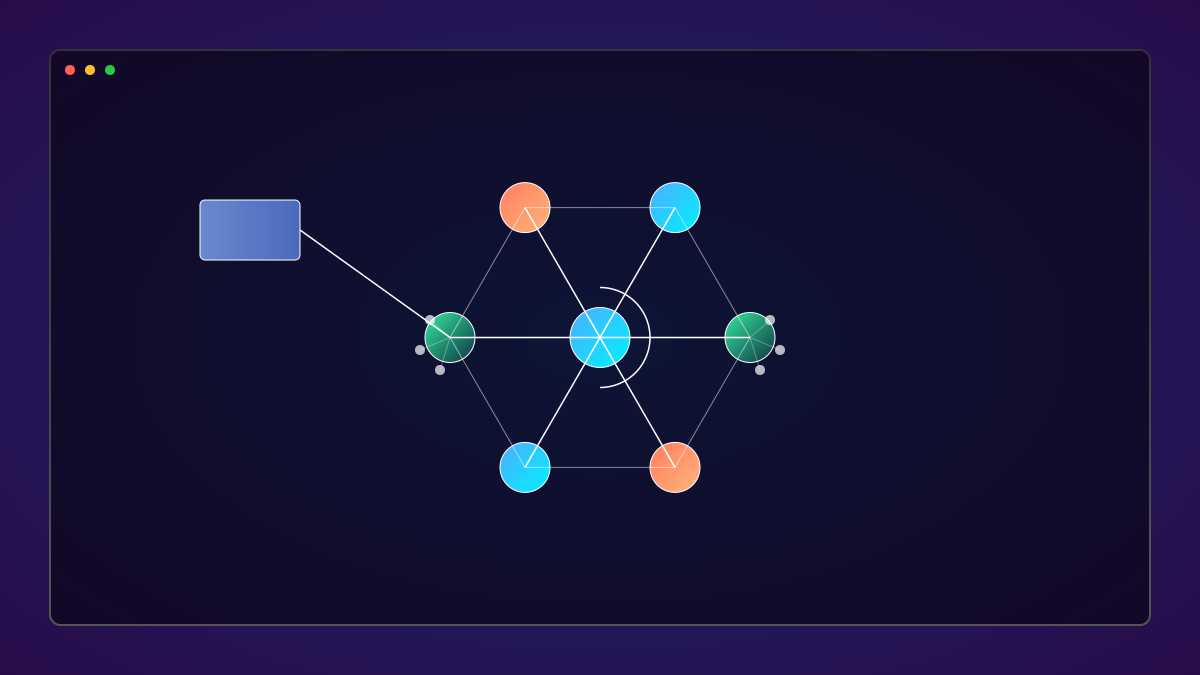
What is Seven-Brain Reasoning?

A modular design that mimics the functional division of the human brain into 7 specialized modules:

  1. Perception Brain: Multi-modal input processing (text, image, voice)
  2. Reasoning Brain: Logical inference, causal analysis, math computation
  3. Memory Brain: Short-term working memory + long-term knowledge storage
  4. Planning Brain: Task decomposition, goal setting, path planning
  5. Action Brain: Execute plans (call tools, run code, operate UI)
  6. Reflection Brain: Monitor system, self-assess, adjust strategies
  7. Coordination Brain: Manage inter-module collaboration, resource allocation

Advantages

  • Specialization: Optimized for specific tasks to avoid one-size-fits-all inefficiency
  • Modularity: Easy to upgrade/replace individual modules
  • Parallel processing: Multiple modules work simultaneously to boost response speed
  • Fault isolation: Single module failure won’t crash the whole system (paired with self-repair)
4

Section 04

Agent Clusters & Reliability Mechanisms

Agent Swarms (Multi-Agent Collaboration)

Inspired by natural group intelligence (ant/bee colonies), tasks are handled by specialized agent clusters:

  • Task decomposition: Split complex tasks into sub-tasks for suitable agents
  • Dynamic coordination: Agents communicate to adjust the division of labor based on progress
  • Redundancy: Critical tasks processed by multiple agents for reliability
  • Learning evolution: Cluster optimizes collaboration strategies from experience

Multi-Model Failover & Self-Repair

  • Multi-Model Failover: Supports OpenAI/Anthropic/Google/local models with load balancing, real-time failure detection, automatic switch to backup models, and performance evaluation
  • Self-Repair: Reflection brain monitors system health; uses pre-built repair strategies, auto-generates fix code, restarts components, or rolls back to stable state when issues occur
5

Section 05

RAG 2.0 & Integrated Tools

RAG 2.0 Knowledge Engine

Next-gen retrieval-augmented generation with upgrades:

  • Multi-modal support: Text, image, audio, video knowledge retrieval
  • Real-time updates: Knowledge base from web, local files, user interactions
  • Deep semantic understanding: Beyond keyword matching to concept associations
  • Personalized memory: User-specific knowledge graphs for tailored experiences

Integrated Tools

  • Cursor-Style Editor: AI-assisted code editing (smart completion, natural language coding, code explanation/refactoring/error diagnosis)
  • Browser Agent: Auto-browse, form filling, structured data scraping, complex web task automation
6

Section 06

Application Scenarios & Prospects

Key Use Cases

  1. Personal AI Assistant: Deeply integrated OS-level assistant
  2. Automated Workflows: Agent clusters handle complex task automation
  3. Development Environment: AI-powered editor for efficient coding
  4. Research Platform: Browser agent + RAG for info collection
  5. Enterprise Deployment: Self-repair and failover for stable enterprise use

Future Potential

Represents a trend of AI moving from application layer to system layer, redefining how users interact with computers.

7

Section 07

Challenges & Considerations

Main Challenges

  1. Resource Consumption: Seven-brain and multi-model design may lead to high compute costs
  2. Complexity Management: Exponential complexity growth as features expand
  3. Security: Deep system integration requires strict safety boundaries
  4. User Experience: Need to help users understand and trust the complex AI system

Critical Questions

How to balance performance and resource usage? How to ensure security in an AI-driven OS? How to make the system intuitive for non-technical users?

8

Section 08

Conclusion & Significance

AgenticOS-Native is a pioneering exploration of AI-native operating systems. Its innovations (seven-brain reasoning, agent clusters, self-repair) push the boundaries of AI integration into system-level computing. Whether it succeeds or not, this project provides valuable insights for the future of AI OS development. For developers and tech enthusiasts, it’s a worth-studying case that shows AI’s potential to transform the core of computing.


