Zing Forum

Reading

Yolium: A Desktop AI Agent Parallel Orchestration Tool

Introducing Yolium—a desktop application that supports containerized isolation and parallel execution of AI agents, exploring its application value in local AI workflow automation.

AI智能体容器化并行执行桌面应用Docker本地部署工作流自动化安全隔离
Published 2026-04-13 04:44Recent activity 2026-04-13 04:54Estimated read 11 min
Yolium: A Desktop AI Agent Parallel Orchestration Tool
1

Section 01

Introduction: Yolium—A Desktop AI Agent Parallel Orchestration Tool

In 2026, as AI agent technology matures rapidly, developers face a new engineering challenge: how to run multiple autonomous AI agents safely and efficiently in a local environment. The Yolium project is a desktop application born to address this need. Through containerized isolation and parallel execution mechanisms, it provides a concise yet powerful solution for local AI workflow automation. This article will discuss Yolium's background, core design, application scenarios, technical dependencies, comparative analysis, and future outlook.

2

Section 02

Engineering Dilemmas of Local AI Agents

With the improvement of large language model capabilities, AI agents are moving from proof-of-concept to practical applications. These agents, which can autonomously plan, call tools, and complete complex tasks, bring new possibilities for automated workflows. However, when deploying agents in a local environment, developers often face several tricky issues:

Environment Isolation: Running operations like code execution and file system access directly in the host environment poses security risks; out-of-control agents may lead to file deletion, resource consumption, and other problems. Parallel Efficiency: Actual workflows require collaboration among multiple agents, but serial execution is inefficient, and manual management of parallel processes is complex. Data Security and Access Control: Agents need access to project files, but unrestricted permissions may leak sensitive data—there's a need to balance functionality and security. Persistent State Management: Intermediate results and cached data during agent execution need to be maintained between sessions without being confused with project code.

Yolium's design is centered around solving these engineering pain points.

3

Section 03

Core Design and Implementation of Yolium

Containerized Isolation Security Architecture

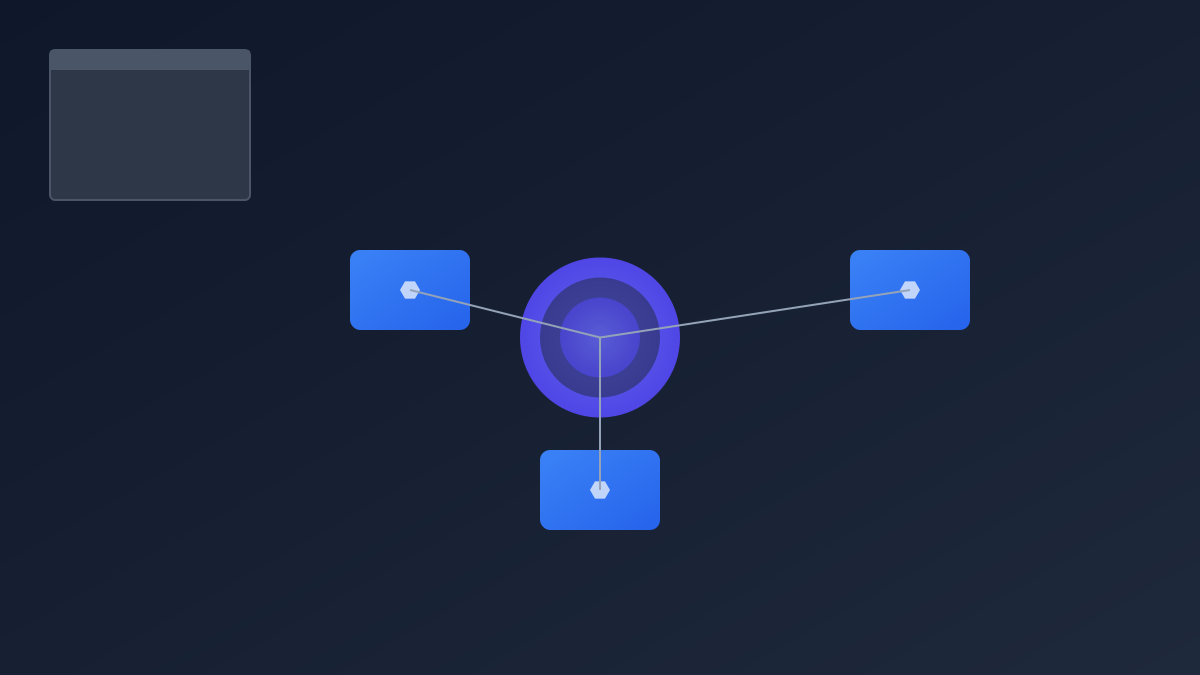
Yolium's core design decision is to use containerization technology to isolate each AI agent. Each agent runs in an independent Docker container with an isolated file system, process space, and network environment. This architecture brings multiple security benefits: clearly bounded security domains limit operation scope, controlled project access follows the principle of least privilege via mounting mechanisms, and container images ensure environment consistency.

Parallel Execution and Resource Scheduling

Yolium supports running multiple agents simultaneously, fully utilizing multi-core CPU capabilities. Different tasks (e.g., code review, document updates) can be parallelized to improve throughput. Resource scheduling relies on Docker to manage CPU and memory allocation, which is transparent to users and lowers the barrier to use.

Design Trade-offs for Persistent Caching

Yolium adopts a separation strategy: real-time mounting of project files (modifications are reflected on the host immediately) and independent storage of cached data (reusable indexes, easy to clean), balancing user habits and state retention needs.

Desktop Application User Experience

Yolium is presented as a desktop application with a graphical interface that lowers the threshold. The typical workflow is concise: create a project → configure agents → run in parallel → monitor results. Cross-platform support for Windows, macOS, and Linux makes it suitable for team collaboration.

4

Section 04

Application Scenarios and Practical Value of Yolium

Yolium is particularly suitable for the following scenarios:

Local Development Assistance: Configure multiple agents to handle code review, document generation, test suggestions, etc., in parallel to get AI assistance and directly operate the local codebase. Batch Data Processing: Assign large-scale file analysis/transformation tasks to multiple agents for parallel processing to reduce total time consumption. Multi-agent Collaborative Workflows: Decompose complex tasks into subtasks, handle them by agents with different expertise, and integrate results—containerized isolation ensures safe context sharing. Automation Script Replacement: Replace complex local scripts with containerized agents for better isolation and maintainability.

5

Section 05

Technical Dependencies and System Requirements

Yolium relies on a Docker environment to run; users need to pre-install and run Docker. Hardware requirements are moderate: dual-core CPU, 4GB memory, and 200MB disk space. Yolium focuses on agent orchestration and management, leaving model inference to professional tools (e.g., Ollama, vLLM, or cloud APIs), reflecting the principle of separation of concerns.

6

Section 06

Comparative Analysis with Related Technologies

Yolium has a unique position in the field of AI agent orchestration:

  • Comparison with Cloud Agent Platforms: The local-first architecture provides better data privacy and lower latency; sensitive code does not need to be uploaded to external services.
  • Comparison with General Container Orchestration Tools (e.g., Kubernetes): Lighter weight and AI-scenario focused, no complex YAML configuration required, and simple graphical interface operation.
  • Comparison with IDE Built-in AI Features: More flexible, not tied to a specific editor, serves the entire project, and supports multi-agent parallel collaboration.
7

Section 07

Limitations and Future Outlook

Current Limitations

  • Docker dependency may bring additional complexity on Windows and macOS (requiring Docker Desktop or virtual machines), creating a learning curve for users unfamiliar with container technology.
  • The coordination mechanism between agents is relatively simple; advanced features like explicit communication and task dependency management need to be implemented by users themselves.

Future Outlook

Yolium can develop in directions such as finer-grained resource quota management, inter-agent message passing mechanisms, deep integration with version control systems, and preset workflow templates—further lowering the threshold for multi-agent collaboration.

8

Section 08

Conclusion

Yolium represents a pragmatic direction for the engineering deployment of AI agents, focusing on solving specific pain points of running agents locally (security isolation, parallel efficiency, data protection). Through containerization technology and a concise desktop interface, it allows developers to leverage AI agent capabilities more easily. In an era of increasingly powerful AI, Yolium provides a valuable reference solution for technical teams to integrate AI into daily workflows, and its design ideas have reference value for building local AI toolchains.


