Zing Forum

Reading

YAML Multi-Agent Orchestrator: Declarative AI Workflow Management

YAML-Multi-Agent-Orchestrator is a tool that uses YAML for declarative definition and execution of multi-agent AI workflows. It simplifies the orchestration process and enhances collaboration capabilities through automatic context handling.

YAML多智能体编排器工作流声明式配置AI协作上下文管理自动化
Published 2026-04-11 15:41Recent activity 2026-04-11 16:34Estimated read 6 min
YAML Multi-Agent Orchestrator: Declarative AI Workflow Management
1

Section 01

YAML Multi-Agent Orchestrator: Guide to Declarative AI Workflow Management

This article introduces the YAML-Multi-Agent-Orchestrator tool, which uses YAML declarative configuration to define and execute multi-agent AI workflows. It automatically handles context to simplify the orchestration process and enhance collaboration capabilities, aiming to solve problems such as complex coordination and high technical barriers in multi-agent collaboration.


2

Section 02

Background and Challenges of Multi-Agent Collaboration

With the maturity of AI agent technology, a single agent can hardly meet complex business needs, making multi-agent collaboration a trend. However, coordinating interactions, state management, and task allocation among multiple agents is complex; traditional programming methods are flexible but have high barriers for non-technical users and are difficult to maintain and iterate. YAML-Multi-Agent-Orchestrator provides a solution through declarative configuration.

3

Section 03

Core Design Concepts: Declarative Configuration and Automatic Context Handling

This tool adopts declarative configuration: users only need to describe the desired final state (agent participation, responsibilities, dependencies, overall goals), and the system automatically handles task scheduling, context transfer, and exception recovery. It also has a built-in automatic context handling mechanism to ensure relevant agents access necessary information, correctly pass dialogue history and intermediate results, and protect privacy from being leaked to irrelevant agents.

4

Section 04

Key Features

  1. YAML workflow definition: Supports using YAML syntax to specify agent roles, system prompts, task decomposition, conditional branches, error handling, etc.
  2. Agent collaboration modes: Includes serial, parallel, negotiation, and master-slave modes.
  3. Dynamic context management: Automatically manages context windows, intelligently summarizes historical dialogues, extracts key decision points, maintains global state, and avoids exceeding model context limits.
5

Section 05

Technical Implementation Architecture

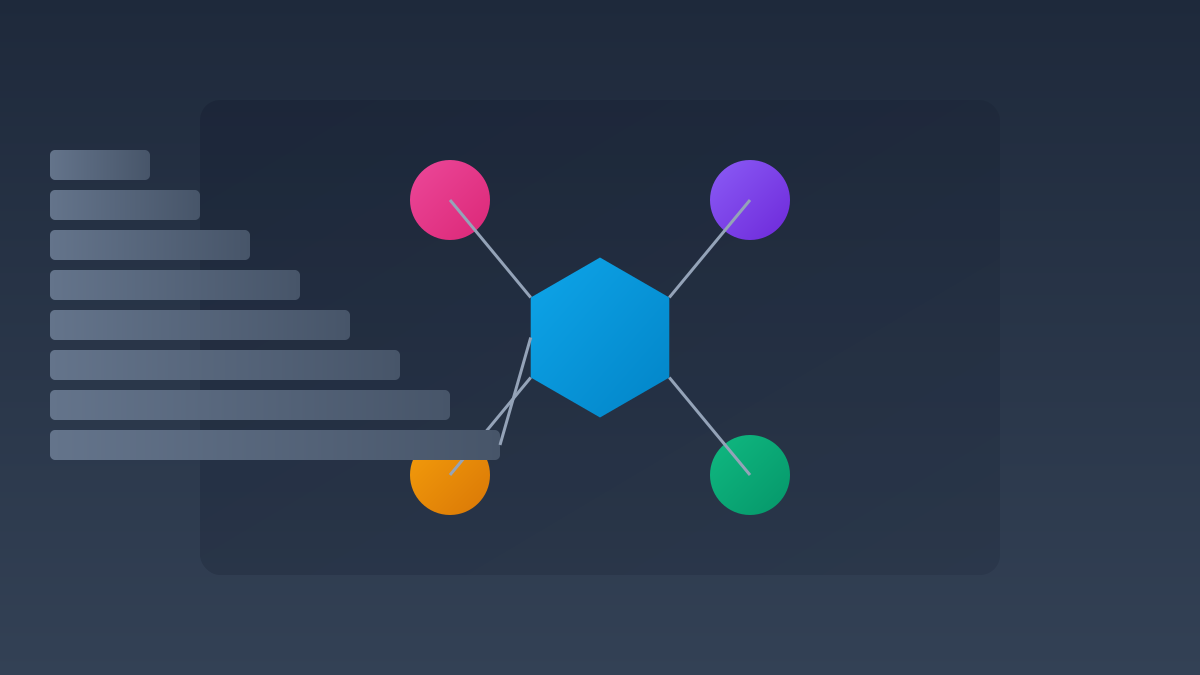
YAML-Multi-Agent-Orchestrator uses a modular architecture, with core components including: Parser (converts YAML configuration into internal execution plans), Scheduler (schedules tasks based on dependencies and resources), Context Manager (maintains information sharing), and Execution Engine (calls underlying AI models to process responses).

6

Section 06

Application Scenario Examples

This tool is suitable for:

  1. Complex document processing (collaboration between extraction, review, summarization, and translation agents)
  2. Software development collaboration (simulating a team with agents for requirement analysis, architecture design, code generation, testing, and review)
  3. Customer service automation (building multi-level customer service systems with agents for intent recognition, knowledge base retrieval, problem solving, and escalation handling)
7

Section 07

Tool Advantages and Value

  1. Lower technical barriers: YAML configuration is easier to learn and maintain than code, allowing non-technical personnel to participate in design.
  2. Improved maintainability: Configuration is separated from code—changes do not require modifying deployed applications, only updating YAML.
  3. Enhanced auditability: Declarative configuration is self-documenting, with clear logic for easy auditing.
  4. Promoted team collaboration: YAML files support version control, multi-person collaboration, code review, and change tracking.
8

Section 08

Summary and Outlook

YAML-Multi-Agent-Orchestrator represents an important direction in AI workflow management: reducing complexity through declarative configuration while maintaining flexibility to handle diverse scenarios. As multi-agent systems become popular in enterprise applications, such tools will become an important part of AI infrastructure, suitable for teams that want to build complex AI workflows but do not want to get bogged down in underlying orchestration details to explore.

