Zing Forum

Reading

Workflow Verifier: Capturing Silent Failures in Agent Workflows via Real Database State Verification

Workflow Verifier is a validation tool for detecting silent failures in AI agent workflows. By comparing the operations the agent claims to have performed with the actual database state, it identifies hidden issues where execution succeeds but results are incorrect, thereby enhancing the reliability of AI workflows.

智能体验证数据库状态检查静默失败检测AI工作流可靠性数据一致性工作流测试副作用验证智能体监控
Published 2026-04-12 01:14Recent activity 2026-04-12 01:22Estimated read 7 min
Workflow Verifier: Capturing Silent Failures in Agent Workflows via Real Database State Verification
1

Section 01

Introduction: Workflow Verifier—Capturing Silent Failures in AI Workflows via Database State Verification

This article introduces the Workflow Verifier tool, which detects silent failures (hidden issues where execution succeeds but results are incorrect) in AI agent workflows by comparing the operations the agent claims to have performed with the real database state, enhancing the reliability of AI workflows. This tool addresses the unreliability of agent self-reports and the limitations of traditional testing methods, providing an innovative validation strategy.


2

Section 02

Reliability Challenges of AI Workflows and the Problem of Silent Failures

When AI agent workflows move from experimentation to production, they face the challenge of ambiguous correctness validation, with the most prominent being "silent failures": the agent reports task success, but actually fails to complete the expected work or produces incorrect results, with no exception logs, leading to issues like data inconsistency. Traditional testing methods (output-based, simulation-based, end-to-end) have limitations and cannot effectively verify the consistency of agent interactions with real systems.

3

Section 03

Core Solutions of Workflow Verifier

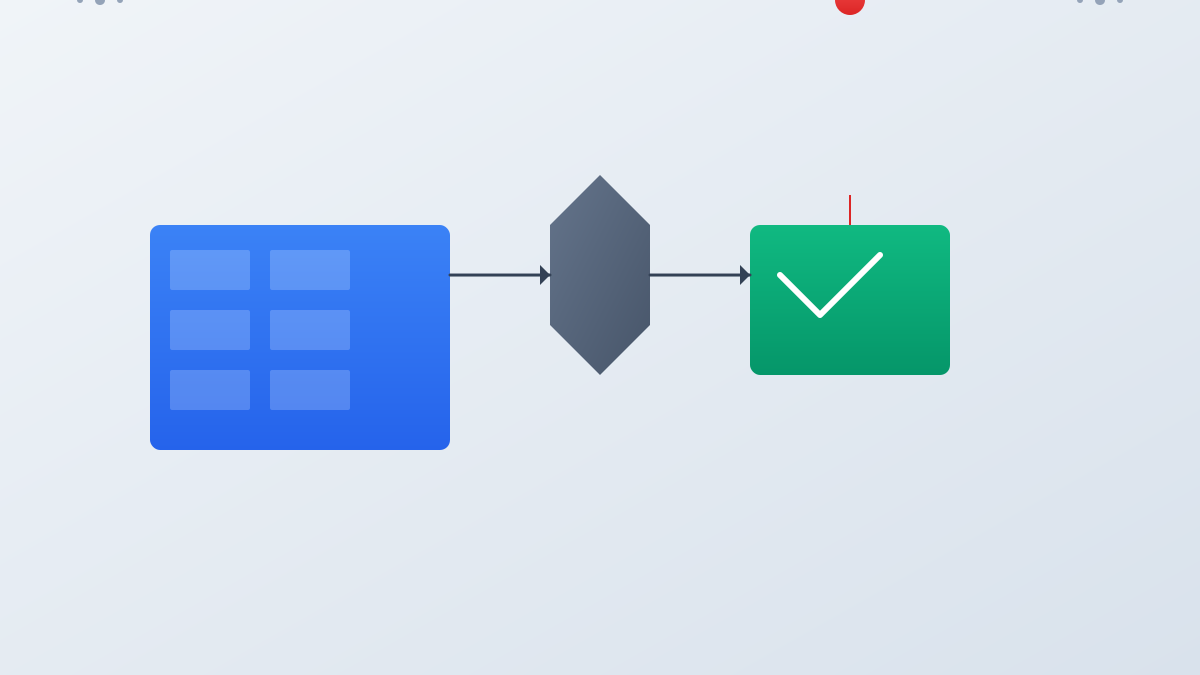
The core design philosophy of Workflow Verifier is "trust but verify". Its specific strategies include: 1. Capturing the database operations the agent claims to perform; 2. Obtaining database state snapshots before and after operations; 3. Comparing expected and actual state changes; 4. Generating difference reports. It supports multiple database validation modes: row-level (validation of specific records), table-level (table state changes), relational integrity (foreign keys, etc.), transactional consistency (multi-step transactionality), and also supports asynchronous and eventual consistency (delayed validation, polling, consistency level configuration).

4

Section 04

Typical Application Scenarios

Workflow Verifier is applicable to multiple scenarios: 1. Order processing: Validate inventory deduction, order status flow, payment matching, and notification records; 2. Data synchronization pipeline: Validate data consistency between source and target systems, transformation logic, incremental synchronization boundaries, and conflict resolution; 3. User permission management: Validate role assignment effectiveness, permission inheritance, revocation effects, and audit logs; 4. Content publishing: Validate state transitions, timestamp/version updates, associated resource synchronization, cache invalidation, and CDN refresh.

5

Section 05

Technical Implementation and Architecture

Workflow Verifier can be integrated with mainstream agent frameworks (LangChain, LlamaIndex, etc.) via middleware, decorators, and explicit API calls. Database connections need to consider read-only access, isolation, security, and performance impacts. The difference report includes expected/actual states, field-level differences, timelines, and context information to help diagnose issues.

6

Section 06

Synergy with Existing Testing Strategies

Workflow Verifier complements rather than replaces traditional testing: unit tests validate code logic, integration tests validate component interactions, and Workflow Verifier validates the consistency between the operations the agent claims to perform and the real state. It can be integrated into CI/CD processes: pre-commit validation, regression testing, and production monitoring (shadow/sampling mode).

7

Section 07

Limitations and Future Development Directions

Limitations: It only focuses on database state validation and cannot directly detect changes in external APIs, file systems, or memory states; there are challenges with validation timing (too early/too late) and concurrency conflicts; complex business logic (computations, probabilistic, subjective judgments) is difficult to validate. Future directions: Expand to message queues, caches, search indexes, and log validation; intelligent difference analysis (automatic cause diagnosis, recommended fixes); visualization and observability (timeline, trend analysis, APM integration).

8

Section 08

Conclusion

Workflow Verifier is an important direction in AI workflow reliability engineering, directly addressing the problem of agents "saying one thing and doing another" and establishing an independent validation boundary. For production AI workflow teams, it can detect silent failures during the development phase and avoid production losses. Although it cannot solve all reliability challenges, it provides a solid validation foundation for the field of database operations.

