Zing Forum

Reading

Wingman: A Unified Scheduling Hub for Large-Scale AI Inference

Wingman is an open-source AI Inference Hub designed specifically for large-scale AI deployment scenarios, providing unified model service scheduling, load balancing, and resource management capabilities.

AI推理模型服务负载均衡弹性伸缩多租户API网关大语言模型LLMOps开源基础设施
Published 2026-04-15 04:15Recent activity 2026-04-15 04:20Estimated read 7 min
Wingman: A Unified Scheduling Hub for Large-Scale AI Inference
1

Section 01

Wingman: Introduction to the Unified Scheduling Hub for Large-Scale AI Inference

Wingman is an open-source large-scale AI inference hub aimed at addressing core challenges in enterprise AI deployment, such as heterogeneous model management, dynamic load fluctuations, cost optimization, and lack of observability. It provides key capabilities including a unified API access layer, intelligent routing and load balancing, elastic scaling and resource optimization, and multi-tenant isolation. It supports scenarios like enterprise AI platform construction and multi-model product strategies, serving as an AI-native inference infrastructure solution.


2

Section 02

Core Challenges Faced by Large-Scale AI Inference

With the explosion of large language models (LLMs) and generative AI applications, enterprise inference infrastructure faces four major challenges: 1. Heterogeneous model management: Different models run on different engines like vLLM and TensorRT-LLM with varying API formats, leading to heavy unified management burdens; 2. Dynamic load fluctuations: The difference between peak and trough request volumes can be dozens of times, requiring a balance between low latency, high availability, and resource waste; 3. Cost optimization pressure: GPU resources are expensive, necessitating intelligent routing, batching, and caching strategies; 4. Lack of observability: Decentralized clusters make monitoring, logging, and tracing difficult, leading to slow problem localization.

3

Section 03

Core Architecture and Design Philosophy of Wingman

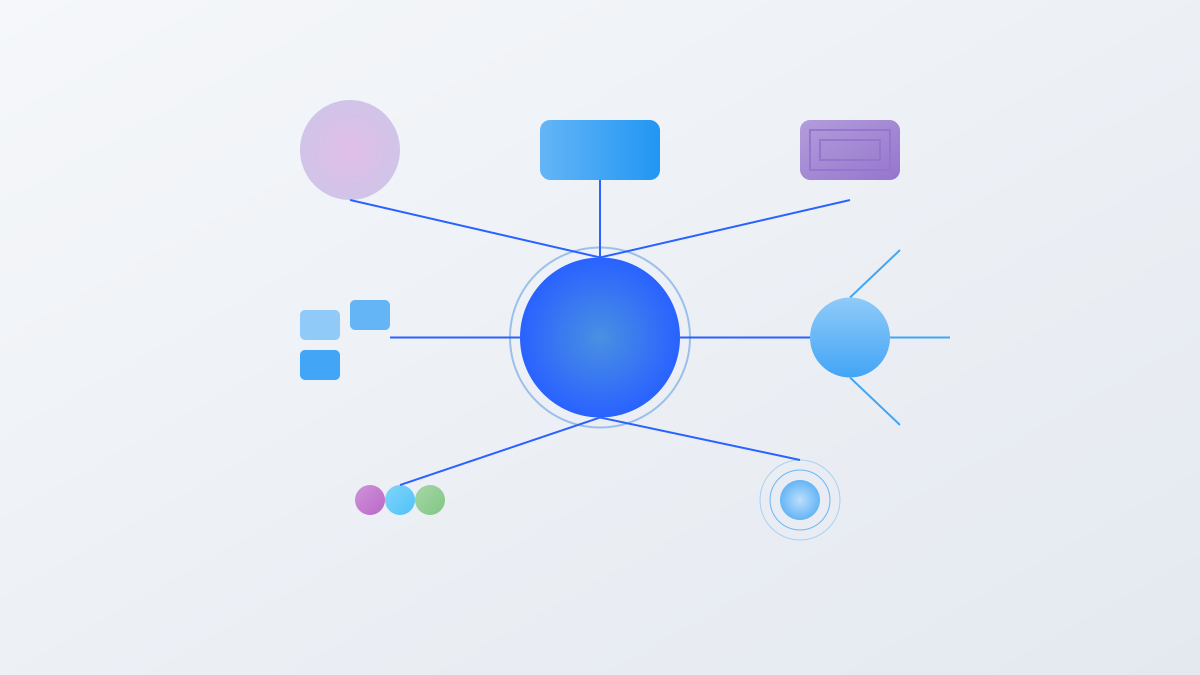
Wingman's core architecture includes: 1. Unified access layer: Provides consistent API interfaces, supports protocol conversion and request normalization, simplifying client calls and model switching; 2. Intelligent routing and load balancing: Distributes requests based on model type, parameters, priority, etc., considering backend health, load, and latency, and supports automatic failover; 3. Elastic scaling and resource optimization: Integrates Kubernetes for automatic scaling, supporting request batching, continuous batching, and asynchronous queues; 4. Multi-tenant and isolation: Identifies tenants based on API Key/Token, sets quotas, priorities, and cost tracking to ensure resource isolation.

4

Section 04

Technical Features and Implementation Highlights of Wingman

Technical features include: 1. High-performance proxy layer: Uses a high-performance network framework, supporting WebSocket and SSE streaming responses; 2. Flexible plugin system: Extensible middleware for scenarios like request transformation, authentication, and auditing; 3. Caching and acceleration: An intelligent cache layer supporting TTL, LRU, and other strategies to improve throughput; 4. Comprehensive observability: Integrates Prometheus metrics, OpenTelemetry distributed tracing, and supports Grafana monitoring dashboards.

5

Section 05

Application Scenarios and Practical Value of Wingman

Application scenarios include: 1. Enterprise AI platform: Unified management of internal model services to achieve resource sharing and cost optimization; 2. Multi-model product strategy: Intelligent routing for automated model selection and dynamic strategy adjustment; 3. AI service providers: Building multi-tenant SaaS platforms to meet quota management and cost tracking needs; 4. Hybrid cloud and edge deployment: Coordinating cloud-based large models and edge lightweight models to handle complex and real-time tasks.

6

Section 06

Deployment Methods and Ecosystem Positioning of Wingman

Deployment options include Docker Compose (single machine) and Kubernetes Helm Chart (production-grade), with configuration using declarative YAML. The client is compatible with the OpenAI API, resulting in low migration costs. Ecosystem positioning: It sits between general-purpose API gateways (Kong/Envoy) and dedicated inference engines (vLLM/TensorRT-LLM), serving as an AI-native inference hub that complements MLOps platforms like BentoML/Seldon.

7

Section 07

Future Outlook and Conclusion of Wingman

Future directions: 1. Advanced model orchestration strategy: Intelligently select models based on request content to balance cost, latency, and quality; 2. Edge collaborative inference: Split execution between cloud and edge models to protect privacy; 3. Integration with model training processes: Participate in MLOps processes like deployment and canary releases. Conclusion: Wingman represents the shift of AI infrastructure from single-point optimization to system-level orchestration, providing an open-source solution for large-scale AI deployment and is expected to become a core component.

