Zing Forum

Reading

WARDEN: Speech Recognition and Translation for Endangered Indigenous Languages with Only 6 Hours of Data

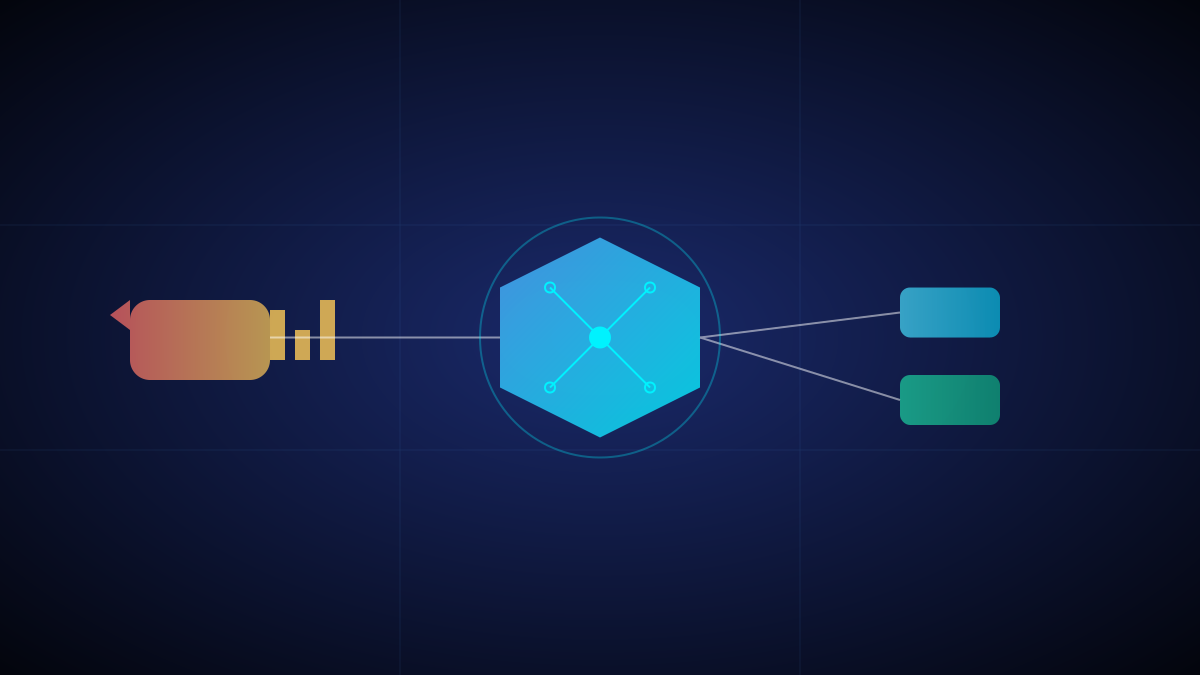
WARDEN uses a two-stage architecture (speech-to-phoneme + phoneme-to-English translation), combined with cross-language transfer and dictionary-enhanced large model reasoning, to achieve high-quality transcription and translation for the endangered Australian language Wardaman with only 6 hours of labeled data.

濒危语言语音识别机器翻译低资源学习跨语言迁移大语言模型原住民语言语言保护
Published 2026-05-14 01:59Recent activity 2026-05-14 10:53Estimated read 8 min
WARDEN: Speech Recognition and Translation for Endangered Indigenous Languages with Only 6 Hours of Data
1

Section 01

[Introduction] WARDEN: Speech Recognition and Translation for Endangered Language Wardaman with 6 Hours of Data

Language diversity is an important part of human cultural heritage, but thousands of languages worldwide are facing the threat of extinction. Traditional speech recognition and translation technologies rely on large amounts of labeled data, which endangered languages precisely lack. The latest research proposes the WARDEN system, which uses a two-stage architecture (speech-to-phoneme + phoneme-to-English translation), combined with cross-language transfer and dictionary-enhanced large model reasoning. With only 6 hours of labeled audio data, it achieves high-quality transcription and translation for Wardaman, an endangered indigenous language in Australia, opening up new possibilities for low-resource language processing.


2

Section 02

[Background] Dilemmas in Endangered Language Protection: Data Scarcity and Limitations of Traditional Methods

Wardaman is an endangered indigenous language in northern Australia with very few speakers. The research team faced three major challenges: only 6 hours of labeled audio (far less than the thousands of hours of data for mainstream languages), no existing Wardaman-English parallel corpus, and limited expert resources. Traditional end-to-end speech recognition-translation methods rely on large amounts of data to learn direct mappings, which is completely infeasible under such extremely low-resource conditions.

3

Section 03

[Method] Core Architecture: Phased Design Reduces Task Complexity

WARDEN's core innovation is its phased architecture, decomposed into two subtasks:

  1. Speech-to-phoneme transcription: Convert audio into phonemes (the smallest speech units), which is a simpler task with lower data requirements;
  2. Phoneme-to-English translation: Eliminate the complexity of speech recognition and better utilize existing NLP technologies. Advantages of the phased approach: Reduce single-stage complexity, enable modular training, and isolate errors (transcription errors do not propagate directly).
4

Section 04

[Method] Technical Innovation 1: Cross-Language Phoneme Transfer Solves Transcription Data Shortage

To address the scarcity of transcription data, a cross-language transfer strategy is adopted:

  • Bridge language selection: Sundanese is phonetically similar to Wardaman;
  • Phoneme embedding initialization: Use phoneme embeddings from a pre-trained Sundanese model to initialize the corresponding embeddings of the Wardaman transcription model, accelerating convergence, improving generalization (handling rare phonemes), and preserving Wardaman's unique phoneme patterns. Experiments show that this strategy significantly improves transcription performance.
5

Section 05

[Method] Technical Innovation 2: Dictionary-Enhanced Large Model Reasoning Improves Translation Quality

To address the lack of parallel corpora in the translation phase, dictionary-enhanced large model reasoning is used:

  • Expert dictionary construction: Extract high-frequency Wardaman-English vocabulary and key concept mappings from expert annotations;
  • LLM combined with dictionary: Add relevant dictionary entries in prompts to guide understanding, dynamically retrieve dictionary entries corresponding to input phonemes, and generate multiple candidates for filtering and ranking. Advantages: Leverage the generalization ability of LLMs, inject domain knowledge, and improve interpretability.
6

Section 06

[Evidence] Experimental Validation: WARDEN Outperforms Baseline Models

Evaluation results on the Wardaman dataset:

  1. Outperforms open-source models: Better performance than larger open-source models like Whisper, indicating that language-specific optimization is more important than model size;
  2. Outperforms proprietary APIs: Even surpasses commercial proprietary services, proving that dedicated systems can outperform general services in specific domains;
  3. Ablation experiments: Verify that the phased architecture, cross-language initialization, and dictionary enhancement all significantly improve performance.
7

Section 07

[Conclusion] Significance of WARDEN: New Hope for Endangered Language Protection

WARDEN's success has important implications:

  • Lower technical barriers: Only 6 hours of data are needed to build a practical system, reducing the cost of digitizing endangered languages;
  • Community participation: Communities can organize data collection and annotation on their own and participate in technical development;
  • Archive processing: Convert historical recordings into searchable text;
  • Cross-language transfer: Provide a knowledge-sharing path for processing other endangered languages.
8

Section 08

[Suggestions] Limitations and Future Directions: Improvement Path from Baseline to Practical Use

WARDEN still has room for improvement:

  • Data scale: Explore semi-supervised learning, data augmentation, and active learning to expand data;
  • Dialect variants: Research dialect adaptation techniques to handle language diversity;
  • Multilingual expansion: Identify suitable bridge languages and build dictionaries;
  • Real-time applications: Optimize inference speed and latency to support conversational translation. The research team has open-sourced the data and code, and looks forward to the community advancing research on endangered language technologies.

