Zing Forum

Reading

VLN-YuanNav: An Autonomous Navigation System Integrating Vision-Language Models and Advanced Memory Mechanisms

VLN-YuanNav is an open-source visual-language navigation project that combines vision-language models, advanced memory mechanisms, and intelligent decision systems to enable robots to explore and navigate complex environments effectively, providing a valuable reference for embodied intelligence and autonomous robot research.

视觉语言导航具身智能自主机器人多模态学习记忆机制强化学习开源项目VLN
Published 2026-04-08 06:44Recent activity 2026-04-08 06:49Estimated read 7 min
VLN-YuanNav: An Autonomous Navigation System Integrating Vision-Language Models and Advanced Memory Mechanisms
1

Section 01

VLN-YuanNav: Open-Source Autonomous Navigation System for Embodied AI

VLN-YuanNav is an open-source visual-language navigation (VLN) project that integrates visual-language models, advanced memory mechanisms, and intelligent decision systems to enable robots to explore and navigate complex environments effectively. It provides a valuable reference for embodied intelligence and autonomous robot research.


2

Section 02

Technical Background of Vision-Language Navigation

Vision-Language Navigation (VLN) is an interdisciplinary field focused on enabling agents to navigate real environments via natural language instructions (e.g., 'go to the kitchen and get a red cup'). Unlike traditional map-based or pure visual navigation, VLN requires handling multi-modal fusion (visual + language), long-term planning, environmental adaptability, and common-sense reasoning—all of which pose significant challenges. VLN-YuanNav addresses these challenges with a solution combining advanced memory and decision models.

3

Section 03

Core Architecture of VLN-YuanNav

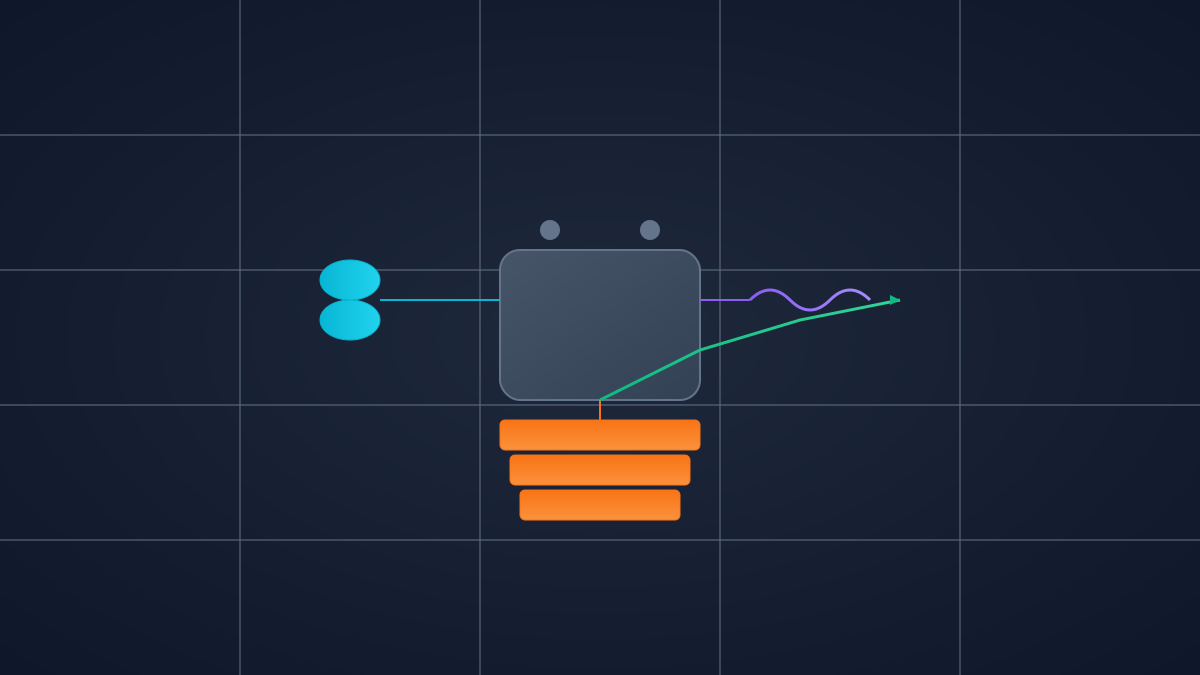
VLN-YuanNav's core architecture includes three key components:

  1. Visual-Language Encoder: Uses advanced models to encode visual (images) and language (instructions) inputs into unified semantic representations, enabling understanding of complex spatial and semantic relationships.
  2. Advanced Memory Mechanism: Features layered memory (episodic, working, spatial, semantic) to record visited locations, maintain task-related info, build environment maps, and store object/spatial knowledge—helping avoid repetition and optimize decisions in long-range navigation.
  3. Decision & Action Module: Uses reinforcement learning and imitation learning to generate optimal actions (forward, turn, stop) by considering instruction progress, environment passability, trajectory efficiency, and target reachability.
4

Section 04

Key Technical Innovations of VLN-YuanNav

VLN-YuanNav introduces several innovations:

  • Memory-Enhanced Attention: Dynamic attention to task-relevant historical observations, improving long-range navigation success.
  • Hierarchical Decision Framework: Separates high-level planning (e.g., 'go to kitchen') from low-level execution (e.g., 'walk forward'), enhancing interpretability and robustness.
  • Continuous Learning: Memory system supports online learning, allowing updates from new experiences to improve performance in specific environments.
  • Modular Scalability: Modular design with standard interfaces enables easy replacement of components for ablation studies and innovation.
5

Section 05

Practical Applications of VLN-YuanNav

VLN-YuanNav has wide applications:

  1. Home Service Robots: Understand natural language instructions (e.g., 'turn off the living room light') and navigate homes.
  2. Warehouse Logistics: Assist in dynamic tasks like 'pick up goods from Area A' with efficient path planning.
  3. Assistive Navigation: Support visually impaired individuals via safe navigation based on natural language.
  4. Search & Rescue: Explore unknown environments for tasks like 'search for missing persons' using exploration strategies and memory.
6

Section 06

Experimental Results & Open Source Availability

VLN-YuanNav has been validated on mainstream VLN benchmarks like R2R (Room-to-Room) and REVERIE. Key results:

  • Significant improvements in navigation success rate and path efficiency (SPL) over baseline methods.
  • Memory mechanism reduces getting lost and loops in long-range tasks.
  • Good generalization to unseen environments. The project is open-source, providing full training pipelines, pre-trained models, and evaluation scripts for reproducibility and further research.
7

Section 07

Implications for Embodied AI & Future Directions

VLN-YuanNav offers insights for embodied AI:

  • Memory as a Key to Intelligence: Effective memory is critical for long-term task execution (aligning with cognitive science findings).
  • Fine-Grained Multi-Modal Fusion: Requires specialized attention and memory structures, not just feature concatenation.
  • Layered Architecture: Separating perception, memory, and decision improves interpretability and robustness. Future directions:
  1. Adapt to larger, more complex indoor/outdoor environments.
  2. Explore multi-agent collaborative navigation.
  3. Enhance continuous/lifelong learning capabilities.
  4. Integrate large language models (e.g., GPT-4) for better common sense reasoning and planning.

