Zing Forum

Reading

VLM-driven Intelligent Invoice Extraction System: Application of Multimodal AI in Document Automation

Learn how to use Visual Language Models (VLM) to achieve intelligent parsing of invoice documents, extract structured data from invoices in any format (images or PDFs), and explore the practical application of multimodal AI in enterprise document automation.

VLMinvoice-processingdocument-automationOCRmultimodalAIJSON-extractionfinancial-automation
Published 2026-06-08 05:18Recent activity 2026-06-08 05:49Estimated read 6 min
VLM-driven Intelligent Invoice Extraction System: Application of Multimodal AI in Document Automation
1

Section 01

Introduction: Core Overview of the VLM-driven Intelligent Invoice Extraction System

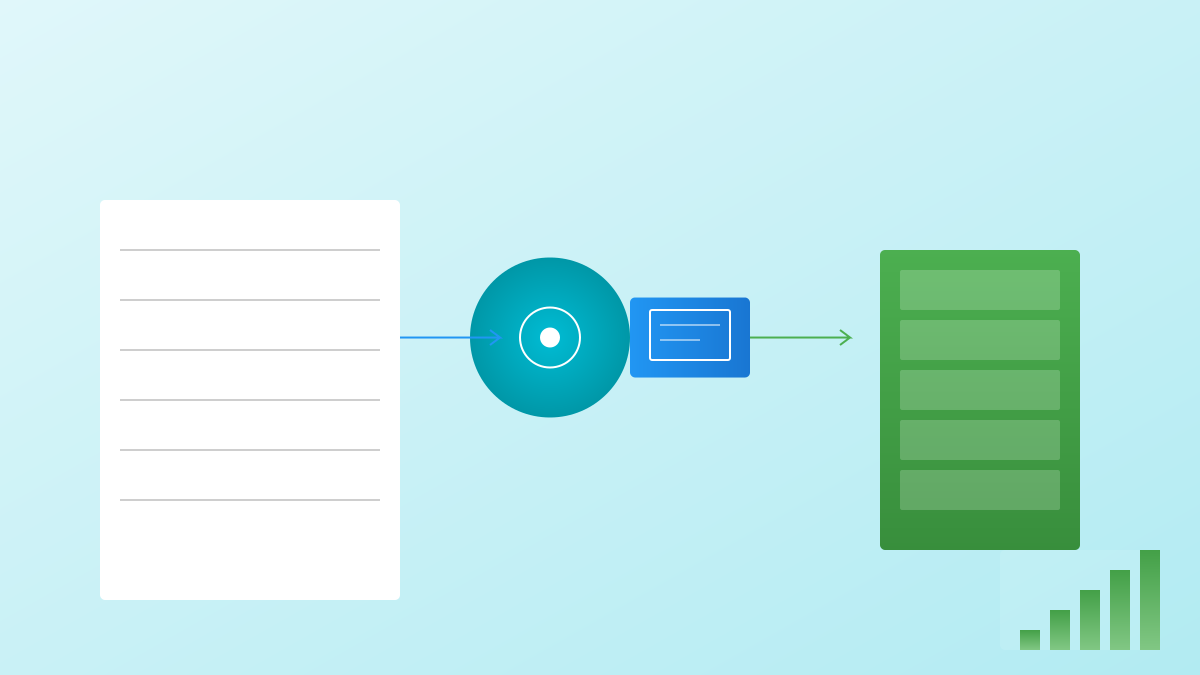
Project Source: GitHub open-source project invoice-extractor (author: dharavathramdas101, release date: 2026-06-07). The core is to use Visual Language Models (VLM) to extract structured data from invoices in any format (images, PDFs, etc.), solving problems in traditional invoice processing such as diverse formats, low accuracy, and efficiency bottlenecks. It outputs data in JSON format to support enterprise document automation.


2

Section 02

Pain Points and Challenges in Invoice Processing

Invoice processing is a basic but tedious task in enterprise finance. Traditional methods face three main challenges:

  1. Format diversity: Invoices from different suppliers vary greatly in format, which rule-based systems are difficult to cover;
  2. Data accuracy: Traditional OCR only recognizes text, lacking structural and semantic understanding, leading to errors easily;
  3. Efficiency bottleneck: Manual processing is time-consuming and error-prone, making it hard to cope with business scale growth.
3

Section 03

VLM Technical Advantages and Core System Functions

VLM Technical Breakthroughs

Visual Language Models (VLM) can understand image content and text semantics. Compared to traditional OCR, their advantages include:

  • Layout awareness: Recognize blocks like headers and detail rows;
  • Semantic understanding: Distinguish fields such as invoice number and order number;
  • Context reasoning: Fill in missing information or correct errors.

Core System Functions

  • Multi-format input: Supports scanned copies, PDFs, phone photos, and electronic invoices;
  • Structured output: JSON format includes basic invoice information, transaction details, tax information, and payment information;
  • Intelligent field mapping: Automatically identify key fields with different label names (e.g., map "合计" (Total) and "总金额" (Gross Amount) to standard fields).
4

Section 04

Key Technical Implementation Points

Preprocessing Flow

  • Image quality enhancement: Denoising, sharpening, and contrast adjustment;
  • Document correction: Automatically correct tilt and perspective distortion;
  • Region segmentation: Identify the main invoice area and remove irrelevant backgrounds.

Prompt Engineering Strategy

  • Structured prompts: Clearly list the fields to be extracted;
  • Format constraints: Require JSON output;
  • Example guidance: Provide examples to help the model understand requirements.

Post-processing Validation

  • Format check: Ensure JSON compliance;
  • Numerical check: Verify the rationality of amount calculations;
  • Logical check: Validate the rationality of dates, invoice numbers, etc.
5

Section 05

Application Scenarios and Value

Application Scenarios

  1. Financial automation: Improve processing efficiency and reduce manual errors;
  2. Expense reimbursement system: Employees upload invoice photos to automatically extract information, simplifying the process;
  3. Supplier management: Update supplier databases and analyze procurement patterns;
  4. Audit and compliance: Provide structured data to support data analysis and anomaly detection.
6

Section 06

Practical Recommendations and Conclusion

Practical Recommendations

  • Deployment considerations: Ensure data security (for sensitive financial information), select appropriate VLM models, and establish a manual review mechanism;
  • Continuous optimization: Collect error cases and optimize prompts and model parameters.

Conclusion

The invoice-extractor project demonstrates the potential of VLM in document automation, provides a solution for improving the efficiency of enterprise financial operations, and is an open-source project worth paying attention to.

