Zing Forum

Reading

VLM Weed Detection Framework: Application of Vision-Language Models in Drone Precision Agriculture

A framework that uses vision-language models to achieve zero-shot weed detection and visual reasoning, specifically designed for drone precision agriculture scenarios, enabling identification without training on specific weed species.

Vision Language ModelVLMprecision agricultureUAVweed detectionzero-shot learningvisual reasoning
Published 2026-06-16 03:10Recent activity 2026-06-16 03:26Estimated read 8 min
VLM Weed Detection Framework: Application of Vision-Language Models in Drone Precision Agriculture
1

Section 01

VLM Weed Detection Framework: An Innovative Solution for Drone Precision Agriculture

Core Overview of the VLM Weed Detection Framework

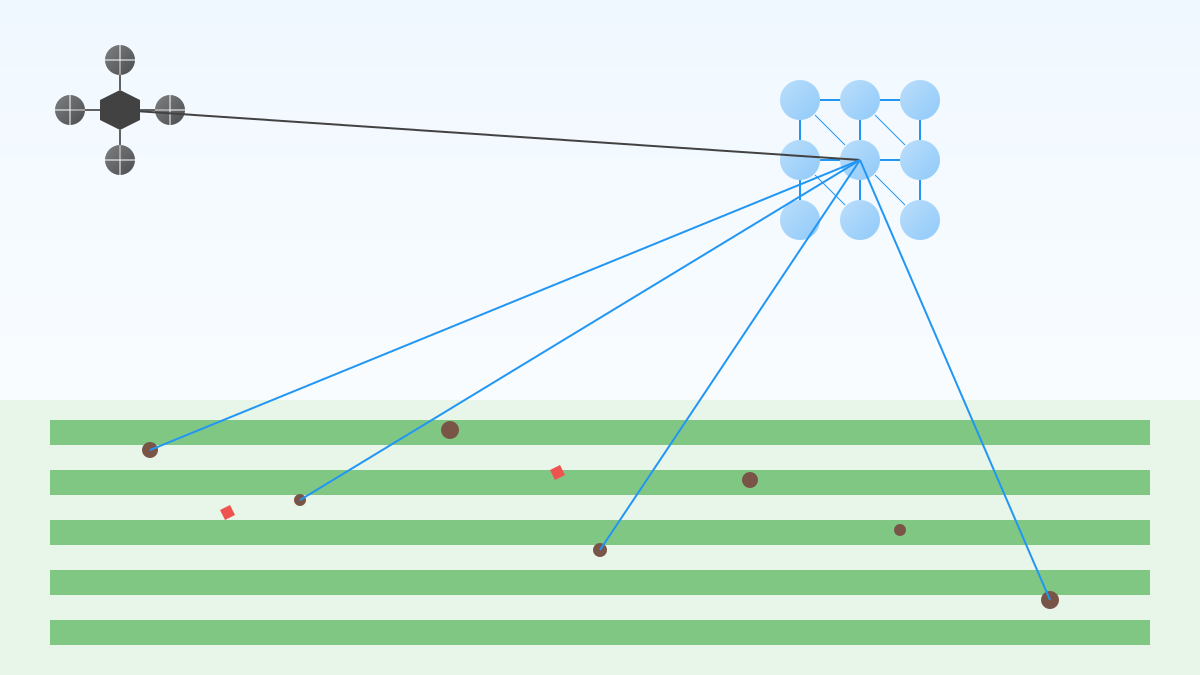
This framework is a vision-language model (VLM) application specifically designed for drone precision agriculture scenarios, enabling zero-shot weed detection and visual reasoning without training on specific weed species. The project is maintained by m-fahad-nasir and was released on GitHub on June 15, 2026 (link: https://github.com/m-fahad-nasir/VLM_Weed_Framework). Its core value lies in breaking through the data dependency bottleneck of traditional methods and providing a flexible and cost-effective solution for precision agriculture.


2

Section 02

Research Background and Challenges

Research Background and Challenges

Weed management is a key agricultural task, but traditional methods have many problems:

  1. There are over 8000 weed species worldwide, making it impractical to train dedicated models for each;
  2. Regional differences make model generalization difficult;
  3. High cost of annotated data;
  4. Traditional models cannot adapt promptly when invasive weeds emerge.

Zero-shot learning technology combined with the visual and language capabilities of VLMs provides new ideas for solving these problems.

3

Section 03

Core Innovations of the Project

Core Innovations of the Project

  1. Innovative Application of VLM in Agriculture: Leveraging the open-vocabulary recognition capability of VLMs to achieve true zero-shot detection without the need for large amounts of annotated data;
  2. Drone Platform Optimization: Adapting to aerial photography perspectives, supporting real-time inference on edge devices, processing large-area farmland data, and linking GPS coordinates for precise pesticide application;
  3. Visual Reasoning Capability: Can describe weed characteristics in natural language, understand the relationship between crops and weeds, judge growth stages and threat levels, and generate weeding recommendations.
4

Section 04

Analysis of Technical Architecture

Analysis of Technical Architecture

Zero-shot Detection Mechanism

Based on cross-modal alignment: Visual encoder extracts image features → Text encoder encodes weed descriptions → Alignment in shared space → Calculate similarity to achieve detection, supporting unseen weed species (only text descriptions needed).

Open-Vocabulary Recognition

Dynamic category expansion (no retraining needed), multi-language support, attribute query (e.g., weeds with serrated leaves), fuzzy matching.

Drone Data Stream Processing

Preprocessing (camera distortion, lighting), image stitching into farmland maps, resolution adaptation (based on flight altitude), embedding GPS geographic information.

5

Section 05

Application Scenarios and Value

Application Scenarios and Value

  1. Precision Weeding: Targeted pesticide application (reducing pesticide use), variable application (based on density/species), operation planning, effect evaluation;
  2. Farmland Monitoring and Early Warning: Early detection, distribution heatmaps, trend analysis, invasion warning;
  3. Research Support: Rapid survey of experimental fields, automatic data recording, comparison of the impact of different treatment measures.
6

Section 06

Analysis of Technical Advantages

Analysis of Technical Advantages

Comparison with Traditional Supervised Learning

Feature Traditional Method This Framework
Training Data Requirement Large amount of annotation Only text descriptions needed
Adaptation to New Categories Requires retraining Immediate support
Generalization Ability Limited by training set Cross-domain generalization
Interpretability Low Natural language reasoning
Deployment Flexibility Fixed categories Dynamically configurable

Differences from General VLMs

Integrates agricultural botany knowledge, optimizes aerial photography perspectives, expands agricultural vocabulary, and optimizes real-time performance on edge devices.

7

Section 07

Future Development Directions

Future Development Directions

Technical Evolution

Multimodal fusion (spectral/thermal imaging), time-series analysis (tracking growth dynamics), swarm intelligence (multi-drone collaboration), active learning (continuous improvement).

Application Expansion

Agricultural AI scenarios such as pest and disease detection, crop growth assessment, yield prediction, and irrigation optimization.

8

Section 08

Project Summary

Project Summary

VLM_Weed_Framework represents an important development direction in agricultural AI. It breaks through traditional data dependency through the zero-shot capability of VLMs and provides a flexible and cost-effective solution for precision agriculture. For researchers and practitioners in the AI+agriculture field, it demonstrates the huge potential of cutting-edge AI technology in applying to traditional industries.

