Zing Forum

Reading

VITA-AI: In-depth Analysis of a Multimodal Intelligent Depression Detection and Prevention System

An in-depth interpretation of the VITA-AI project—a real-time depression detection, prediction, and prevention framework integrating multimodal data streams, Agentic AI, and explainable AI (XAI)—showcasing the innovative application of AI in the mental health field.

心理健康抑郁检测多模态AIAgentic AI可解释AIXAI医疗健康情感计算智能干预
Published 2026-05-19 14:15Recent activity 2026-05-19 14:24Estimated read 7 min
VITA-AI: In-depth Analysis of a Multimodal Intelligent Depression Detection and Prevention System
1

Section 01

VITA-AI Project Guide: Core Analysis of the Multimodal Intelligent Depression Detection and Prevention System

VITA-AI is a real-time depression detection, prediction, and prevention system that integrates multimodal data streams, Agentic AI, and explainable AI (XAI). Addressing issues like lag, narrow coverage, and high costs in traditional mental health assessments, it enables continuous, non-invasive monitoring, representing the social value application direction of AI in the healthcare field—using technology to safeguard mental health.


2

Section 02

Project Background and Social Significance

Depression is a global public health challenge, affecting over 300 million people worldwide, yet many cases go undiagnosed and untreated in time. Traditional assessments rely on subjective questionnaires and clinical interviews, which have issues like lag, narrow coverage, and high costs. VITA-AI emerged as a solution, enabling real-time continuous monitoring through multimodal data and advanced AI technologies, making it one of the socially valuable applications of AI in healthcare.

3

Section 03

System Architecture and Multimodal Data Fusion Technology

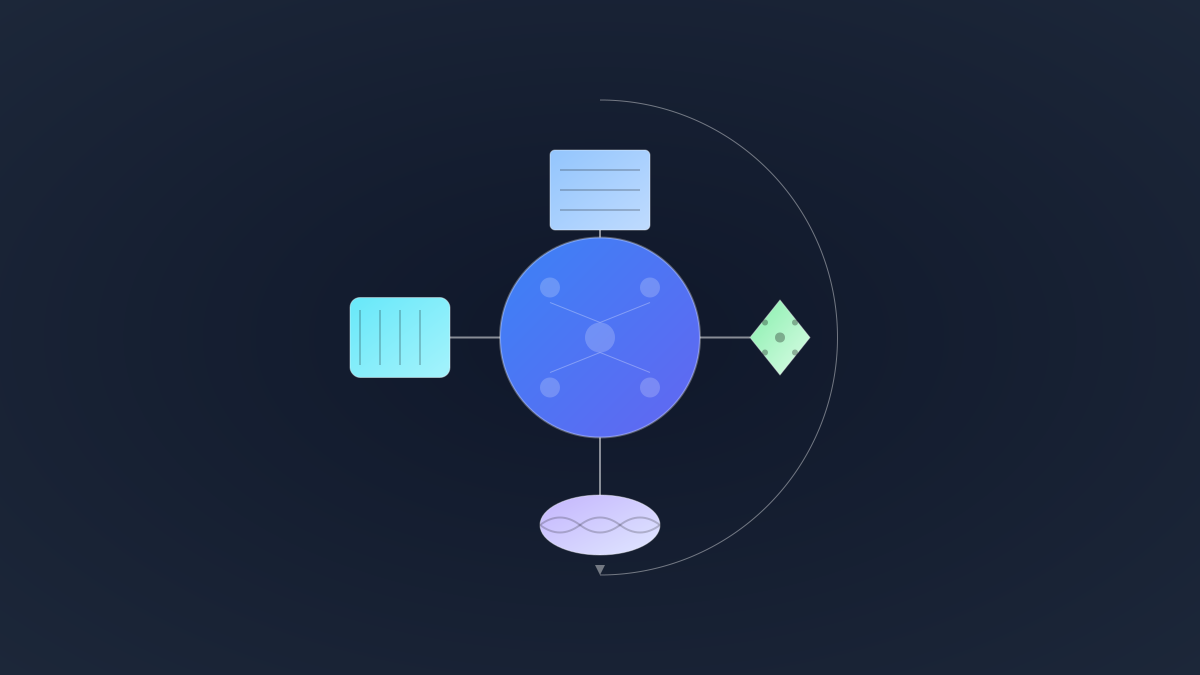
VITA-AI adopts a multi-layered architecture, integrating modules for data collection, feature extraction, model inference, and intelligent intervention. Its core advantage lies in multimodal data fusion:

  • Behavioral data: Voice features, text sentiment, activity patterns, digital footprints
  • Physiological data: Wearable devices (HRV, GSR), sleep monitoring, facial expressions
  • Environmental data: Light exposure, geographic location, weather and seasons Multimodal fusion enhances accuracy and robustness, while complementary verification reduces false positives and negatives.
4

Section 04

AI Model Layer and Agentic AI Intelligent Intervention Design

The AI model layer integrates multiple algorithms:

  • Temporal modeling: LSTM/GRU, Transformer, anomaly detection
  • Multimodal fusion: Early (feature-level), late (decision-level), attention mechanisms
  • Predictive modeling: Survival analysis, sequence-to-sequence, ensemble learning Innovations in the Agentic AI intervention layer: Autonomous hierarchical alerts (notifying family members/medical staff), personalized intervention recommendations (CBT exercises, mindfulness, etc.), intelligent chat agents (24/7 emotional support with human transfer), realizing the shift from passive detection to active protection.
5

Section 05

Explainable AI (XAI) Design: Transparency and Credibility Assurance

To address the black-box model issue, VITA-AI employs XAI technologies:

  • Feature importance: SHAP values quantify contributions, allowing users/doctors to understand early warning triggers
  • Attention visualization: Focus on key time periods in sequences to identify behavioral turning points
  • Natural language explanation: Convert model outputs into easy-to-understand text (e.g., "Decreased sleep + reduced social interaction—suggest paying attention")
  • Adversarial sample detection: Prevent malicious data manipulation XAI enhances credibility and paves the way for clinical integration.
6

Section 06

Privacy and Ethical Considerations: Security Assurance for Sensitive Data

Privacy and ethical considerations:

  • Data security: End-to-end encryption, local-first approach, differential privacy
  • Informed consent: Clear disclosure of usage, fine-grained privacy controls, support for data export and deletion
  • Algorithmic fairness: Ensure consistent performance across different populations, avoid bias, and conduct regular audits
  • Human supervision: AI assists rather than replaces diagnosis; high-risk cases are transferred to human review.
7

Section 07

Application Scenarios and Technology Development Trends

Application scenarios:

  • Personal health: Daily monitoring via smartwatches/APPs, early warning
  • Corporate employees: Anonymous risk statistics, integration with EAP (Employee Assistance Programs)
  • Clinical assistance: Doctor decision support, supplementary outpatient assessment, treatment effect tracking
  • Academic research: Large-scale data collection, pathogenesis research Technology trends: Multimodal fusion becomes standard, Agentic AI reshapes human-machine relationships, XAI is the cornerstone of trust, and privacy protection technology innovations.
8

Section 08

Conclusion: Mental Health Protection Through Technology for Good

VITA-AI represents AI technology for good. As a 24/7 digital sentinel, it bridges patients and the healthcare system, making mental health services more accessible, timely, and personalized. Technology is neutral, but its applications reflect values; combining humanistic care with technological innovation is the direction of AI development. It provides frontline technical practice references for developers and addresses health challenges for society. We look forward to its continuous development to protect more people's mental health.

