Zing Forum

Reading

VibeBlade: A New Option for Local Large Model Inference, A Practical Solution to Break Through VRAM Limitations

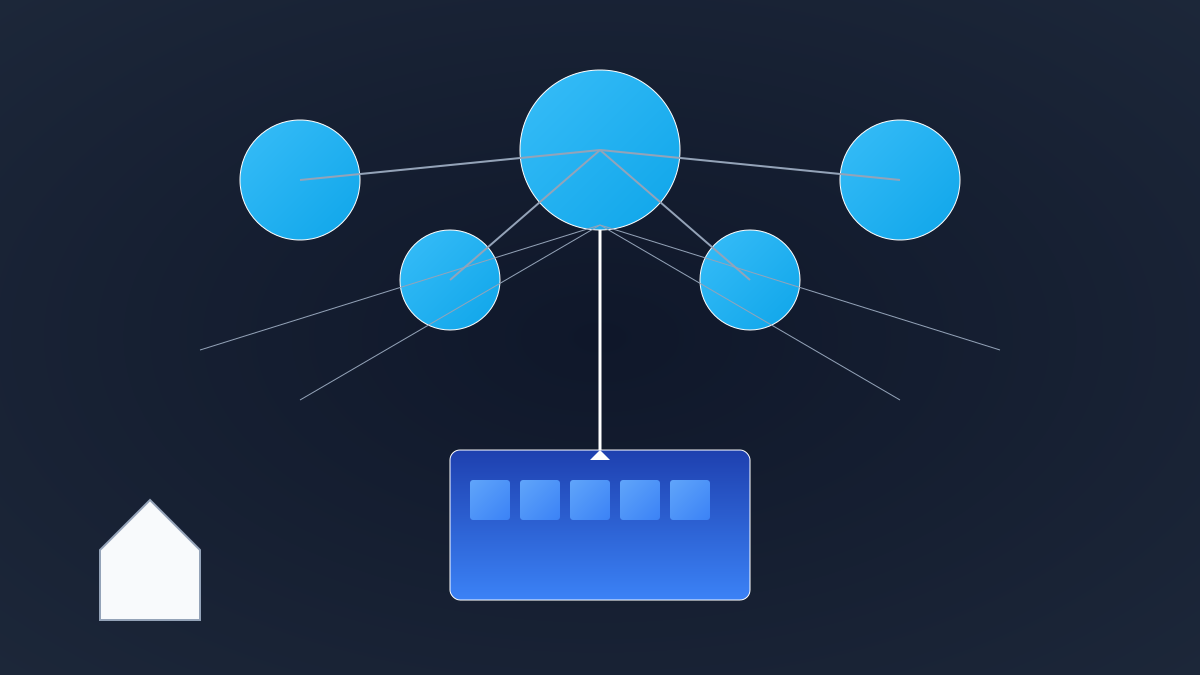
VibeBlade is an open-source project dedicated to enabling users to run any large language model (LLM) on local hardware. Using technologies like CPU/RAM inference, MOE expert offloading, and 4-bit quantization, it bypasses the VRAM wall limitation, enabling private AI deployment without cloud services or subscriptions.

本地推理大语言模型LLM量化MOECPU推理开源项目隐私保护
Published 2026-04-28 00:47Recent activity 2026-04-28 01:18Estimated read 5 min
VibeBlade: A New Option for Local Large Model Inference, A Practical Solution to Break Through VRAM Limitations
1

Section 01

Introduction: VibeBlade - A Local Large Model Inference Solution Breaking Through VRAM Limitations

VibeBlade is an open-source project dedicated to enabling users to run any large language model (LLM) on local hardware. Using technologies like CPU/RAM inference, MOE expert offloading, and 4-bit quantization, it bypasses the VRAM wall limitation, enabling private AI deployment without cloud services or subscriptions, while balancing data privacy and zero-cost advantages.


2

Section 02

Project Background and Motivation

As the capabilities of large language models (LLMs) improve, the demand for local deployment is growing. However, traditional inference is limited by VRAM capacity (mainstream models require tens or even hundreds of GB of VRAM), making it difficult for consumer hardware users to implement. VibeBlade emerged to address this; its core goal is to break the VRAM wall, allowing ordinary users to run advanced LLMs locally while maintaining data privacy and zero subscription costs.

3

Section 03

Core Technical Architecture

CPU/RAM Hybrid Inference

Supports loading part or all of the model into system memory (RAM) and using CPU for inference, suitable for batch processing or low-concurrency scenarios.

MOE Expert Offloading

For MOE architecture models like Mixtral, only part of the expert networks are activated and loaded into VRAM, significantly reducing VRAM usage.

4-bit Quantization Technology

Compresses model weights from FP16/FP32 to 4-bit, combined with GGML/GGUF formats, reducing model size and improving inference efficiency while maintaining acceptable accuracy.

4

Section 04

Practical Application Scenarios

  • Privacy-sensitive enterprises: Industries like finance, healthcare, and law ensure sensitive data stays local.
  • Edge computing devices: Supports offline AI capabilities on devices with limited computing power.
  • Research and experimentation: Personal workstations can quickly validate models without cloud GPU resources.
  • Cost-sensitive projects: Startups or individual developers can access LLM capabilities with zero subscription costs.
5

Section 05

Technical Challenges and Trade-offs

  • Inference speed: CPU inference speed is slower than GPU, suitable for latency-insensitive tasks.
  • Model compatibility: Some complex architectures require additional adaptation.
  • Hardware requirements: 32GB+ system memory is recommended to ensure smooth operation.
6

Section 06

Future Outlook

  • More efficient dynamic loading strategies
  • Support for more hardware backends like NPU and TPU
  • Deep integration with LLM ecosystems like Ollama and llama.cpp
  • Intelligent model sharding and parallel inference
7

Section 07

Conclusion and Project Address

VibeBlade promotes AI democratization, making advanced AI technology no longer limited by hardware thresholds. It is a noteworthy open-source project for privacy protection and low-cost local deployment.

Project address: https://github.com/kevin046/VibeBlade

