Zing Forum

Reading

Vehicle-Deal-Jacket-Evaluator: AI-Powered Intelligent Evaluation System for Vehicle Transaction Documents

Vehicle-Deal-Jacket-Evaluator is an AI workflow system based on a multi-agent architecture, designed to automate the processing of vehicle transaction document packages. It enables document identification and classification, data extraction, consistency verification, and regulatory compliance validation, thereby improving document processing efficiency in the automotive finance and transaction sectors.

车辆交易文档智能多智能体OCR合规检查汽车金融数据提取工作流自动化
Published 2026-04-19 02:45Recent activity 2026-04-19 02:54Estimated read 6 min
Vehicle-Deal-Jacket-Evaluator: AI-Powered Intelligent Evaluation System for Vehicle Transaction Documents
1

Section 01

[Main Floor] Vehicle-Deal-Jacket-Evaluator: Guide to the AI-Powered Intelligent Evaluation System for Vehicle Transaction Documents

Vehicle-Deal-Jacket-Evaluator is an AI workflow system based on a multi-agent architecture, aiming to address document processing pain points in the automotive finance and transaction sectors (such as low manual efficiency, diverse formats, and complex compliance requirements). It enables document identification and classification, data extraction, consistency verification, and regulatory compliance validation, improving processing efficiency and compliance. Core capabilities include intelligent document processing, accurate data extraction, cross-document consistency verification, dynamic compliance checks, and an extensible architecture.


2

Section 02

[Industry Background] Pain Point Analysis of Vehicle Transaction Document Processing

Automotive finance and vehicle transactions are document-intensive industries, where each transaction generates a large number of documents (contracts, loan agreements, etc.). Traditional processing faces challenges:

  1. Low efficiency of manual review, which becomes a bottleneck;
  2. Diverse document formats (scanned PDFs, images, etc.) with varying quality;
  3. Complex and changing compliance requirements that are difficult for humans to keep up with in a timely manner;
  4. Easy omission of cross-document data consistency.
3

Section 03

[Technical Architecture] Multi-Agent Architecture and AI Technology Applications

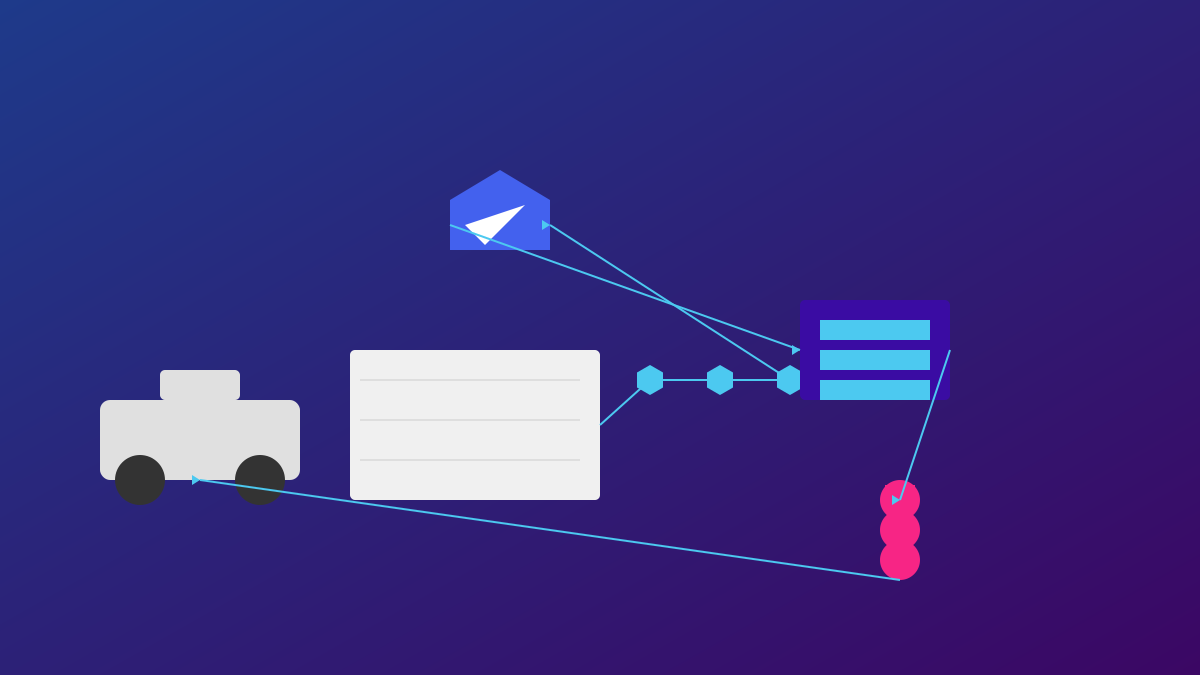
The system adopts a multi-agent architecture, decomposing tasks into collaborative professional agents:

  • Document receiving/identification/splitting agent: processes input, identifies types, splits and merges documents;
  • Data extraction agent: extracts key fields from different documents;
  • Consistency verification/compliance check agent: verifies data consistency and regulatory compliance;
  • Report generation agent: summarizes results to generate evaluation reports. AI technologies applied include visual language models (such as LayoutLM), OCR, NER, rule engines, etc.
4

Section 04

[Core Functions] Intelligent Document Processing and Compliance Validation Capabilities

Core functions:

  1. Intelligent document processing: merging/splitting PDFs, document classification, quality assessment;
  2. Accurate data extraction: extracting key fields (VIN, price, customer information, etc.) from documents like contracts and loan agreements;
  3. Consistency verification: cross-document validation of customer/vehicle/financial/date information;
  4. Compliance validation: checking document completeness, mandatory fields, disclosure requirements, signature dates, and region-specific rules.
5

Section 05

[Application Value] Application Scenarios and Benefits in Automotive Finance and Other Fields

Application scenarios:

  • Automotive financial institutions: accelerate loan approval, reduce operational risks, ensure compliance, and improve customer experience;
  • Dealers: pre-review documents, standardize processes, and assist in training;
  • Insurance companies: fast underwriting and fraud detection.
6

Section 06

[Implementation and Future] Project Challenges and Development Directions

Implementation considerations:

  • Data privacy and security (encryption, access control, etc.);
  • Model accuracy (training data, continuous learning);
  • Integration complexity (integration with legacy systems). Future directions: multi-language support, predictive analysis, mobile integration, blockchain applications, and industry expansion to real estate and other fields.
7

Section 07

[Conclusion] The Value of AI-Driven Digital Transformation in Traditional Industries

Vehicle-Deal-Jacket-Evaluator is a typical application of AI in the digital transformation of traditional industries. It automates document review through a multi-agent architecture, improving operational efficiency. With technological progress, similar systems will drive operational model changes in more industries.

