Zing Forum

Reading

Veda: Multi-AI Reasoning Engine — Cross-Model Answer Synthesis and Verification System

This article introduces the Veda Multi-AI Reasoning Engine, a system that synthesizes, compares, and verifies answers from multiple models to deliver more reliable reasoning results.

多AI推理模型综合答案验证大语言模型Veda模型协作
Published 2026-04-03 23:04Recent activity 2026-04-03 23:27Estimated read 9 min
Veda: Multi-AI Reasoning Engine — Cross-Model Answer Synthesis and Verification System
1

Section 01

Introduction to Veda Multi-AI Reasoning Engine: Core Value of Cross-Model Synthesis and Verification

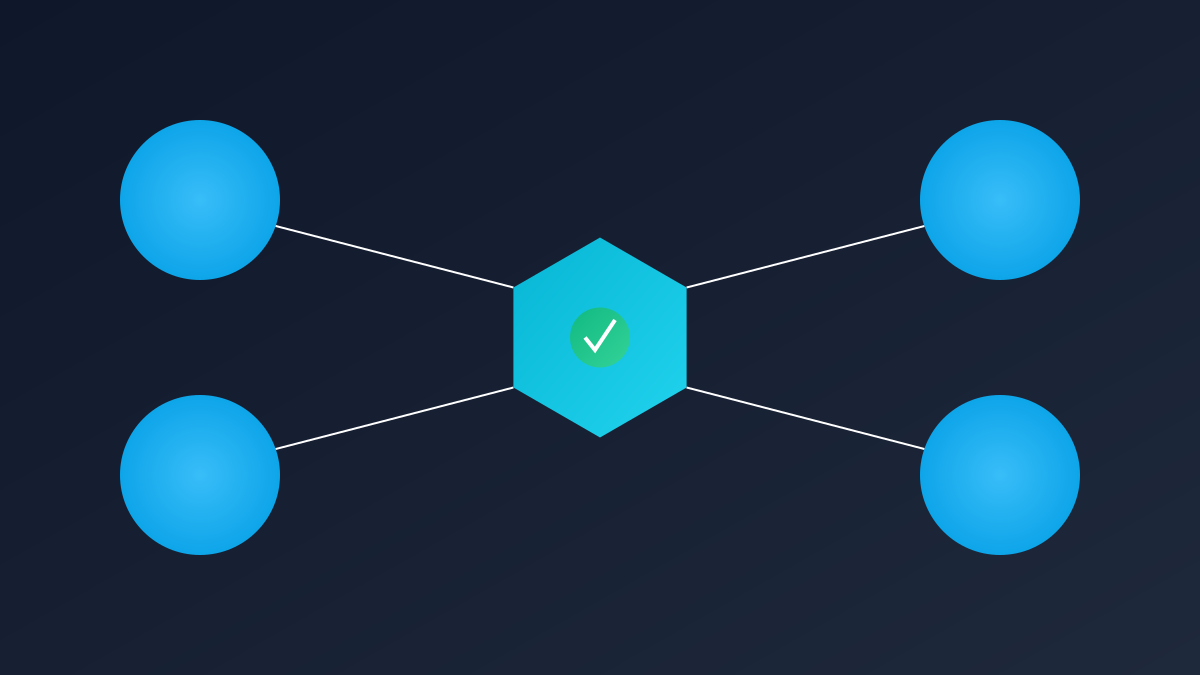
This article introduces the Veda Multi-AI Reasoning Engine, designed to address the inherent limitations of single large language models (such as knowledge cutoff, hallucinations, biases, etc.). The system provides more reliable reasoning results by synthesizing, comparing, and verifying answers from multiple models. Its name is derived from the Sanskrit word 'Veda' (meaning knowledge/wisdom), with the vision of gathering the wisdom of multiple models to generate more reliable answers than a single model.


2

Section 02

Background: Inherent Limitations of Single Large Language Models

Current large language models have many limitations:

  • Knowledge Cutoff: Training data has an expiration date, making it impossible to access the latest information
  • Hallucination Issue: Generates content that seems plausible but is incorrect
  • Bias Tendency: Inherits biases from training data
  • Capability Differences: Different models perform differently on tasks
  • Uncertainty: Difficult to accurately assess the confidence level of its own output In the face of these challenges, Veda proposes a solution through multi-model collaboration.
3

Section 03

Methodology: Veda's System Architecture and Reasoning Flow

Multi-Model Backend

Supports access to various models:

  • Commercial models: OpenAI GPT, Anthropic Claude, Google Gemini
  • Open-source models: Llama, Mistral, and other Hugging Face models
  • Local deployment: Access local models via Ollama, supporting private deployment

Reasoning Flow

  1. Parallel Query: Send the question to all configured models simultaneously and collect original answers
  2. Answer Parsing: Extract core conclusions, key arguments, and label confidence and uncertainty
  3. Cross Analysis: Detect consensus, disagreements, complementary information, and contradictions
  4. Synthesis Generation: Prioritize presenting high-consensus content, balance the elaboration of disagreements, and label uncertainty
  5. Meta-Verification: Optional layer including model critical evaluation, fact-checking tool verification, and external knowledge retrieval
4

Section 04

Core Technologies: Key Algorithms for Answer Synthesis and Verification

Answer Similarity Calculation

  • Semantic Similarity: Convert to vectors using embedding models and calculate cosine similarity
  • Structural Similarity: Analyze logical structure and compare the organization of arguments
  • Entity Alignment: Identify key entities (names, places, etc.) and check consistency

Confidence Aggregation

Using Bayesian methods: Treat model outputs as probability distributions, combine priors from historical performance, and calculate comprehensive confidence

Disagreement Resolution Strategies

  • Factual Disagreements: Adopt answers consistent with reliable knowledge sources
  • Opinion-based Disagreements: Present multiple viewpoints and their bases
  • Ambiguous Disagreements: Clearly label uncertainty
5

Section 05

Application Scenarios: Practical Value Areas of Multi-Model Reasoning

Veda is suitable for the following scenarios:

  • High-Risk Decision Support: Cross-validation of medical diagnoses, interpretation of legal clauses, investment risk assessment
  • Research and Academia: Literature review comparison, experimental result verification, hypothesis generation and exploration
  • Content Moderation and Fact-Checking: Automated fact-checking, content moderation voting, balanced reporting on controversial topics
  • Education and Learning: Present multiple problem-solving approaches, understand different viewpoints, cultivate critical thinking
6

Section 06

Advantages and Limitations: Veda's Two Sides and Scheme Comparison

Advantages

  • Improved Reliability: Reduces the impact of hallucinations from a single model
  • Enhanced Comprehensiveness: Synthesizes knowledge and reasoning styles from different models
  • Improved Interpretability: Shows consensus and disagreements, clarifies uncertainty
  • Bias Mitigation: Offsets specific biases of individual models

Limitations

  • Increased Cost: Higher API fees and computing costs
  • Increased Latency: Waiting for the slowest model to return
  • Increased Complexity: Synthesis logic may introduce errors
  • Misleading Consensus: Shared training data biases among multiple models lead to incorrect consensus

Scheme Comparison

Scheme Principle Advantages Disadvantages
Single Model Direct use Simple and fast Limited reliability
Model Integration Voting or weighting Easy to implement Coarse granularity
Veda Deep synthesis Intelligent analysis High complexity
Human-in-the-Loop Manual review Most reliable Not scalable
7

Section 07

Future Directions: Veda's Iteration and Expansion Path

Veda will develop in the following directions:

  • Adaptive Model Selection: Dynamically select model combinations based on problem types
  • Continuous Learning: Optimize synthesis algorithms through user feedback
  • Multimodal Expansion: Support reasoning for multimodal content such as images, audio, and video
  • Real-Time Knowledge Enhancement: Integrate retrieval-augmented generation to introduce real-time external knowledge
  • Enhanced Interpretability: Provide visualization of the synthesis process
8

Section 08

Conclusion: Significance and Outlook of Multi-Model Collaborative Reasoning

Veda represents an innovative approach to addressing the limitations of large language models: acknowledging the limitations of single models and acquiring collective wisdom through intelligent synthesis strategies. This echoes human decision-making wisdom—important decisions rely on comprehensive discussions from multiple parties. As AI models multiply and diversify, systems like Veda will become more important. It is not only a technical tool but also a responsible way to apply AI: acknowledging uncertainty, embracing diversity, and pursuing reliable intelligence.

