Zing Forum

Reading

VCSE: A Symbolic Reasoning Engine Without LLM — A Deterministic Verification-Driven Intelligent System

VCSE is a symbolic reasoning engine completely free from large language models (LLMs). It achieves trustworthy reasoning through structured state transitions, bounded search, and deterministic verification, providing auditable and interpretable intelligent support for critical decision-making scenarios.

符号推理确定性验证无LLM可解释AIVCSE形式化验证自动推理AI安全
Published 2026-04-28 05:57Recent activity 2026-04-28 06:19Estimated read 7 min
VCSE: A Symbolic Reasoning Engine Without LLM — A Deterministic Verification-Driven Intelligent System
1

Section 01

VCSE: A Symbolic Reasoning Engine Without LLM — A Deterministic Verification-Driven Intelligent System (Introduction)

VCSE is a symbolic reasoning engine completely free from large language models (LLMs). It achieves trustworthy reasoning through structured state transitions, bounded search, and deterministic verification, providing auditable and interpretable intelligent support for critical decision-making scenarios. Its core philosophy is "verification first", which stands in stark contrast to the "generate and answer" mode of LLMs, aiming to solve the problems of non-interpretability and non-verifiability of LLMs in critical scenarios.


2

Section 02

Background: The Reliability Dilemma of Large Language Models

In recent years, LLMs have made achievements in natural language processing, code generation, and other fields. However, when applied to critical decision-making scenarios such as legal analysis, medical diagnosis, and financial risk control, there are fundamental problems: the reasoning process is a "black box", the output cannot be strictly verified, and there is a lack of auditable decision-making basis. For example, GPT-4's high score in legal exams cannot confirm whether it is correct reasoning or memorized cases, and medical advice cannot be verified to see if it conforms to medical logic. This non-interpretability constitutes a trust barrier.

3

Section 03

Core Philosophy and System Architecture of VCSE

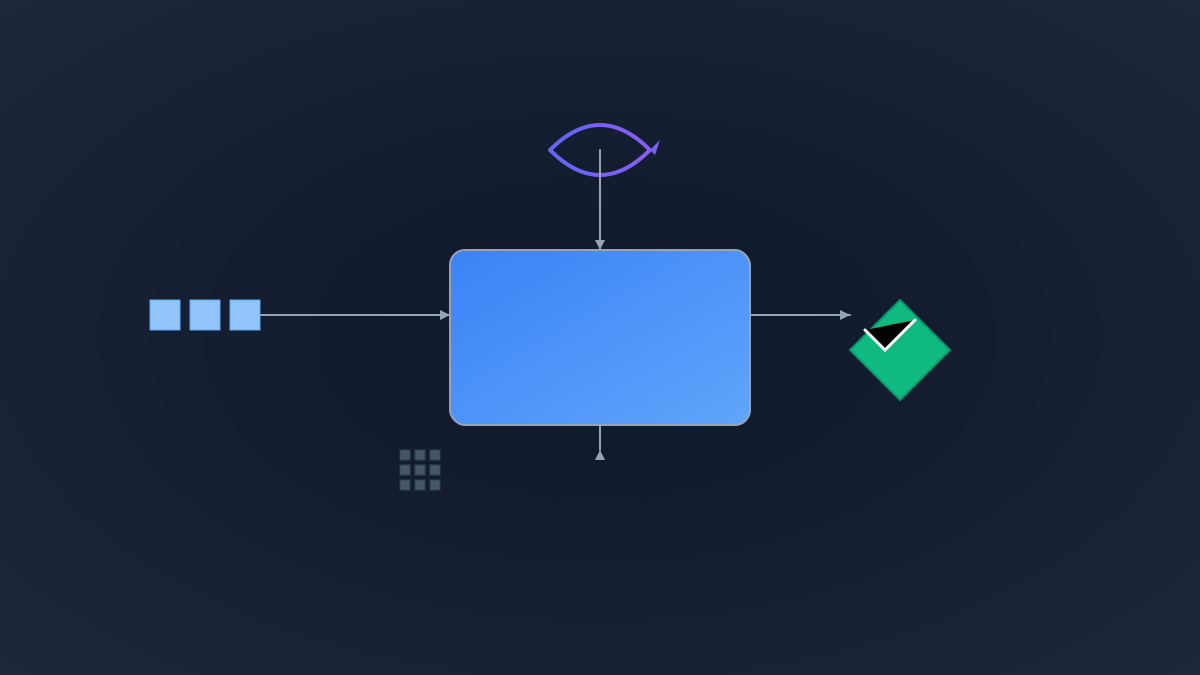
VCSE adopts a "verification first" reasoning mode, completely abandoning the token prediction of LLMs. It realizes reasoning through symbolic state transitions, bounded search, and deterministic verification, with each step explicitly constructed and requiring inspection by a verifier. The system architecture is a six-layer deterministic pipeline: Parser (extracts structured information), Memory Module (stores states), Proposer (generates candidate transitions), Search Component (explores reasoning paths, supports beam search, etc.), Verifier Stack (core, performs checks such as logical consistency), and Renderer (presents verified results).

4

Section 04

Key Features and Capabilities of VCSE

VCSE has the following features: 1. Deterministic reasoning without neural networks (implemented on CPU, behavior can be predicted and reproduced); 2. Structured knowledge ingestion (imported from files such as JSON, requiring verification); 3. Domain-specific language (DSL) support; 4. Deterministic generation (construction plus verification; returns a need for clarification if fields are missing); 5. Adversarial benchmark testing (Gauntlet suite to evaluate robustness); 6. OpenAI-compatible API; 7. Optional symbolic indexing (pure CPU deterministic ranking).

5

Section 05

Applicable Scenarios of VCSE

VCSE is particularly suitable for: 1. Critical decision support (scenarios requiring audit compliance such as financial risk control, medical diagnosis assistance, legal analysis, etc.); 2. Safety-critical systems (autonomous driving, industrial control, etc.); 3. Interpretable AI research; 4. Educational tools (helping to understand logical reasoning); 5. Formal verification (as part of a verification system).

6

Section 06

Limitations and Challenges of VCSE

VCSE has the following limitations: 1. Limited semantic understanding ability (currently mainly supports structured input and cannot directly process free text); 2. Restricted reasoning domain (only supports simple reasoning such as transitive relations, with limited ability for complex common-sense reasoning); 3. Knowledge acquisition bottleneck (requires manual explicit provision of knowledge, making it difficult to expand automatically); 4. Search complexity (the search space may grow exponentially in complex state spaces).

7

Section 07

Technical Philosophy and Conclusion

VCSE represents an alternative path for AI development: rule-driven, symbolic reasoning, and strict verification, which contrasts with the data-driven, statistical learning route of LLMs. The two are not opposites and can be integrated. The value of VCSE lies in providing an alternative solution for "error-free" scenarios, rather than replacing LLMs. It reawakens the value of symbolic AI, reminds us that intelligence needs to build verifiable reasoning chains, provides an exploration direction for AI safety and interpretability, and serves as both a research platform and a practical tool.

