Zing Forum

Reading

V2 Bank Recommendation: An Intelligent Bank Recommendation System Based on RAG

V2 Bank Recommendation is a recommendation system that applies Retrieval-Augmented Generation (RAG) technology to banking and financial scenarios. By combining semantic search and large language models, it enables data-driven intelligent financial recommendations.

RAG银行推荐系统检索增强生成金融 AI智能推荐可解释 AI语义搜索大语言模型
Published 2026-04-28 07:42Recent activity 2026-04-28 07:50Estimated read 8 min
V2 Bank Recommendation: An Intelligent Bank Recommendation System Based on RAG
1

Section 01

V2 Bank Recommendation: Guide to the RAG-Based Intelligent Bank Recommendation System

V2 Bank Recommendation is a recommendation system that applies Retrieval-Augmented Generation (RAG) technology to banking and financial scenarios. It aims to solve the "black box" problem of traditional financial recommendations and achieve data-driven, interpretable, and compliant intelligent financial recommendations. By combining semantic search and large language models, the system balances personalized needs with the transparency requirements of high-risk financial decisions, providing financial institutions with responsible AI recommendation solutions.


2

Section 02

Core Contradictions in Financial Recommendations and Project Background

Financial recommendation faces fundamental contradictions: users expect personalized product suggestions, but the high risk of financial decisions requires recommendations to be verifiable and interpretable. Traditional collaborative filtering or deep learning models are accurate but "black box", unable to explain the basis for recommendations, leading to trust crises and regulatory compliance issues. The V2 Bank Recommendation project was designed for this purpose, using a RAG architecture combined with large language models and structured financial data to build an intelligent and interpretable system.

3

Section 03

Analysis of RAG Technology Advantages and System Architecture

What is RAG

Retrieval-Augmented Generation (RAG) combines information retrieval with text generation. Before generating content, it retrieves relevant data fragments from the knowledge base as context to guide the model to output fact-based content.

Advantages of RAG for Financial Recommendations

  • Fact Anchoring: Recommendations have clear data sources, avoiding model hallucinations;
  • Dynamic Updates: Can reflect real-time market changes without retraining the model;
  • Interpretability: Provides a complete evidence chain to support regulatory compliance;
  • Domain Integration: Incorporates professional knowledge such as regulation and risk preferences.

System Architecture

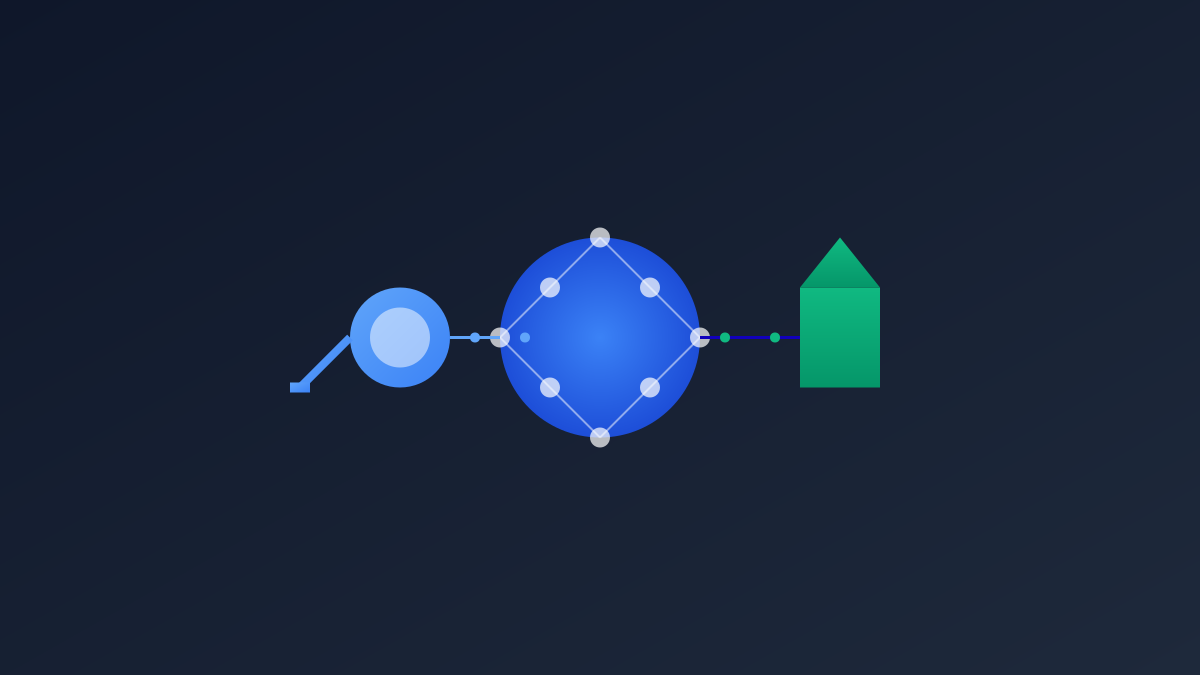
  • Multi-source Data Integration Layer: Integrates product, customer, market, and knowledge base data;
  • Semantic Retrieval Engine: Uses vector embedding to understand the deep meaning of queries;
  • Context-Augmented Generation: Generates natural and factual recommendations based on retrieved information;
  • Compliance and Risk Control Layer: Ensures recommendations meet suitability, disclosure, and fairness requirements.
4

Section 04

Application Scenarios and Value

V2 Bank Recommendation applies to various banking scenarios:

  • Personalized Financial Advice: Recommends customized portfolios based on customer assets and goals, with data support;
  • Loan Product Matching: Analyzes customer credit and needs, selects the optimal loan and explains the reasons;
  • Customer Lifecycle Management: Identifies life stages and proactively recommends relevant products;
  • Cross-selling: Recommends suitable products based on actual behavior data, avoiding blind promotion;
  • Customer Self-service: Answers complex financial questions through a natural language interface and generates data-driven analysis.
5

Section 05

Technical Advantages and Innovation Points

  • Data Freshness: Updates the knowledge base in real time, allowing the use of the latest data without retraining;
  • Multimodal Potential: Can integrate table, chart, voice, and other data in the future;
  • Progressive Improvement: Modular optimization of components (embedding model, knowledge base, generation model);
  • Cost-effectiveness: Uses retrieved fragments to reduce inference costs and minimize hallucination risks.
6

Section 06

Implementation Challenges and Considerations

  • Data Quality: RAG performance depends on high-quality data, requiring strict governance processes;
  • Privacy and Security: Protects sensitive financial data, requiring technologies like differential privacy and federated learning;
  • Regulatory Compliance: Generates explanations that comply with local regulations and supports audit trails;
  • User Trust: Designs transparent interactive interfaces, displays recommendation bases, and allows users to question.
7

Section 07

Future Development Directions and Summary

Future Directions

  • Conversational Financial Advisor: Multi-turn dialogue to understand complex needs;
  • Predictive Recommendations: Anticipate customers' future financial needs;
  • Cross-institution Integration: Integrate data from multiple institutions (with authorization) to provide comprehensive advice;
  • Simulation Planning Tool: Allow customers to "test drive" different financial decisions.

Summary

V2 Bank Recommendation demonstrates the potential of RAG technology in financial scenarios, proving that AI can be both intelligent and interpretable. This "responsible AI" paradigm will become mainstream in the financial industry, providing institutions with a feasible path to enhance customer experience, maintain trust, and ensure compliance.

