Zing Forum

Reading

v1-multiagent-articles: A Hierarchical Memory Multi-Agent Collaboration Framework Based on DAG Orchestration

An open-source multi-agent collaboration system that uses DAG (Directed Acyclic Graph) workflow orchestration and a hierarchical memory architecture to provide efficient agent collaboration and memory management capabilities for complex AI workflows.

多智能体DAG编排工作流分层记忆AI协作智能体系统
Published 2026-04-23 05:15Recent activity 2026-04-23 05:18Estimated read 6 min
v1-multiagent-articles: A Hierarchical Memory Multi-Agent Collaboration Framework Based on DAG Orchestration
1

Section 01

v1-multiagent-articles: Guide to the Multi-Agent Collaboration Framework Based on DAG Orchestration and Hierarchical Memory

v1-multiagent-articles is an open-source multi-agent collaboration system. Its core uses DAG (Directed Acyclic Graph) workflow orchestration and a hierarchical memory architecture, aiming to solve agent collaboration and memory management problems in complex AI workflows, and provide basic support for building efficient collaborative AI applications.


2

Section 02

The Era Challenges of Multi-Agent Collaboration

With the improvement of large model capabilities, a single agent can no longer meet the needs of complex tasks (such as automated content creation, complex data analysis, etc.). Building multi-agent systems faces three core challenges: How to coordinate workflows? How to effectively transfer information? How to avoid repeated calculations and resource waste? The v1-multiagent-articles project is designed to solve these problems.

3

Section 03

Core Architecture: Engineering Wisdom of DAG Orchestration

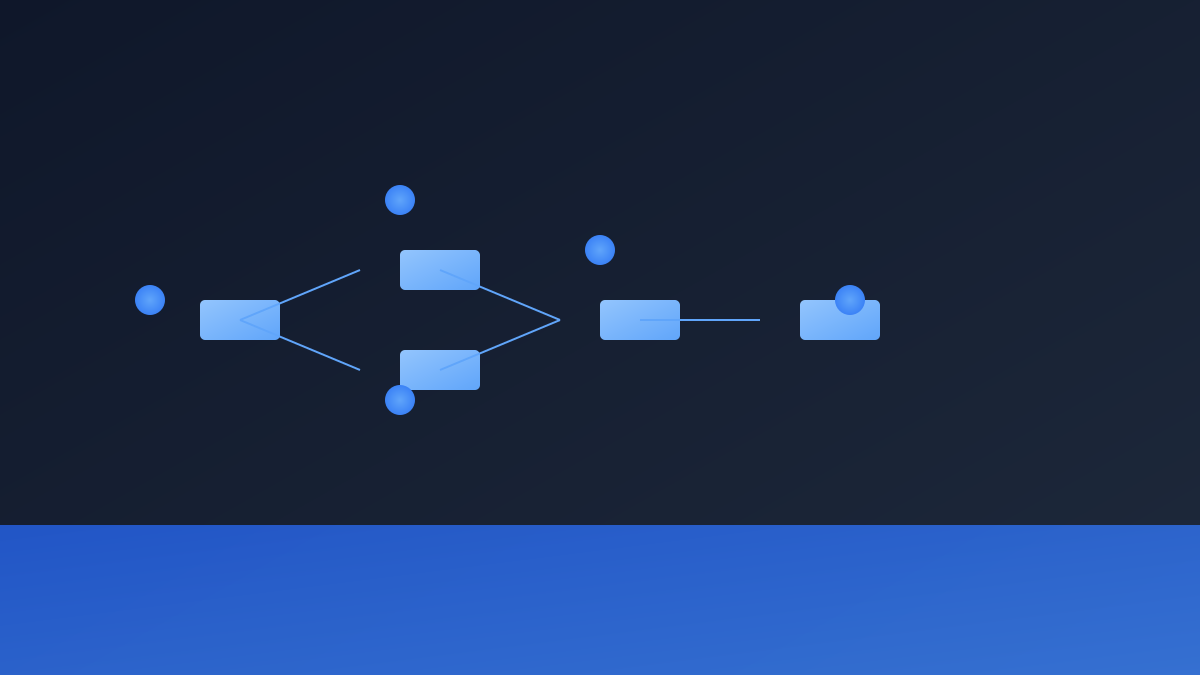
The core innovation of the project lies in using DAG as the foundation for workflow orchestration. In a DAG, nodes represent tasks, edges represent dependencies, and there are no cyclic dependencies, bringing three major advantages: 1. Clear execution order, ensuring agents get the correct input at the right time; 2. Parallelization potential, where unrelated tasks can be parallelized to improve efficiency; 3. Predictability and debuggability, making it easy to track data flow and locate faults.

4

Section 04

Hierarchical Memory Architecture: Persistent Management of Intelligence

To address the challenges of multi-agent memory management, the project adopts a hierarchical memory architecture: 1. Short-term working memory: Stores real-time information of current tasks, with fast access but limited capacity; 2. Long-term knowledge base: Stores cross-task persistent knowledge (domain knowledge, historical experience, etc.), with large capacity but slower access; 3. Inter-agent shared memory: A collaborative shared space to ensure key information is passed to the correct agent. This design simulates human cognition, balancing efficiency and avoiding information overload.

5

Section 05

Practical Application Scenarios: Adaptability Across Multiple Domains

The project architecture is suitable for three types of scenarios: 1. Automated content production: Links such as topic research, outline writing, text creation, editing and proofreading are handled by specialized agents, and DAG orchestration ensures smooth processes; 2. Complex data analysis: Steps like data cleaning, feature engineering, model training, and visualization are assigned to different agents, and hierarchical memory provides the required context; 3. Customer service automation: Modules such as intent recognition, knowledge retrieval, answer generation, and sentiment analysis work collaboratively.

6

Section 06

Highlights of Technical Implementation: Engineering and Scalability

The project code embodies engineering best practices: Modular design facilitates independent testing and replacement; clear interfaces reduce integration complexity; and complete error handling ensures system robustness. In addition, the design considers scalability—adding new agent types or modifying workflows can be done smoothly without reconstructing the entire system.

7

Section 07

Summary: A Pragmatic Solution for Multi-Agent Collaboration

v1-multiagent-articles solves workflow coordination problems through DAG orchestration and information management problems through a hierarchical memory architecture, providing a solid foundation for complex AI applications. In the trend of AI evolving from single agents to multi-agents, this project has important reference value and provides developers with valuable references for building multi-agent applications.

