Zing Forum

Reading

UiPath Maestro ECM: Physical AI and Human-Robot Collaboration On-Site Inspection Solution

This project is an entry for UiPath AgentHack 2026. Built on Maestro BPMN, it is a physical AI and robot on-site inspection system with human-robot collaboration capabilities, demonstrating the innovative application of combining RPA with physical robots.

UiPathRPA物理AI机器人巡检BPMN人机协作Maestro
Published 2026-06-02 16:15Recent activity 2026-06-02 16:23Estimated read 7 min
UiPath Maestro ECM: Physical AI and Human-Robot Collaboration On-Site Inspection Solution
1

Section 01

Introduction: UiPath Maestro ECM—An Innovative On-Site Inspection Solution with Physical AI and Human-Robot Collaboration

Project Basic Information

Core Insights

UiPath Maestro ECM is an entry for UiPath AgentHack 2026. Built on Maestro BPMN, it is a physical AI and robot on-site inspection system with human-robot collaboration capabilities. This solution innovatively combines RPA technology with physical robots, demonstrating the trend of software automation extending to the physical world—evolving from 'digital employees' to 'digital + physical employees'—and providing a new direction for enterprise automation.


2

Section 02

Project Background: The Need for RPA to Extend to the Physical World

Traditional RPA technology is mainly limited to digital task automation at the software level (such as clicking, data entry). With the advancement of physical AI and robotics technology, RPA has begun to extend to the physical world, evolving from 'digital employees' to 'digital + physical employees' that can interact with the physical environment. As an entry for UiPath AgentHack 2026, this project is an embodiment of this trend, showing how to combine UiPath Maestro BPMN with physical AI and robotics technology to build an intelligent solution for on-site inspection, representing the new direction of 'software-defined robots' in enterprise automation.

3

Section 03

Core Architecture: BPMN-Driven Physical AI Workflow Orchestration

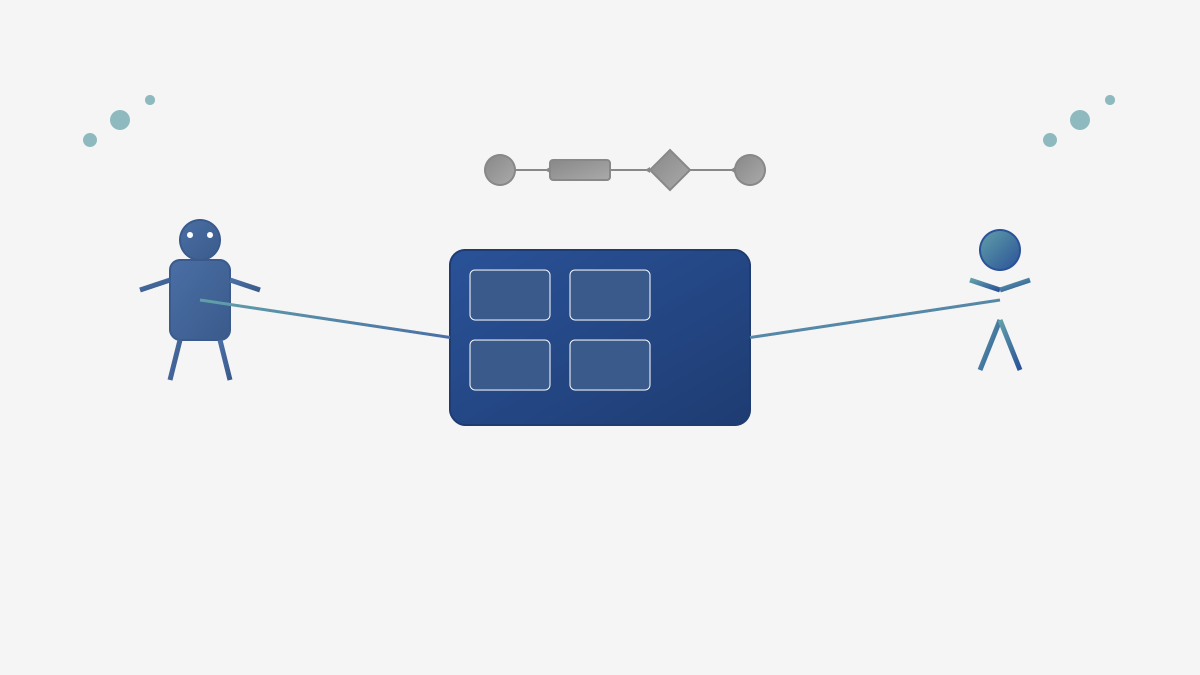
The core innovation of the project lies in using BPMN (Business Process Model and Notation) to orchestrate physical AI and robot tasks. BPMN is a standardized business process modeling language, traditionally used for enterprise process description. This project applies it to physical robot control, enabling visual definition of complex inspection processes (including task allocation, exception handling, human-robot collaboration, etc.). As a unified orchestration layer, the UiPath Maestro platform not only coordinates traditional software robots but also coordinates and manages physical robot actions, sensor data collection, and human operator intervention, greatly simplifying the coordination difficulty of complex on-site tasks.

4

Section 04

Human-Robot Collaboration: The 'Human-in-the-Loop' Design Philosophy

The on-site inspection environment has uncertainties, and AI cannot cover all abnormal situations. The project adopts the 'human-in-the-loop' design: when the system detects low-confidence recognition results, unknown exceptions, or needs complex decisions, the workflow automatically transfers the task to human operators. Operators can view real-time video and sensor data through the interface and guide robot actions. This design improves system reliability, meets the safety and traceability requirements of industrial scenarios (complete operation records), and can continuously optimize the AI model through human decisions.

5

Section 05

Application Scenarios: The Value of Intelligent Upgrade for Industrial Inspection

On-site inspection is a core activity in industries such as manufacturing, energy, and logistics. Traditional manual inspection has problems such as low efficiency, incomplete coverage, strong subjectivity, and safety hazards. The application value of this solution includes:

  1. Efficiency Improvement: Robots perform inspections 7x24 hours, freeing humans from repetitive labor;
  2. Quality Improvement: Machine vision and sensors provide precise detection, enabling predictive maintenance;
  3. Safety Guarantee: Replace humans in dangerous environments (high temperature, high pressure, etc.);
  4. Data Accumulation: Systematic data supports equipment health management and process optimization.
6

Section 06

Technical Challenges and Implementation Considerations

Integrating BPMN with physical robots faces multiple challenges:

  1. Irreversible Physical Operations: Need stronger fault tolerance and safety mechanisms;
  2. Environmental Uncertainties: Network latency, sensor noise, etc., require retry, degradation, and human intervention strategies;
  3. Multimodal Data Fusion: Effective fusion of visual, temperature, vibration, and sound data is the core difficulty of physical AI.
7

Section 07

Conclusion: The Future Vision of Physical AI

Although this project is a hackathon entry, it points to the important trend of integration between software automation and physical automation. Future enterprise automation will no longer separate software and physical robots, but a hybrid workforce (humans, software agents, and physical robots collaborating seamlessly) orchestrated by a unified workflow engine. This project provides valuable references for the architectural design of physical AI.

