Zing Forum

Reading

Tutorial Videos RAG: A Video Tutorial Q&A System Based on Semantic Search and Local LLM

An open-source RAG system that extracts knowledge from transcribed text of tutorial videos, enabling intelligent Q&A through semantic search and embedding technologies combined with local large language models.

RAG检索增强生成视频教程语义搜索本地LLM知识库问答系统GitHub
Published 2026-06-06 01:45Recent activity 2026-06-06 01:52Estimated read 8 min
Tutorial Videos RAG: A Video Tutorial Q&A System Based on Semantic Search and Local LLM
1

Section 01

【Introduction】Core Introduction to the Tutorial Videos RAG Project

Core Project Information

  • Project Name: Tutorial Videos RAG
  • Core Objective: Build an open-source RAG system to extract knowledge from transcribed text of tutorial videos and enable intelligent Q&A via semantic search and local LLM
  • Key Features: Preserve the knowledge value of videos; support real-time natural language Q&A; local LLM ensures privacy and cost control; semantic-level retrieval understands query intent
  • Source Info: GitHub project (Author: OmShelar2004, Link: https://github.com/OmShelar2004/tutorial-videos-rag), Release Date: 2026-06-05

This project aims to transform passive video learning into an interactive experience of active exploration.


2

Section 02

Background: Pain Points of Video Learning and Opportunities for RAG Technology

Pain Points of Video Learning

Online tutorial videos are a major channel for technical learning, but they have obvious pain points:

  1. Low Retrieval Efficiency: Need to repeatedly jump through videos to find specific knowledge points
  2. Low Information Density: Require significant time investment to get desired information
  3. Difficulty in Association: Hard to correlate and compare with other learning resources

Opportunities for RAG Technology

The maturity of large language models and RAG technology provides a possibility to solve the above problems—transforming video content into a retrievable and Q&A-capable knowledge base to improve learning efficiency.

3

Section 03

Project Design and Technical Architecture

Design Objectives

  1. Preserve video knowledge value: Extract structured knowledge via transcription and semantic understanding
  2. Real-time Q&A capability: Get video-related answers via natural language queries
  3. Privacy and cost control: Local LLM inference without external APIs
  4. Semantic-level retrieval: Understand the real intent of queries, going beyond keyword matching

Technical Architecture

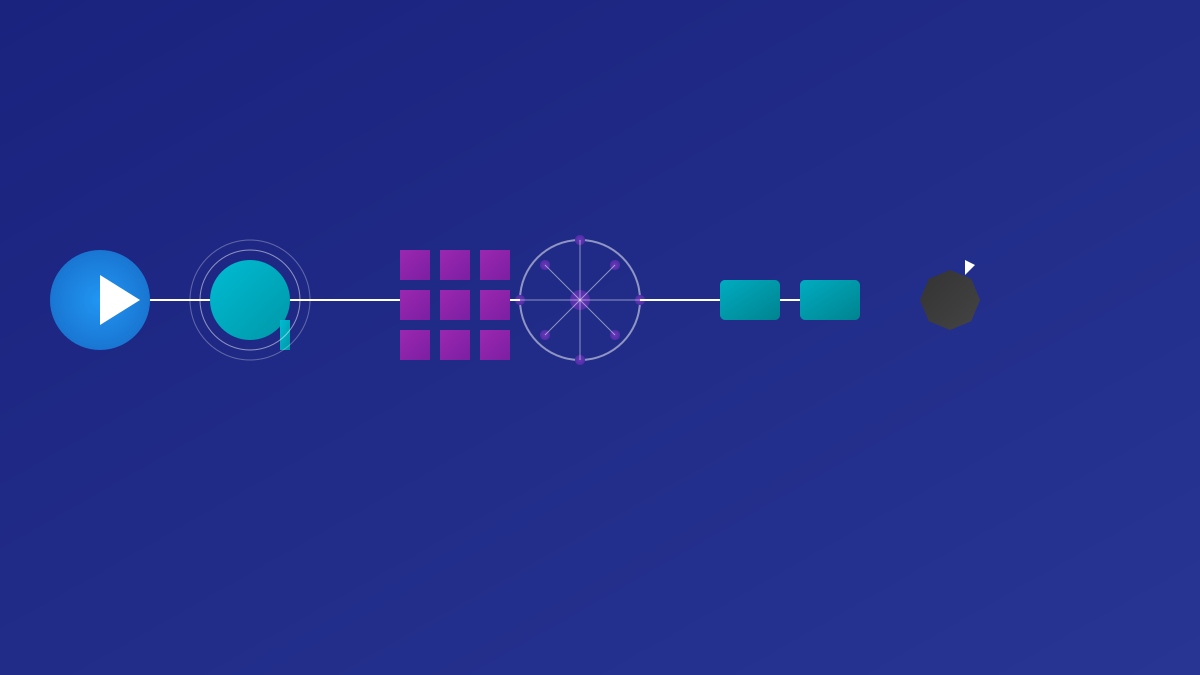
Following a typical RAG architecture, core components include:

  1. Video Transcription: Audio extraction → Whisper ASR to text → Timestamp alignment
  2. Text Processing: Semantically complete chunking (with context overlap) → sentence-transformers to generate embedding vectors
  3. Semantic Retrieval: Store vectors in Chroma/FAISS/Milvus → Query vector matches Top-K similar segments
  4. Local LLM Generation: Input retrieved segments as context into local LLM to generate answers
4

Section 04

Application Scenarios: Interactive Video Learning Experience

Main Application Scenarios

  1. Quick Knowledge Location: For example, ask "How does useEffect clean up side effects in React?" to directly get relevant video segments
  2. Cross-Video Integration: Integrate information from multiple video resources to provide comprehensive answers
  3. Review and Consolidation: Ask questions about watched content, and the system points out relevant explanation positions in the video
  4. Learning Path Planning: Answer "What prerequisite knowledge is needed to learn X?" to assist in path planning
5

Section 05

Technical Challenges and Optimization Directions

Technical Challenges

  1. Transcription Quality: Accents, background noise, and pronunciation of technical terms affect accuracy
  2. Multimodal Loss: Pure text transcription lacks visual information like code demos and charts
  3. Long Context Issue: Simple chunking may break the narrative coherence of the video
  4. Real-time Update: Incremental indexing is needed when adding/updating videos to avoid full reconstruction

Optimization Directions

  • Enhance transcription error correction and noise robustness
  • Introduce visual models to extract screen content and build a multimodal knowledge base
  • Design intelligent chunking strategies to preserve narrative coherence
  • Implement incremental indexing mechanism
6

Section 06

Practical Value of Local LLM Deployment

Value of Local LLM Deployment

Reasons for choosing local LLM over cloud APIs:

  1. Privacy Protection: Sensitive content does not leave the local environment
  2. Cost Control: No API call fees, low marginal cost
  3. Customizability: Choose/fine-tune open-source models suitable for specific domains
  4. Offline Availability: Usable without network access

Notes

Requires certain hardware resources (GPU/high-performance CPU), as well as model management and update maintenance work.

7

Section 07

Summary and Future Outlook

Project Summary

Tutorial Videos RAG demonstrates the application of RAG technology in the educational video field, transforming passive viewing into active exploration and providing developers with a referenceable tech stack and architecture pattern.

Future Outlook

With the advancement of multimodal models and video understanding technology, we can expect more intelligent learning assistants in the future: ones that can not only answer text questions but also understand multimodal information such as code demos, interface operations, instructor gestures, and blackboard writing.

