Zing Forum

Reading

TurboQuant-GPU: An LLM Inference Acceleration Solution with 5x KV Cache Compression via cuTile Kernel

TurboQuant-GPU achieves efficient KV Cache compression on NVIDIA GPUs through innovative cuTile kernel technology, delivering a 5.02x efficiency improvement and providing a significant memory optimization solution for large language model (LLM) inference deployment.

KV CacheLLM推理优化GPU加速量化压缩CUDA内核显存优化大语言模型推理吞吐量
Published 2026-04-30 08:42Recent activity 2026-04-30 10:11Estimated read 6 min
TurboQuant-GPU: An LLM Inference Acceleration Solution with 5x KV Cache Compression via cuTile Kernel
1

Section 01

Introduction: TurboQuant-GPU—An LLM Inference Acceleration Solution with 5x KV Cache Compression

TurboQuant-GPU achieves efficient KV Cache compression on NVIDIA GPUs via innovative cuTile kernel technology, delivering a 5.02x efficiency improvement and providing a significant memory optimization solution for LLM inference deployment. This article will cover background, technical innovations, performance data, application scenarios, and other aspects.


2

Section 02

Background: Memory Bottleneck Issue of KV Cache

In LLM inference, KV Cache is the core mechanism supporting autoregressive generation, storing key-value vectors for each token to avoid redundant computation of historical context. However, as sequence length and model size increase, KV Cache memory usage grows exponentially, becoming a major bottleneck for long-context inference and batch deployment.

For example, with Llama-2-70B, a sequence length of 4096, and a batch size of 32, KV Cache occupies over 40GB of VRAM, limiting consumer-grade GPU deployment and context window size.

3

Section 03

Technical Innovations: cuTile Kernel and Quantization Compression Strategy

The core innovations of TurboQuant-GPU include:

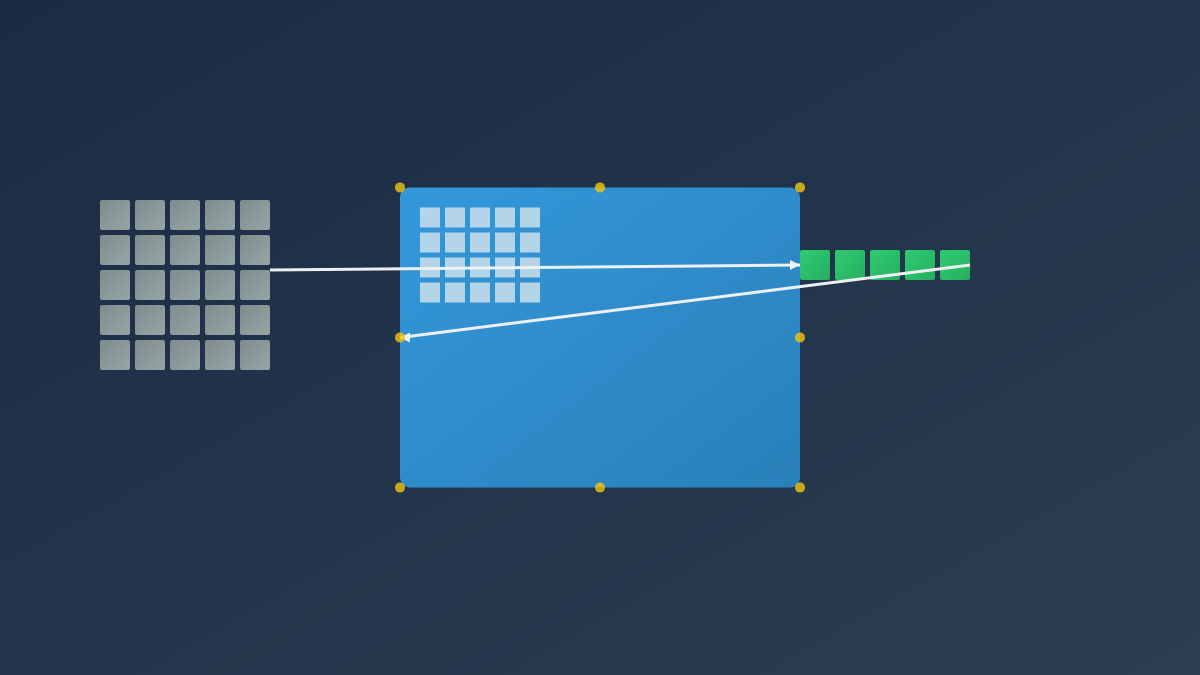
  1. cuTile Kernel Architecture: Uses a block-based strategy to decompose large matrix operations into small blocks suitable for GPU shared memory processing, reducing global memory access and increasing computational density.
  2. Quantization Compression Strategy: Based on the characteristics of the attention mechanism, asymmetric quantization bit widths are applied to Key and Value vectors (Key is more sensitive, Value has a higher compression rate), maximizing memory savings while maintaining accuracy.
  3. Dynamic Decompression Mechanism: During attention computation, only the currently needed KV blocks are decompressed into registers/shared memory and released immediately after computation, minimizing peak VRAM usage.
4

Section 04

Performance Test Results: 5.02x Efficiency Improvement and Memory Optimization

On NVIDIA A100 GPUs, TurboQuant-GPU achieves a 5.02x efficiency improvement, including multi-dimensional benefits:

  • Memory compression ratio: KV Cache usage reduced by 4-5x, supporting longer contexts or larger batch sizes;
  • Inference throughput: Reduced memory bandwidth pressure, 20-30% faster token generation speed;
  • Deployment cost: Fewer GPU instances needed for the same workload in cloud service scenarios.

These improvements are achieved while maintaining almost lossless model output quality, with progressive quantization calibration ensuring attention score stability.

5

Section 05

Application Scenarios and Deployment Recommendations

TurboQuant-GPU is suitable for the following scenarios:

  1. Long document processing: Supports RAG applications with 8K/16K+ context;
  2. High-concurrency services: Multi-user chatbots or API services, supporting more concurrent requests within limited VRAM;
  3. Edge deployment: Running medium-scale LLMs on memory-constrained devices like the Jetson series.

Deployment recommendations: First verify accuracy loss in small-scale benchmark tests, then gradually expand to production environments; currently only supports NVIDIA GPUs, AMD/Intel users need to wait for adaptation.

6

Section 06

Technical Limitations and Future Outlook

Limitations:

  • Hardware binding: The cuTile kernel relies on the NVIDIA CUDA ecosystem, cross-platform porting requires significant work;
  • Model adaptation: Different architecture models (GPT/Llama/Mistral) need targeted quantization parameter tuning;
  • Precision-sensitive tasks: Full precision verification is required for scenarios like mathematical reasoning and code generation.

Future outlook: Expand to more hardware platforms and model architectures, becoming one of the standard tools for LLM inference optimization.

7

Section 07

Conclusion: Core Value of KV Cache Compression and Project Significance

KV Cache compression is a core battlefield for LLM inference optimization, and TurboQuant-GPU provides a new technical path through cuTile kernel innovation. For AI teams facing VRAM bottlenecks, this is an open-source project worth paying attention to and trying.

