Zing Forum

Reading

Multimodal Depression Detection: Application of Transformer Architecture in Mental Health AI

This article introduces a Transformer-based multimodal deep learning framework that combines text and acoustic features for depression detection, integrating RoBERTa and Wav2Vec2 models to enable scalable mental health analysis.

多模态学习抑郁检测TransformerRoBERTaWav2Vec2心理健康语音分析医疗AI
Published 2026-05-22 02:42Recent activity 2026-05-22 02:54Estimated read 8 min
Multimodal Depression Detection: Application of Transformer Architecture in Mental Health AI
1

Section 01

[Introduction] Multimodal Depression Detection: Application of Transformer Architecture in Mental Health AI

This article introduces a Transformer-based multimodal deep learning framework that combines text (RoBERTa) and acoustic (Wav2Vec2) features for depression detection. It aims to address the limitations of traditional depression screening, achieve low-cost and efficient preliminary screening, and provide a scalable analysis solution for mental health AI.


2

Section 02

Background: Mental Health Screening Needs and the DAIC-WOZ Dataset

Digital Needs for Mental Health Screening

Depression affects over 300 million people globally, but due to stigma, insufficient resources, etc., many patients are not diagnosed in time. Traditional screening relies on clinical interviews and self-assessment scales, which have limitations such as dependence on professionals, time-consuming processes, and patient concealment. AI technology provides the possibility for low-cost and efficient screening.

DAIC-WOZ Dataset

Based on the DAIC-WOZ dataset (Distress Analysis Interview Corpus + Wizard of Oz paradigm), it includes clinical interview audio and transcribed text, annotated with the PHQ-8 scale, with identity information removed to balance research value and ethics. Clinical interviews are structured, and participants' responses contain information on content and expression, making them suitable for multimodal analysis.

3

Section 03

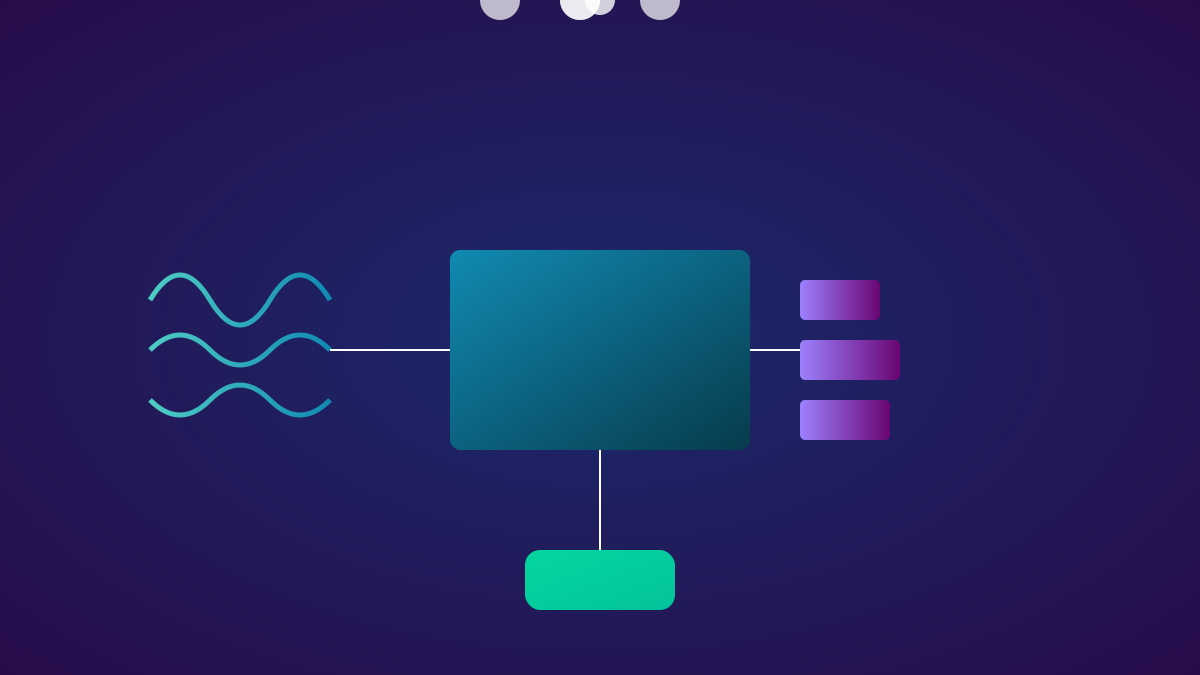
Methodology: Multimodal Architecture Design

Text Modality: RoBERTa

RoBERTa (an optimized version of BERT) is used, which is fine-tuned for the domain to adapt to clinical interview language (colloquialism, emotional vocabulary, etc.), outputting high-level semantic representations.

Acoustic Modality: Wav2Vec2

Wav2Vec2 from Facebook AI is used to extract audio features, capturing depression-related acoustic cues such as speech rate, volume, and pauses, while retaining rich acoustic information.

Multimodal Fusion

A hybrid early + late fusion strategy is adopted. After feature extraction from each modality, fusion is performed at the decision layer with automatic weight adjustment, connected to a fully connected classifier (equipped with Dropout to prevent overfitting).

4

Section 04

Training Strategy and Model Optimization

Stratified Cross-Validation

To address class imbalance, stratified cross-validation is used to ensure that the ratio of depressed/healthy samples in each fold is consistent with the overall dataset, making full use of the data.

Regularization Techniques

Dropout, weight decay, and early stopping are used to prevent overfitting; text augmentation (synonym replacement, back-translation) and audio augmentation (time stretching, pitch shifting) are used to expand the dataset.

Interpretability

Attention visualization is used to show the text segments and audio periods that the model focuses on, enhancing trust and identifying potential biases.

5

Section 05

Technical Challenges and Solutions

Data Privacy and Ethics

Strictly follow data protocols; future exploration will include federated learning and differential privacy to protect privacy.

Cross-Dataset Generalization

Improve robustness through domain adaptation and multi-dataset joint training.

Clinical Practicality

Design a scalable architecture to support incremental updates, and a lightweight inference solution to lower deployment barriers.

6

Section 06

Application Scenarios and Social Value

Primary Screening Tool

As a primary screening tool to identify high-risk groups, expand coverage (especially in resource-poor areas), and can be integrated into digital health applications.

Treatment Effect Monitoring

Assist in monitoring treatment progress of diagnosed patients, capture dynamic changes in symptoms, and provide references for doctors to adjust treatment plans.

Mental Health Research

Analyze large-scale speech data to reveal depression biomarkers, deepen understanding of disease mechanisms, and feed back into clinical research.

7

Section 07

Limitations and Future Directions

The current system relies on English data and has limited cross-language capabilities; depression is highly heterogeneous, making it difficult for a single model to cover all subtypes. In the future, we will explore fusion of more modalities (facial expressions, physiological signals, behavioral data, etc.) to improve accuracy and robustness.

8

Section 08

Conclusion: Technology Empowerment and Ethical Balance

Multimodal depression detection shows the potential of AI to empower mental health services, but there is still a gap from wide clinical application. AI should be used as an auxiliary tool, with the final diagnosis right in the hands of doctors. We need to balance technological development and ethical considerations to ensure the healthy and benign development of health AI.

