Zing Forum

Reading

Innovative Application of Hierarchical Transformer Architecture in Anomaly Detection for Intelligent Surveillance

This article introduces an anomaly understanding framework for intelligent surveillance systems based on the hierarchical TimeSformer architecture, which combines multimodal Transformer models and FAISS retrieval technology to achieve semantic-level understanding and analysis of abnormal events in CCTV surveillance videos.

TransformerTimeSformer智能监控异常检测多模态学习FAISS视频理解计算机视觉深度学习
Published 2026-05-15 06:11Recent activity 2026-05-15 06:19Estimated read 5 min
Innovative Application of Hierarchical Transformer Architecture in Anomaly Detection for Intelligent Surveillance
1

Section 01

[Introduction] Core Innovations of Hierarchical Transformer Architecture in Anomaly Detection for Intelligent Surveillance

The Hierarchical-Transformer-CCTV-Anomaly-Understanding project introduced in this article combines the hierarchical TimeSformer architecture, multimodal Transformer models, and FAISS retrieval technology to achieve semantic-level understanding of abnormal events in CCTV surveillance videos. It not only improves detection accuracy but also provides in-depth information support for security decision-making.


2

Section 02

Background: Technological Evolution and Pain Points of Intelligent Surveillance

The acceleration of urbanization and the increasing demand for public safety have made video surveillance a core part of security. However, traditional manual monitoring is inefficient and prone to omissions. Deep learning technology has brought changes to intelligent surveillance, and this project proposes an innovative solution to the demand for semantic understanding of abnormal events.

3

Section 03

Method: Design of Hierarchical TimeSformer Architecture

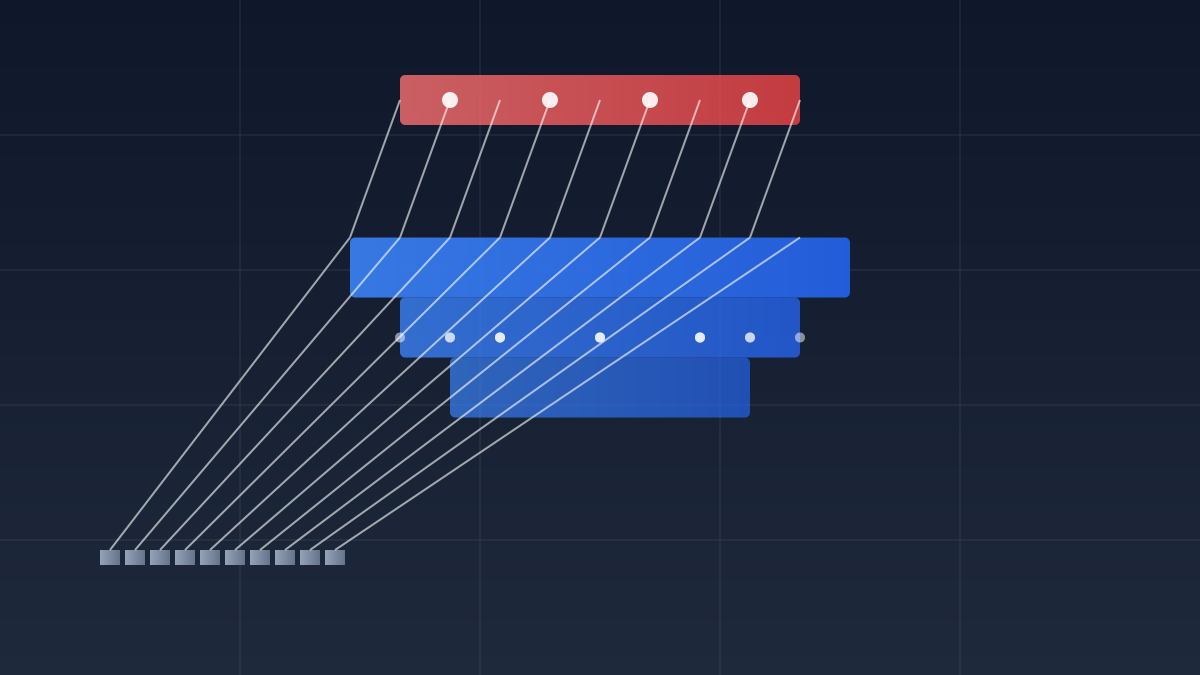
TimeSformer is a Transformer architecture dedicated to video understanding, which can capture spatiotemporal features and long-range temporal dependencies. The project adopts a hierarchical design: the bottom layer processes local spatiotemporal features (such as object trajectories), the middle layer integrates behavior patterns, and the top layer achieves semantic understanding, imitating the human visual information processing mechanism.

4

Section 04

Method: Application of Multimodal Fusion Technology

The project introduces a multimodal Transformer model to integrate information such as video frames, audio, and text. It solves the modal alignment problem through a unified feature space, uses audio to assist in locating suspicious areas, and text to assist in retrieving specific events, achieving three-dimensional scene understanding.

5

Section 05

Method: FAISS Retrieval Supports Large-Scale Video Analysis

Integrating the FAISS library enables fast search for high-dimensional vector similarity. Video clips are encoded into feature vectors to build a database, and new abnormal events can quickly retrieve historical similar cases. This is more flexible than keyword search and can discover semantically similar events.

6

Section 06

Effect: Breakthrough in Semantic-Level Anomaly Understanding

Traditional systems only judge whether an anomaly exists, while this framework can answer the type, severity, and cause of the anomaly. The end-to-end design learns semantics from raw videos, can distinguish abnormal behaviors such as crowd gathering and left-behind items, and evaluate confidence levels.

7

Section 07

Application Scenarios and Practical Value

It can be deployed in public safety (crowd density analysis, suspicious behavior detection), traffic management (accident/violation identification), and industrial production (equipment anomaly monitoring). The modular design is easy to expand and customize to meet the needs of different scenarios.

8

Section 08

Challenges and Future Outlook

Current challenges: The Transformer architecture has high computational resource requirements, making edge deployment difficult; data privacy issues are prominent. Future directions: Popularization of hardware performance improvement and model compression; federated learning to protect privacy; combining large language models to generate natural language reports to enhance human-computer interaction.

