Zing Forum

Reading

Trans-RAG: Query-Centric Vector Transformation Technology for Cross-Organization Secure Retrieval

Trans-RAG achieves secure isolation and efficient retrieval of knowledge between organizations through the vector space language paradigm and vector2Trans multi-stage transformation technology. It maintains native retrieval efficiency while reaching a 99.81% vector space isolation rate, providing a solution that balances security, accuracy, and efficiency for cross-organization RAG systems.


RAG向量检索跨组织安全隐私计算检索增强生成数据隔离
Published 2026-04-11 01:58Recent activity 2026-04-13 13:20Estimated read 5 min
Trans-RAG: Query-Centric Vector Transformation Technology for Cross-Organization Secure Retrieval
1

Section 01

Trans-RAG: Query-Centric Vector Transformation Technology for Cross-Organization Secure Retrieval (Introduction)

Trans-RAG achieves secure isolation and efficient retrieval of knowledge between organizations through the vector space language paradigm and vector2Trans multi-stage transformation technology. It maintains native retrieval efficiency while reaching a 99.81% vector space isolation rate, providing a solution that balances security, accuracy, and efficiency for cross-organization RAG systems.

2

Section 02

Security Dilemmas of Cross-Organization RAG and Deficiencies of Existing Solutions

When retrieval-augmented generation (RAG) systems are deployed across organizations, they face the core tension between privacy protection and efficient knowledge sharing. Existing solutions have obvious deficiencies: traditional encryption requires decryption, exposing plaintext risks; federated architectures hinder resource integration and have high communication overhead; homomorphic encryption has high computational costs and is difficult to meet real-time retrieval needs.

3

Section 03

Core Innovations: Vector Space Language Paradigm and vector2Trans Technology

The core of Trans-RAG is the "vector space language"—knowledge of each organization resides in a mathematically isolated semantic space. It achieves a 99.81% isolation rate through approximate orthogonal design (average angular separation of 89.90 degrees); the vector2Trans multi-stage transformation technology dynamically converts vectors to the target space on the query side, with no decryption risk, lightweight computation, and maintains native retrieval efficiency.

4

Section 04

Trans-RAG System Architecture and Workflow

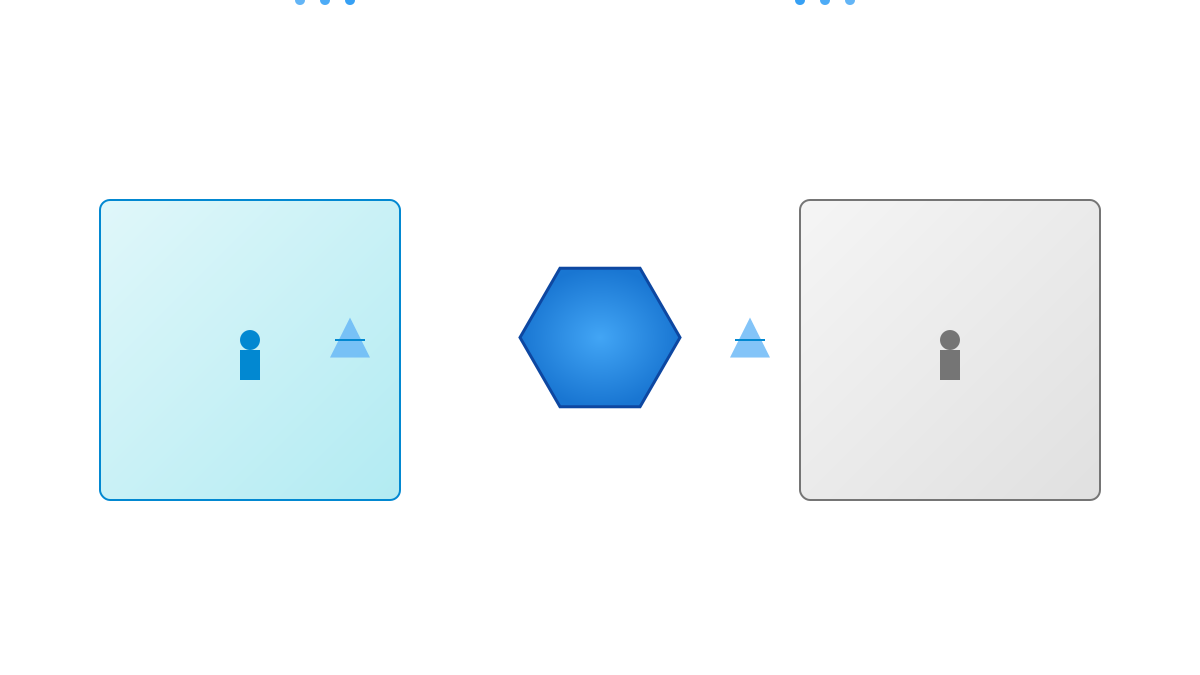
The system includes three core components: 1. Local vector space maintenance: each organization independently generates an orthogonal space and only exchanges transformation meta-information; 2. Dynamic query transformation: multi-stage mapping of query vectors to the target space to enhance security; 3. Native retrieval execution: transformed vectors are directly retrieved using ANN algorithms without performance compromise.

5

Section 05

Experimental Evaluation: Verification of Security, Accuracy, and Efficiency

Security: The average angular separation between spaces of different organizations is 89.90 degrees, close to complete orthogonality; Accuracy: nDCG@10 only decreases by 3.5% compared to plaintext retrieval, which is better than perturbation methods; Efficiency: The transformation overhead is at the microsecond level, and the overall latency is close to native retrieval, far better than the millisecond-level computation of homomorphic encryption.

6

Section 06

Typical Application Scenarios of Trans-RAG

It is suitable for scenarios such as joint medical research (sharing medical knowledge without exposing patient data), financial risk control collaboration (sharing risk intelligence without leaking customer information), and enterprise knowledge alliances (secure retrieval of technical documents among upstream and downstream of the industrial chain).

7

Section 07

Limitations and Future Research Directions

Limitations: It requires a trust foundation between organizations to collaboratively establish transformation parameters, and it is currently optimized for static knowledge bases; Future directions: Explore complex nonlinear transformations to improve security, study cross-space retrieval mechanisms for multi-hop reasoning, and expand to multi-modal retrieval scenarios.
