Zing Forum

Reading

TopoAlign: Understanding Neural Network Representation Alignment from a Topological Perspective

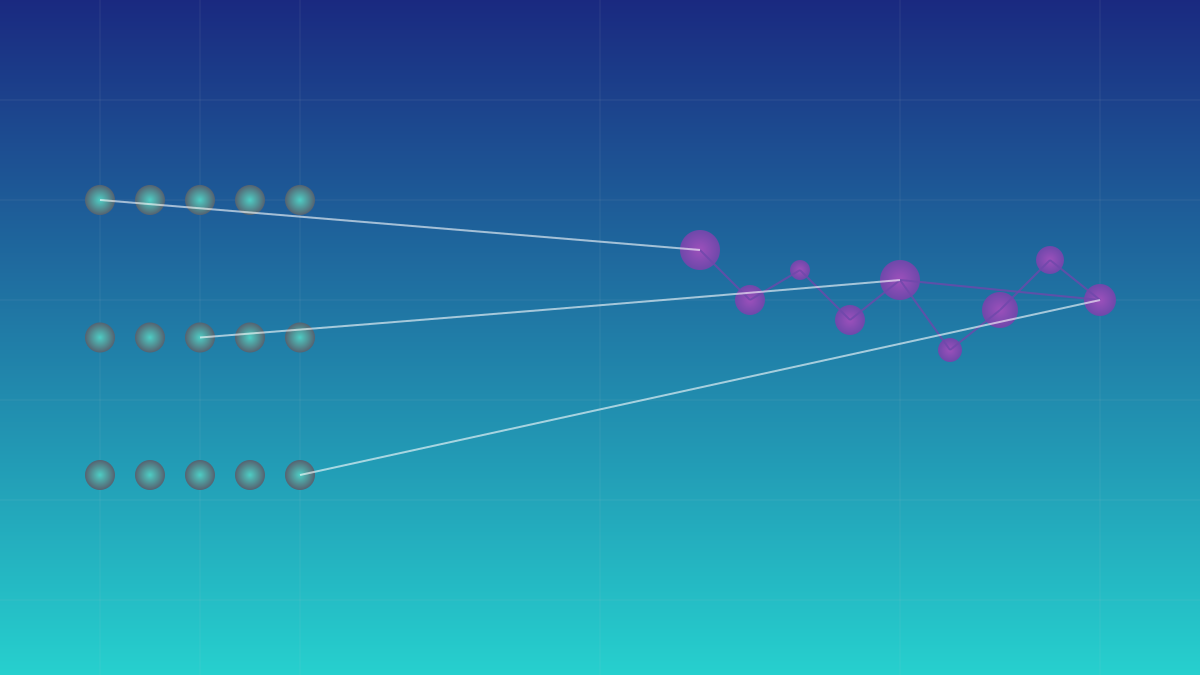
TopoAlign proposes a topology-aware visualization framework that achieves global structural alignment of model representations via Mapper graphs and force-directed optimization. Combined with Bubble Sets and membrane visualization techniques, it provides a new perspective for understanding the structural relationships of representations between different models and layers.

TopoAlign表征对齐拓扑数据分析神经网络可视化Mapper图模型可解释性深度学习
Published 2026-05-25 15:58Recent activity 2026-05-26 13:27Estimated read 10 min
TopoAlign: Understanding Neural Network Representation Alignment from a Topological Perspective
1

Section 01

TopoAlign: A Guide to the Neural Network Representation Alignment Framework from a Topological Perspective

TopoAlign is a topology-aware visualization framework designed to understand neural network representation alignment from a structural perspective. It achieves global structural alignment using Mapper graphs (a topological data analysis technique) and joint force-directed optimization. Combined with Bubble Sets and membrane visualization techniques, it addresses the limitation of existing geometric methods that only focus on local similarity, providing a new perspective for understanding the structural relationships of representations between different models and layers, and facilitating model interpretation, selection, and robustness analysis.


2

Section 02

Background of Representation Alignment and Limitations of Existing Methods

Definition and Importance of Representation Alignment

The "representation" of a neural network is a high-dimensional vector encoding input data, capturing task-related structures and semantics. Representation alignment studies the similarity of representations of the same input across different models, layers, or training conditions, which is crucial for model interpretation, selection, and robustness analysis (similar representations may lead to similar predictions and share internal understanding).

Limitations of Existing Methods

Current methods rely on geometric properties (neighborhood/clustering similarity) and only provide a local perspective, making it difficult to reveal global organizational structures. For example, geometric methods can compare the similarity of local blocks in a city but cannot judge whether the overall layout is similar—this is a major flaw in understanding the representation space of deep neural networks.

3

Section 03

Core Methods and Workflow of the TopoAlign Framework

Core Tool: Mapper Graph

TopoAlign uses Mapper graphs (a topological data analysis technique) to convert high-dimensional representations into graph structures (nodes + edges) that preserve key topological features, facilitating structural comparison.

Three-Layer Progressive Workflow

  1. Global Structural Alignment: Generate a coordinated layout via joint force-directed optimization (simulating gravitational and repulsive forces), allowing Mapper graphs of different models/layers to be compared in the same space.
  2. Local Correspondence Identification: Automatically detect structurally matching regions and visualize corresponding structures using Bubble Sets (bubble outlines enclosing related nodes).
  3. Fine-Grained Pattern Inspection: Support motif queries and membrane visualization (biological membrane-like surfaces wrapping nodes) to deeply analyze specific patterns (e.g., topological similarities and differences of semantic concepts).
4

Section 04

Case Studies and Validation of TopoAlign

Language Model Case

Comparing representations of language models with different architectures/scales, we found:

  • Vocabulary-level representations differ significantly, but sentence-level semantic representations are topologically similar;
  • Specific semantic concepts such as negation and tense form similar topological structures, supporting the hypothesis that "different architectures converge to similar semantic representations" and providing a basis for distillation/transfer learning.

Multimodal Model Case

Comparing image-text representations of vision-language models:

  • Image and text representations form clearly corresponding topologies in the joint space;
  • Some visual/language concepts form "bridging" regions;
  • Alignment quality is highly correlated with cross-modal task performance, facilitating model diagnosis and improvement.

Expert Validation

Domain experts confirmed that the topological correspondences revealed by TopoAlign are consistent with intuition, providing new insights and enhancing the credibility of the results.

5

Section 05

Technical Innovations and Advantages of TopoAlign

  1. Robustness of Topological Perspective: More robust to noise and deformations (rotation/scale/minor distortion), suitable for comparing models with different architectures/training objectives.
  2. Visualization-Driven Exploration: Interactive visualization supports "roaming" the representation space, discovering unexpected patterns, and facilitating hypothesis generation.
  3. Cross-Model Comparability: Based on topological structures rather than absolute coordinates, it naturally supports the comparison of models with different architectures.
6

Section 06

Application Scenarios and Potential Value of TopoAlign

  • Model Selection and Integration: Identify models with complementary representation structures (large differences indicate diversity suitable for integration; similarity indicates redundancy).
  • Model Compression and Distillation: Diagnose whether student models reproduce key topological structures of teacher models to judge the effect of knowledge transfer.
  • Fault Diagnosis and Debugging: Compare the representation topologies of normal/abnormal behaviors to locate model "understanding" deviations.
  • Scientific Discovery and Hypothesis Generation: Discover new data patterns through visualization and generate testable hypotheses about model behavior.
7

Section 07

Limitations and Future Directions of TopoAlign

Limitations

  • Computational Complexity: Building Mapper graphs requires significant computational resources, especially for large-scale datasets.
  • Parameter Sensitivity: Mapper graph construction depends on hyperparameters (binning strategy, clustering threshold), which affect results.
  • Causal Explanation Challenge: Reveals structural correspondences but is difficult to explain "why"; needs to be combined with causal inference.

Future Directions

  • Explore more efficient approximation algorithms to reduce computational complexity;
  • Develop automated parameter selection methods;
  • Combine causal inference to enhance explanatory power.
8

Section 08

Significance and Future Outlook of TopoAlign

TopoAlign represents an important advancement in neural network interpretability research, introducing topological data analysis into the field of representation alignment and providing a new perspective for understanding the internal structure of models. In the era of deep learning, it helps us glimpse the order and laws of the "artificial brain", just as a telescope reveals the structure of the universe. With the rise of multimodal and large-model systems, the importance of representation alignment is increasingly prominent, and the topological perspective opened up by TopoAlign will continue to provide inspiration and tool support for this field.

