Zing Forum

Reading

TinyRecursiveModels: How a Small Model with 7 Million Parameters Achieves Recursive Reasoning

TinyRecursiveModels demonstrates that small-scale neural networks can also achieve complex recursive reasoning capabilities, achieving high scores on multiple challenging tasks and providing new ideas for efficient AI model design.

小模型递归神经网络参数效率边缘AI架构创新推理能力模型压缩
Published 2026-03-30 02:35Recent activity 2026-03-30 02:54Estimated read 7 min
TinyRecursiveModels: How a Small Model with 7 Million Parameters Achieves Recursive Reasoning
1

Section 01

[Main Post/Introduction] TinyRecursiveModels: Recursive Reasoning Breakthrough of a Small Model with 7 Million Parameters

TinyRecursiveModels proves that a small neural network with 7 million parameters can achieve complex reasoning capabilities through clever recursive architecture design. It performs excellently on multiple challenging tasks such as mathematics, logic, and program analysis, challenging the "scale worship" in the AI field, providing new ideas for efficient AI model design, and also having the possibility of edge deployment.


2

Section 02

Background: Efficiency Reflection in the Era of Large Models and the Core Position of Recursive Reasoning

Currently, there is "scale worship" in the AI field. Top models have hundreds of billions of parameters, with high training costs and poor accessibility. The human brain reveals that the essence of intelligence may lie in architectural design rather than mere scale accumulation. Recursive reasoning is a core ability of human cognition (such as understanding nested structures and multi-step deduction), but traditional models (feedforward, recurrent, Transformer) have limitations in handling recursive structures.

3

Section 03

Methodology: Explicit Recursive Architecture and Targeted Training Strategies

Architecture Design

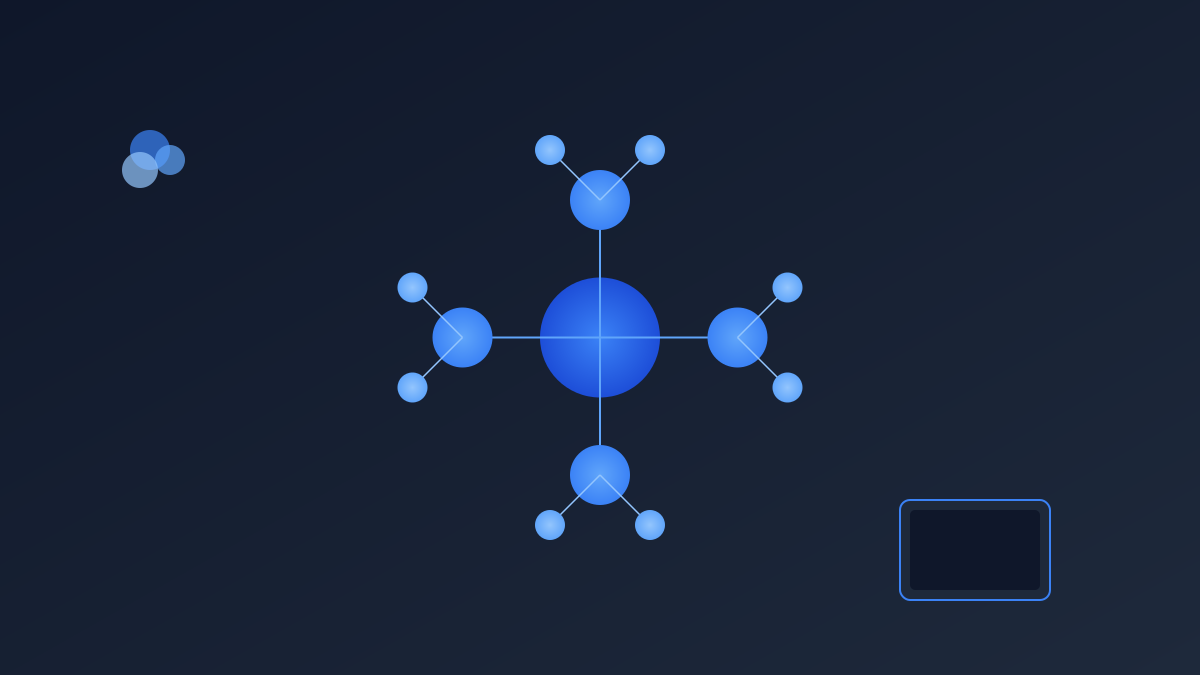
  • Recursive Unit: Supports dynamic recursive calls; when processing nested structures, inner layers are delegated as subproblems to its own instance.
  • Dynamic Computational Graph: Adaptively expands recursive levels based on input complexity.
  • Hierarchical Representation: Lower layers handle basic patterns, higher layers integrate global structures.
  • Parameter Sharing: The same parameters are recursively applied to different layers to improve efficiency.

Training Strategies

  • Curriculum Learning: Gradually increase complexity from simple recursive patterns.
  • Recursive Depth Reward: In reinforcement learning, reward correct recursion and penalize excessive or insufficient recursion.
  • Meta-Learning Module: Learn to select optimal recursive strategies for different tasks.
4

Section 04

Evidence: Excellent Performance of the Small Model in Multi-Tasks

Despite having only one-thousandth the number of parameters of large models, TinyRecursiveModels performs excellently in multiple tasks:

  • Mathematical Reasoning: Accuracy on multi-step deduction problems is close to or exceeds that of larger models.
  • Logical Reasoning: Understands nested quantifiers and complex implication relationships.
  • Program Analysis: Handles nested control structures and recursive functions.
  • Language Understanding: Understands complex discourse structures and long-distance anaphora.
5

Section 05

Efficiency Advantages: Possibility of Edge Deployment

The 7-million-parameter model has significant efficiency advantages:

  • Inference Speed: Real-time inference on CPU without the need for GPU.
  • Memory Usage: Extremely small, suitable for resource-constrained environments (IoT, embedded systems).
  • Training Cost: Reproducible on consumer-grade hardware, lowering the research threshold.
  • Energy Efficiency: Low power consumption, suitable for battery-powered devices.
6

Section 06

Conclusion: Another Path to Intelligence and Implications for Sustainable Development

TinyRecursiveModels demonstrates an AI development path where architectural innovation replaces scale expansion, alleviating problems of development costs, environmental costs, and social concentration, and promoting academic democratization. It suggests that AI research should shift to understanding the essential mechanisms of intelligence rather than blindly pursuing scale.

7

Section 07

Limitations and Future Research Directions

Limitations

  • Task Specificity: Optimized for recursive reasoning tasks, still inferior to large models in world knowledge-related tasks.
  • Recursive Depth Limitation: Actual reasoning is constrained by maximum depth; excessive depth easily leads to gradient vanishing.
  • Generalization Ability: Out-of-distribution generalization needs further verification.

Future Directions

  • Hybrid architecture design (e.g., combining with Transformer).
  • Adaptive recursive depth control.
  • Multimodal recursive reasoning.
  • Applying recursive ideas to larger models to improve efficiency.

