Zing Forum

Reading

Three-Step Nav: A Three-Step Visual Navigation Method to Keep Large Models from Getting Lost

Vision-and-Language Navigation (VLN) agents driven by multimodal large models often face issues like route deviation and early stopping. Three-Step Nav proposes a three-step protocol of "Look Ahead - Look Now - Look Back", achieving state-of-the-art zero-shot performance without fine-tuning.

视觉语言导航多模态大模型零样本学习具身智能机器人导航空间推理
Published 2026-04-30 01:55Recent activity 2026-04-30 10:30Estimated read 5 min
Three-Step Nav: A Three-Step Visual Navigation Method to Keep Large Models from Getting Lost
1

Section 01

[Introduction] Three-Step Nav: A Three-Step Navigation Method to Solve Large Model Visual Navigation Challenges

Multimodal large model-driven Vision-and-Language Navigation (VLN) agents often encounter problems such as route deviation and early stopping. Three-Step Nav proposes a three-step protocol of "Look Ahead - Look Now - Look Back", achieving optimal zero-shot performance without fine-tuning, effectively addressing the core pain points of existing VLN agents.


2

Section 02

Real-World Dilemmas of VLN and Limitations of Existing MLLM Applications

Vision-and-Language Navigation is a challenging task in the field of embodied intelligence, requiring collaboration between multiple abilities like language understanding and visual perception. Multimodal Large Language Models (MLLMs) have brought new hope to VLN, but current zero-shot VLN agents have three major issues: easy route deviation, early stopping, and low success rates. The root cause lies in MLLMs' lack of targeted modeling for navigation-specific risks (such as cumulative drift and target confusion).

3

Section 03

Core Insight of Three-Step Nav: From Human Navigation to Three-Step Protocol

Most existing VLN methods adopt a short-sighted "single-frame decision" strategy, which struggles to handle long-range dependencies. Inspired by human navigation (global planning → local alignment → drift correction), Three-Step Nav formalizes it into a three-step protocol of "Look Ahead - Look Now - Look Back" to solve long-range decision-making problems.

4

Section 04

Detailed Design of the Three-Step Protocol: Global Planning, Local Alignment, and Drift Correction

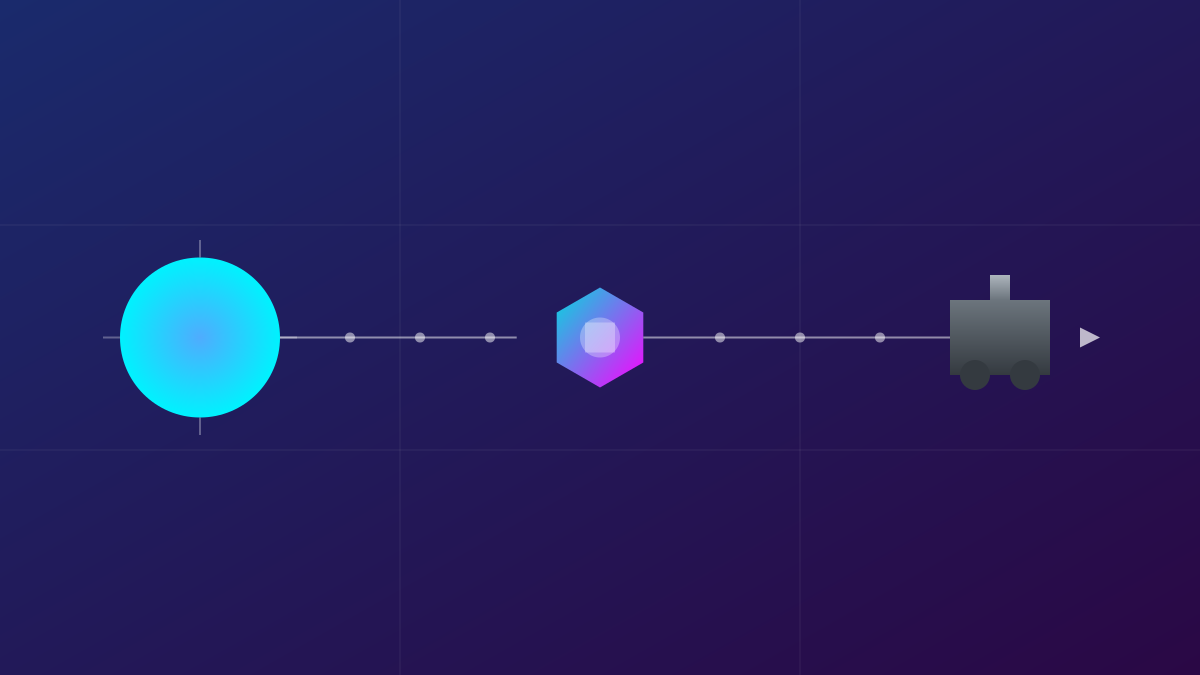
  1. Look Ahead: Extract key landmarks, build a coarse-grained global plan, and establish global anchors to avoid local disorientation; 2. Look Now: Align current observations with the next sub-goal, making context-aware local decisions based on the global plan; 3. Look Back: Review the trajectory before stopping to check if the target is reached, suppressing early stopping errors.
5

Section 05

Zero-Shot Advantages and Plug-and-Play Features

Three-Step Nav does not require fine-tuning or gradient updates and can be plug-and-play integrated into existing VLN pipelines. It taps into the potential of off-the-shelf MLLMs through prompt engineering and structured reasoning, avoiding expensive data annotation and model training costs, and adapting to diverse VLN task scenarios.

6

Section 06

Experimental Validation: State-of-the-Art Zero-Shot Performance on Two Datasets

Three-Step Nav was evaluated on the R2R-CE (English) and RxR-CE (multilingual) continuous environment datasets. Metrics like success rate, SPL (Success weighted by Path Length), and navigation error comprehensively outperformed previous zero-shot methods, with some metrics approaching supervised learning methods, verifying the effectiveness of the three-step protocol.

7

Section 07

Technical Insights and Future Directions

Insights: Pure prompt engineering + structured reasoning can significantly improve the performance of large models on specific tasks; the three-step paradigm can be extended to long-range decision-making tasks (e.g., robot manipulation). Future directions: Online learning for adaptive landmark extraction, explicit spatial memory modules, multi-agent collaboration. The open-source code (https://github.com/ZoeyZheng0/3-step-Nav) lowers the threshold for implementation.

