Zing Forum

Reading

thrashl: A Control Layer for Agent Workflows to Reduce Oscillations and Improve Signal-to-Noise Ratio

thrashl is a control layer framework focused on optimizing the stability of AI Agent workflows. It reduces invalid oscillations during Agent execution and improves task completion quality and efficiency through state management, execution strategies, and feedback mechanisms.

Agent工作流AI Agent工作流控制LLM应用任务稳定性开源项目执行优化状态管理
Published 2026-05-23 04:15Recent activity 2026-05-23 04:21Estimated read 6 min
thrashl: A Control Layer for Agent Workflows to Reduce Oscillations and Improve Signal-to-Noise Ratio
1

Section 01

Introduction: thrashl — A Stability Control Layer for Agent Workflows

thrashl is a control layer framework focused on optimizing the stability of AI Agent workflows. It aims to reduce invalid oscillations during Agent execution and improve task completion quality and efficiency through state management, execution strategies, and feedback mechanisms. This article will cover its background, methods, applications, and other aspects.


2

Section 02

Background: Core Pain Point of Agent Workflows — Execution Instability

Current AI Agent systems based on large language models are evolving toward complex workflows, but execution instability issues are prominent. "Oscillation" refers to Agents repeatedly jumping between multiple states without convergence, manifesting as repeated content modifications, wavering plans, cyclic progression, etc. This wastes computing resources and seriously affects user experience and task success rates. thrashl addresses this pain point by building a control layer to enhance stability.

3

Section 03

Methodology: Definition and Core Responsibilities of the Agent Control Layer

The control layer is an intermediate layer (between LLM reasoning and tool execution layers) that coordinates component execution order and manages state transitions. Its core responsibilities include: execution planning (decomposing high-level tasks into sub-task sequences), state tracking (maintaining a task execution state machine), decision arbitration (selecting the optimal next action), and convergence detection (identifying and terminating meaningless oscillations).

4

Section 04

Methodology: Core Mechanisms to Reduce Oscillations

thrashl reduces oscillations through the following mechanisms: 1. Intent stability detection (tracking intent changes and intervening in frequent modifications); 2. Execution path memory (caching tried paths and prompting for repeated operations); 3. Signal strength evaluation (marking low-contribution operations and requiring value explanation); 4. Progressive commitment (higher threshold for modifying partially submitted decisions).

5

Section 05

Methodology: Architectural Design and Core Modules of thrashl

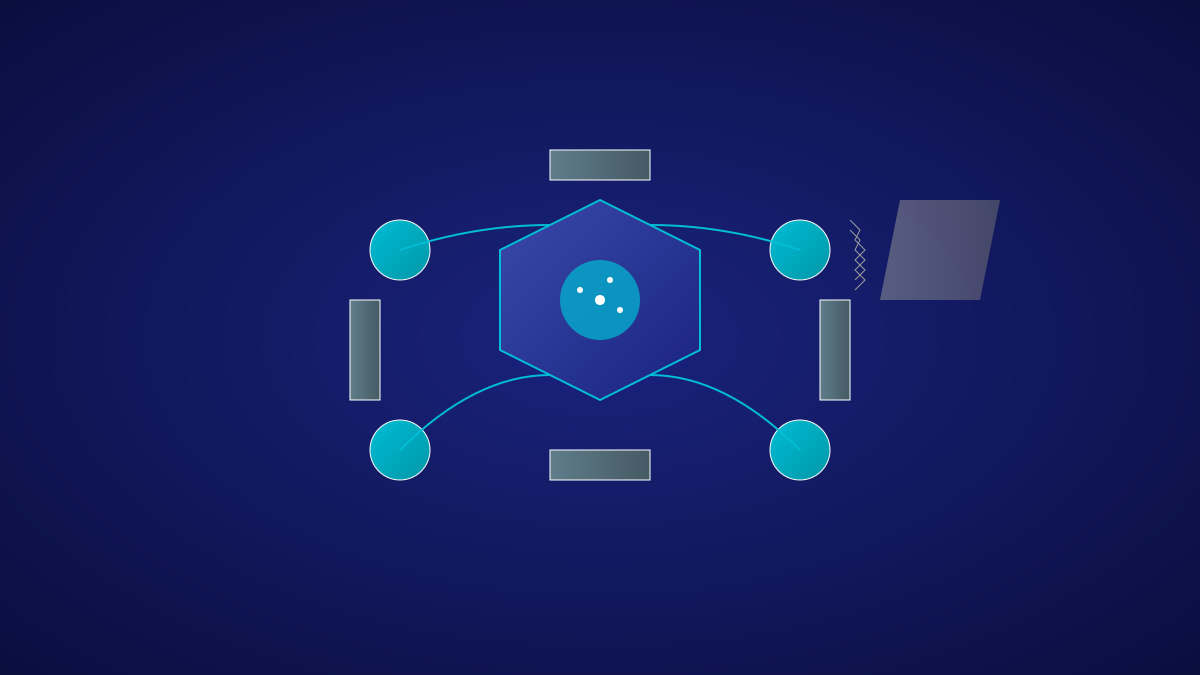
It adopts a layered architecture with core modules including: Workflow Engine (task lifecycle management, supporting multiple execution modes), State Manager (maintaining state and persistence to ensure context recovery), Policy Evaluator (assessing execution health and intervening in oscillation risks), and Feedback Loop (collecting results to update strategies and continuously optimize recognition capabilities).

6

Section 06

Evidence: Practical Application Value and Typical Scenarios of thrashl

It improves reliability in multiple scenarios: Code generation Agents (avoid repeated modifications and improve coherence); Data analysis Agents (prevent loops and ensure convergence to reports); Multi-tool coordination Agents (detect invalid call sequences); Long-conversation Agents (maintain context coherence and prevent drift).

7

Section 07

Discussion: Technical Challenges and the Trade-off Between Stability and Creativity

The core challenge is balancing stability and creativity—excessive control stifles innovation. thrashl adjusts control intensity via configurable parameters (e.g., strict for medical/financial scenarios, loose for creative ones); another challenge is the trade-off between latency and quality, mitigated through optimizations like asynchronous evaluation.

8

Section 08

Conclusion: The Key to Agent System Engineering — The Value of the Control Layer

thrashl reveals that Agents require engineering capabilities to move from prototype to production, and the control layer is key infrastructure. It can collaborate with existing frameworks (e.g., LangChain) to provide progressive enhancement. The layered architecture improves stability and also provides an engineering foundation for monitoring, debugging, and optimization.

