Zing Forum

Reading

TensorRT-LLM MoE Inference Optimization: A New Approach to KV Cache Scheduling

This article introduces a TensorRT-LLM runtime patch for Mixture-of-Experts (MoE) models, which improves large model inference efficiency through an MoE structure-aware KV cache scheduling strategy.

TensorRT-LLMMoE模型混合专家KV缓存推理优化大模型部署GPU加速
Published 2026-04-26 00:41Recent activity 2026-04-26 00:51Estimated read 6 min
TensorRT-LLM MoE Inference Optimization: A New Approach to KV Cache Scheduling
1

Section 01

TensorRT-LLM MoE Inference Optimization: Introduction to the New KV Cache Scheduling Approach

This article introduces trtllm-moe-kv-scheduler, a TensorRT-LLM runtime patch for Mixture-of-Experts (MoE) models. This patch addresses cache management challenges in MoE model inference and improves large model inference efficiency through an MoE structure-aware KV cache scheduling strategy. Key ideas include routing-aware cache allocation, expert-level reuse, and dynamic load balancing.


2

Section 02

Inference Challenges of MoE Models

Mixture-of-Experts (MoE) models are an important path for scaling large language models, achieving a balance between performance and efficiency through sparse activation. However, MoE inference faces unique challenges: activating only a subset of experts per layer leads to irregular memory access and dynamic computational load; KV cache management during inference is complex as different tokens are routed to different expert combinations, and existing engines have limited support for MoE's special patterns.

3

Section 03

Current Status and Limitations of MoE Support in TensorRT-LLM

TensorRT-LLM is a high-performance inference framework launched by NVIDIA, which already supports basic MoE model functions. However, KV cache scheduling does not fully consider MoE routing characteristics, leading to issues such as low cache hit rates, memory fragmentation, reduced batch processing efficiency, and unbalanced expert loading.

4

Section 04

Core Innovations of trtllm-moe-kv-scheduler

This patch introduces an MoE-aware KV cache scheduling mechanism with core innovations including:

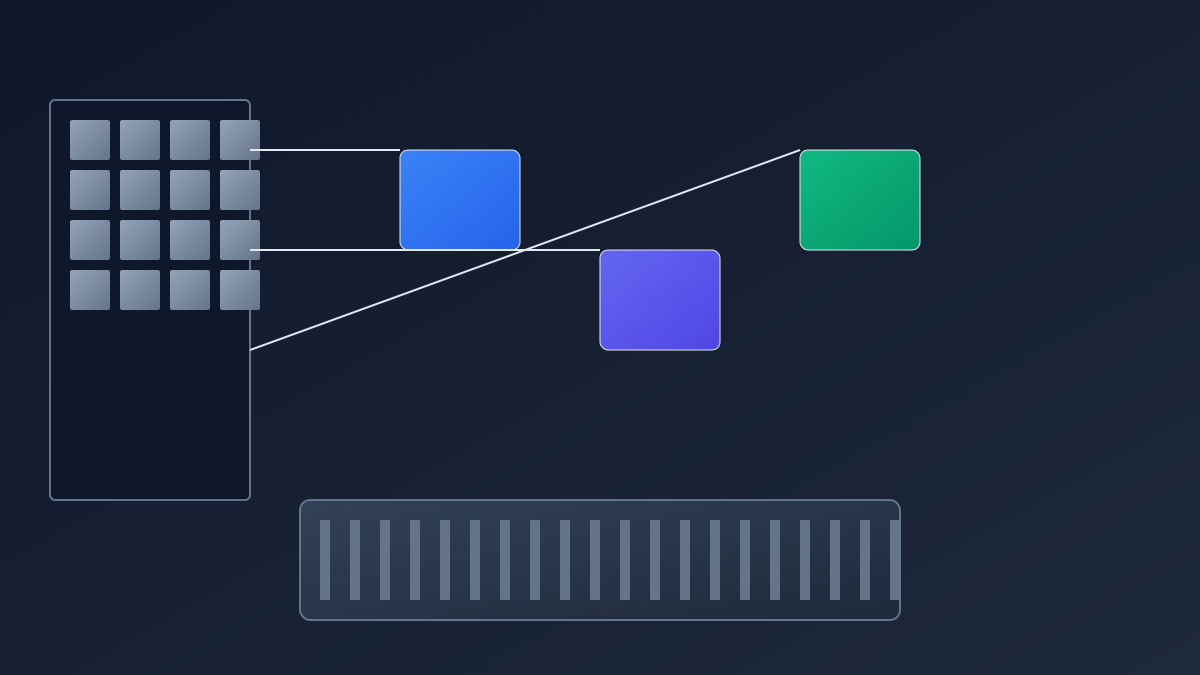
  1. Routing-aware cache allocation: Combines expert routing prediction to reduce dynamic memory adjustment overhead;
  2. Expert-level cache reuse: KV values of the same expert can be reused across requests to avoid redundant computation;
  3. Dynamic load balancing: Monitors expert access frequency and cache hit rates to adjust cache allocation strategies.
5

Section 05

Technical Implementation Details

The project is implemented as a runtime patch without modifying the TensorRT-LLM source code, offering advantages such as low invasiveness, rollback capability, and version compatibility. Key modifications to the KV cache manager logic include:

  • Cache allocator: Extends interfaces to support expert preference hints;
  • Cache pool: Organizes expert-aware cache blocks to support cross-request sharing;
  • Scheduler: Integrates routing prediction and load monitoring to optimize scheduling decisions.
6

Section 06

Performance Benefit Analysis

Based on design principles, the patch is expected to bring the following benefits:

  • Latency optimization: Improves cache hit rates and reduces HBM read times;
  • Throughput improvement: Better cache reuse supports larger batch sizes and reduces memory fragmentation;
  • Memory efficiency: Expert-level cache sharing reduces overall memory usage, enabling larger models or longer contexts.
7

Section 07

Application Scenarios and Deployment Considerations

Applicable scenarios: High-concurrency services, long-context processing, MoE models with a large number of experts; Inapplicable scenarios: Single-user, short-sequence, low-concurrency scenarios; Deployment notes: Must match the TensorRT-LLM version, conduct sufficient testing before production, and add monitoring for metrics such as cache hit rate and expert load.

8

Section 08

Conclusion and Future Outlook

trtllm-moe-kv-scheduler addresses key pain points in MoE inference optimization and demonstrates community innovation value. Future expansion directions include: supporting fine-grained expert grouping, integrating quantization techniques, combining with speculative decoding, and extending to multi-GPU scenarios.

