Zing Forum

Reading

Synthex: Dual-stream Inference Pipeline Enables Model-agnostic AI Reasoning Enhancement

This article introduces the Synthex project, an innovative dual-stream inference pipeline that achieves model-agnostic AI reasoning enhancement through parallel tokenization and reasoning paths, combined with cross-stream consistency fusion technology, supporting Claude, GPT, and local models.

双流推理模型融合AI推理模型无关ClaudeGPT一致性融合推理增强
Published 2026-04-09 22:11Recent activity 2026-04-09 22:23Estimated read 6 min
Synthex: Dual-stream Inference Pipeline Enables Model-agnostic AI Reasoning Enhancement
1

Section 01

Introduction: Synthex Dual-stream Inference Pipeline—A Model-agnostic AI Reasoning Enhancement Solution

This article introduces the Synthex project, an innovative dual-stream inference pipeline architecture that achieves model-agnostic AI reasoning enhancement through parallel tokenization and reasoning paths, combined with cross-stream consistency fusion technology. This solution is compatible with commercial models like Claude and GPT as well as local open-source models, providing new ideas for improving reasoning quality and reliability.


2

Section 02

Technical Background: Existing Problems and Improvement Directions of Large Language Model Reasoning

Large language model reasoning has three major problems: insufficient consistency (different results from the same prompt executed multiple times), limited reasoning depth (prone to errors in complex multi-step reasoning), and poor interpretability (black-box thinking process). Existing improvement methods include prompt engineering (e.g., Chain of Thought), integration methods (multi-model output aggregation), and post-processing techniques. Synthex's dual-stream architecture is an innovative variant of integration methods, emphasizing real-time fusion rather than just post-output aggregation.

3

Section 03

Core Methods: Dual-stream Inference Pipeline and Cross-stream Fusion Mechanism

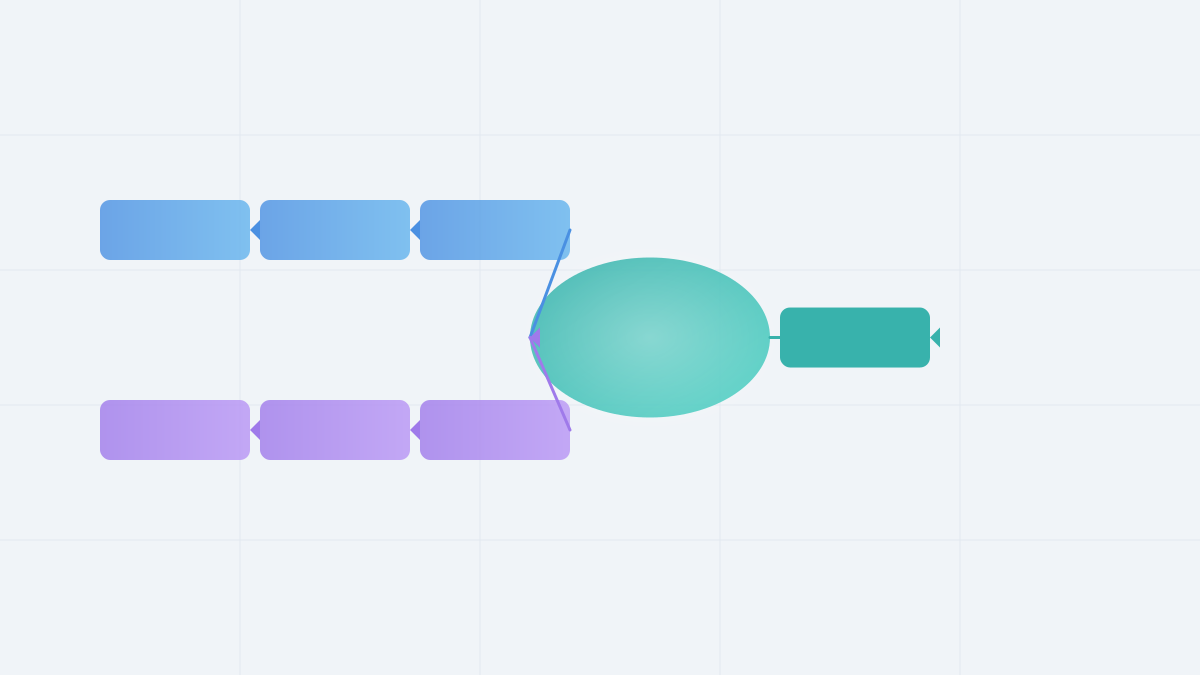
The core innovation of Synthex is its dual-stream design: running two processing streams in parallel (with different parameters/models/prompt strategies) to capture diverse reasoning perspectives. The key lies in cross-stream consistency fusion: interaction at intermediate stages, where consensus enhances confidence and divergence triggers verification. Model agnosticism is achieved through a unified interface abstraction layer, adapting to API differences and characteristics of different models (GPT/Claude/local open-source). Parallel tokenization needs to solve alignment (semantic or positional) and synchronization (adaptive strategy) issues. The fusion mechanism is designed from semantic, structural, and confidence dimensions, dynamically selecting fusion timing, and adopting strategies like arbitration/weighting/re-reasoning in case of conflicts.

4

Section 04

Application Scenarios: Suitable Domains for the Dual-stream Architecture

The dual-stream inference architecture is suitable for: cross-validation in high-reliability scenarios (medical diagnosis, legal analysis, financial risk control); multi-path exploration for complex reasoning tasks (mathematical problem-solving, logical puzzles, multi-step planning); multi-angle combination for creative generation; real-time comparison for model comparison and A/B testing.

5

Section 05

Performance Efficiency and Implementation Challenges

The dual-stream architecture has computational overhead; optimization strategies include asynchronous parallel execution, early termination (ending early when there is high-confidence consensus), incremental fusion, dynamic resource allocation, and cache reuse. Implementation challenges include stream synchronization complexity, single-stream failure handling (graceful degradation), observability (trajectory recording), and configuration management (multi-parameter adjustment), with corresponding solutions such as health checks, automatic recovery, and visual analysis.

6

Section 06

Future Outlook and Summary

Future directions for Synthex: expanding to multi-stream architecture (adaptive number), learning to optimize fusion strategies (reinforcement learning), domain specialization (e.g., code generation), and hardware acceleration. Summary: Synthex provides model-agnostic reasoning enhancement through a dual-stream pipeline; cross-stream fusion ensures reliability. Although there is overhead, it is valuable in high-reliability scenarios and provides an innovative solution for reasoning optimization.

