Zing Forum

Reading

Svvy: An Intelligent Agent Programming Workbench for Bounded Workflows

Svvy is a strategic programming workbench designed to guide and orchestrate bounded, workflow-based agent tasks, providing a structured framework for AI agent development.

AI代理工作流编排LLM应用编程工作台自动化软件工程人工智能开发
Published 2026-05-16 04:43Recent activity 2026-05-16 04:48Estimated read 7 min
Svvy: An Intelligent Agent Programming Workbench for Bounded Workflows
1

Section 01

Svvy: An Intelligent Agent Programming Workbench for Bounded Workflows (Introduction)

Svvy: An Intelligent Agent Programming Workbench for Bounded Workflows (Introduction)

Svvy is a strategic programming workbench designed to guide and orchestrate bounded, workflow-based agent tasks. It aims to address core engineering challenges in AI agent development—ensuring the predictability of agent behavior, and balancing the open capabilities of LLMs with the requirements of deterministic software systems. Its core concept is workflow-driven agent orchestration, providing a structured framework for AI agent development that balances flexibility and determinism.


2

Section 02

Engineering Challenges in Agent Development (Background)

Engineering Challenges in Agent Development (Background)

With the rapid advancement of LLM capabilities, AI agents have become a new paradigm in software development, but they face unique engineering challenges: How to ensure the predictability of agent behavior? How to balance the open capabilities of LLMs with the needs of deterministic software systems? These questions led to the birth of the Svvy project.

3

Section 03

Core Concepts and Technical Architecture (Methodology)

Core Concepts and Technical Architecture (Methodology)

Core Concepts

Svvy's core concept is to workflow-ize agents, bringing four key advantages:

  • Predictability: Enhance the predictability of agent behavior by clearly defining workflow stages and state transitions;
  • Debuggability: The workflow structure provides clear checkpoints for easy problem localization;
  • Composability: Decompose complex tasks into reusable components for easy maintenance and expansion;
  • Human-Agent Collaboration: Pause at key nodes to wait for human confirmation.

Technical Architecture

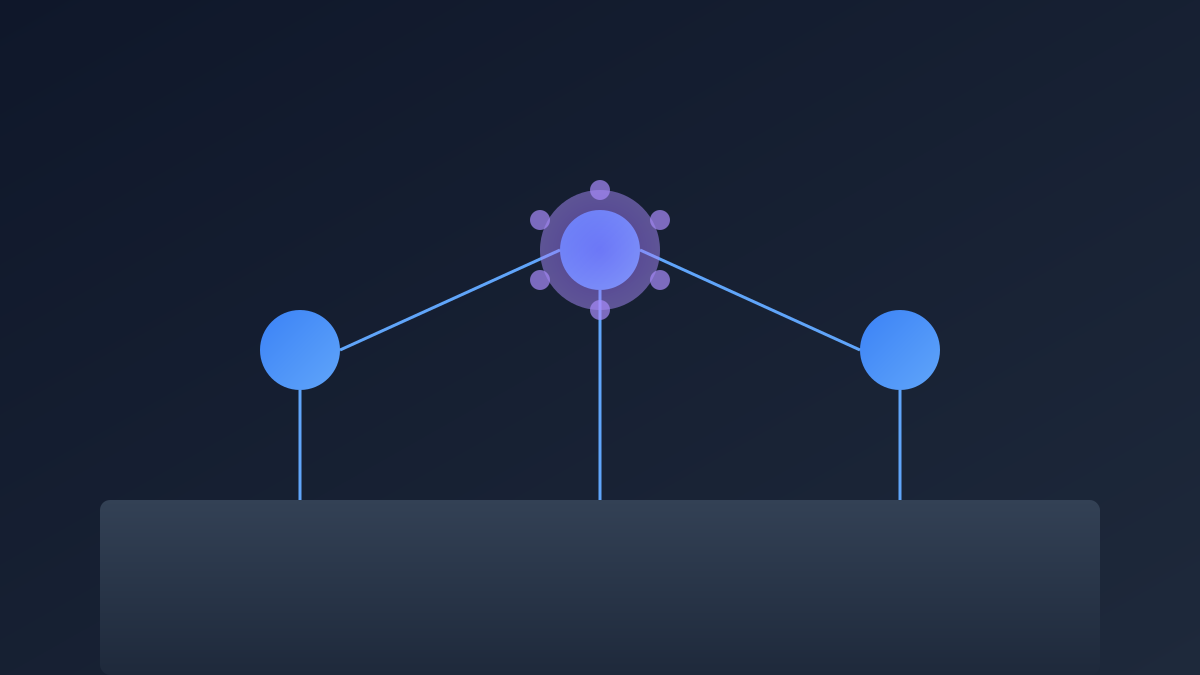
  • Bottom Layer: The workflow engine manages the agent lifecycle, supports patterns like state machines and conditional branches, and nodes can include LLM calls;
  • Orchestration Layer: Provides tools to define agent strategies (rules, example learning, or dynamic strategies);
  • Interface Layer: Supports integration with existing IDEs and other development toolchains to lower the barrier to use.
4

Section 04

Application Scenarios and Technical Comparison (Evidence)

Application Scenarios and Technical Comparison (Evidence)

Application Scenarios

Svvy is suitable for:

  • Enterprise automation processes (high compliance requirements);
  • Multi-step research tasks (academic, market analysis, etc.);
  • Customer service automation (handling edge cases);
  • Content review and quality control (automatic routing + review history).

Technical Comparison

  • vs. LangChain: Svvy places more emphasis on boundedness and workflow structure, providing a more opinionated framework;
  • vs. AutoGPT: Svvy focuses on bounded work, while AutoGPT pursues maximum autonomy;
  • vs. Traditional RPA: Svvy integrates LLM cognitive capabilities, filling the gap in unstructured data processing.
5

Section 05

Development Experience Design

Development Experience Design

Svvy's development experience designed for engineers:

  • Code-First: Configuration definitions are done via code, supporting software engineering practices like version control and code review;
  • Progressive Adoption: Start with simple workflows and gradually increase complexity;
  • Ecosystem Integration: Integrate with popular LLM providers, vector databases, monitoring tools, etc., to avoid ecosystem silos.
6

Section 06

Limitations and Future Directions

Limitations and Future Directions

Limitations

  • Learning Curve: Developers need to adapt to the workflow-driven model;
  • Ecosystem Maturity: Compared to LangChain and others, the ecosystem is in the early stage;
  • Performance Optimization: The latency issue from combining workflow engines with LLM calls needs to be resolved.

Future Directions

  • More powerful visual debugging tools;
  • More abundant pre-built workflow templates;
  • Deep integration with more enterprise systems;
  • Support for multi-agent collaboration scenarios.
7

Section 07

Conclusion

Conclusion

Svvy represents an important exploration direction in the field of AI agent development—embracing LLM capabilities while maintaining the predictability and maintainability of software systems. Its 'bounded workflow' concept provides a pragmatic middle path for agent applications in production environments, which is worth considering for AI agent developers and technical decision-makers.

