Zing Forum

Reading

Supermanual: Reverse-Engineering Undocumented Codebases with AI Agent Clusters

Explore how the Supermanual project uses a hybrid dual-model architecture and 11 parallel agents to enable automated code reverse analysis and high-quality documentation generation, addressing the documentation gap in technical debt.

AI智能体集群代码逆向工程文档生成Gemini静态分析技术债务软件考古
Published 2026-06-03 21:34Recent activity 2026-06-03 21:52Estimated read 7 min
Supermanual: Reverse-Engineering Undocumented Codebases with AI Agent Clusters
1

Section 01

Supermanual Project Guide: AI Agent Clusters Solve Reverse-Engineering Challenges for Undocumented Codebases

Core Overview of the Supermanual Project

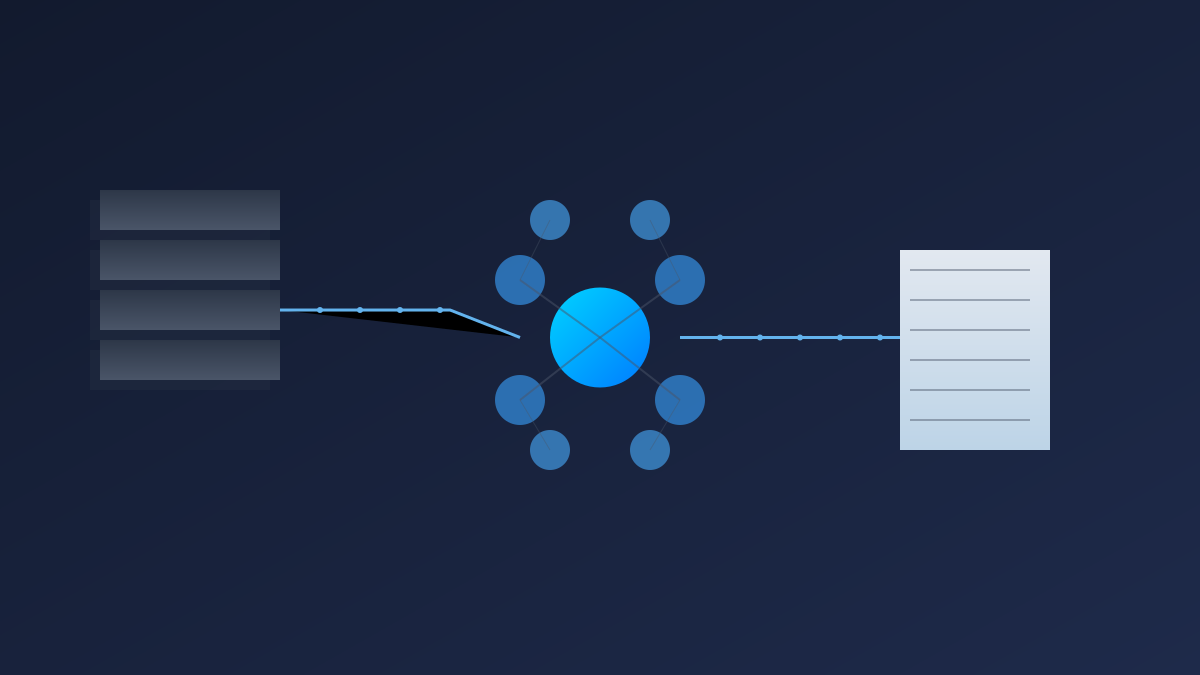
Project Name: Supermanual Core Objective: Use AI agent clusters to achieve automated reverse engineering of undocumented codebases and generate high-quality documentation, addressing the documentation gap in technical debt. Project Source: Original author/maintainer is perkinswdavid-a11y, released on GitHub (link: https://github.com/perkinswdavid-a11y/supermanual) on June 3, 2026. Core Innovation: Adopts a hybrid dual-model architecture (Gemini 3.1 Pro deep reasoning hub + 11 Gemini 2.5 Flash parallel analysis agents) to collaboratively complete complex code understanding tasks.


2

Section 02

Background: Technical Reality of Documentation Debt

In software development, it's common for code evolution to outpace documentation updates. According to GitHub statistics, over 80% of open-source projects lack complete documentation, and the situation is even more severe for enterprise internal legacy systems. When core developers leave or codebases age, understanding system behavior becomes a huge cognitive burden. Traditional manual reverse engineering is time-consuming and labor-intensive, while automated tools can only generate surface-level API documentation and struggle to capture design intent and business logic.

3

Section 03

Methodology: Hybrid Dual-Model Architecture Design

Supermanual uses a hybrid dual-model architecture of "one heavy, multiple light" to fully leverage the advantages of models of different scales:

  1. Gemini 3.1 Pro (Deep Reasoning Hub):Responsible for architecture pattern recognition, business logic inference, dependency analysis, and documentation structure planning;
  2. 11 Gemini 2.5 Flash (Parallel Static Analysis Engines):Process in parallel by module:
    • Agents 1-3: Function-level analysis (signature, parameters, return values, etc.)
    • Agents 4-5: Class and object analysis (inheritance, composition, state management)
    • Agents 6-7: Data flow analysis (variable lifecycle, data transformation)
    • Agents 8-9: Control flow analysis (branches, loops, asynchronous processes)
    • Agent 10: External dependency analysis (third-party libraries, API calls)
    • Agent 11: Test and example analysis (infer expected behavior from test cases) This architecture balances analysis depth and processing speed.
4

Section 04

Methodology: Deterministic State Management Mechanism

To ensure fault tolerance and reproducibility of production-level systems, Supermanual implements the following mechanisms:

  • State Snapshots: Save complete state snapshots at each analysis stage; recovery from the latest snapshot is possible in case of failure;
  • Task Queue and Retry: Fine-grained tasks enter a priority queue and are retried automatically on failure (supports exponential backoff and model downgrade strategies);
  • Idempotency Guarantee: All analysis operations are designed to be idempotent—repeating the same input produces the same output, supporting safe retries and audits.
5

Section 05

Methodology: Self-Assessment Quality Gates Ensure Documentation Credibility

Supermanual introduces a multi-layer self-assessment mechanism to ensure documentation quality:

  • Consistency Check: Cross-validate results from different agents, verify the existence of code referenced in documentation, and check type consistency;
  • Completeness Evaluation: Calculate the coverage of documented code and distinguish documentation depth (API-only vs. including examples and design explanations);
  • Confidence Annotation: Attach a confidence score to each section of documentation; low-confidence content is marked as "speculative" and prompts manual review.
6

Section 06

Application Scenarios and Value

Supermanual applies to multiple scenarios:

  • Legacy System Modernization: Generate basic documentation for old codebases to reduce refactoring risks;
  • Open-Source Project Maintenance: Assist in understanding community-contributed code and accelerate PR reviews;
  • Compliance Auditing: Generate system documentation and interface descriptions that meet regulatory requirements;
  • Team Knowledge Transfer: Quickly extract implicit knowledge from core developers.
7

Section 07

Conclusion: A New Paradigm for AI-Assisted Software Engineering

Supermanual represents a new direction for AI applications in software engineering—enhancing humans' ability to understand complex systems rather than replacing developers. The agent cluster architecture combines large-model reasoning capabilities with engineering practice needs (fault tolerance, observability). As codebase sizes grow, such automated understanding tools will become standard equipment for development teams.

