Zing Forum

Reading

StudyMate: An Intelligent Learning Assistant and Quiz Generation System Based on RAG Technology

Dive deep into StudyMate—a full-stack RAG application built with Next.js 16, FastAPI, Qdrant, and Google Gemini API, enabling hallucination-free academic Q&A, automatic summarization, and structured quiz generation.

RAG检索增强生成教育技术Next.jsFastAPIQdrantGeminiPDF处理智能问答测验生成
Published 2026-06-14 05:44Recent activity 2026-06-14 05:55Estimated read 7 min
StudyMate: An Intelligent Learning Assistant and Quiz Generation System Based on RAG Technology
1

Section 01

StudyMate: Core Guide to the RAG-Based Intelligent Learning Assistant

Core Overview of StudyMate

StudyMate is a full-stack RAG application developed by Ekwem Kamsiyochukwu Fredrick (Fortexfreddie), released on June 13, 2026 (GitHub link: https://github.com/Fortexfreddie/StudyMate), affiliated with the Federal University of Technology, Owerri. Its core features include: intelligent Q&A based on uploaded PDFs, automatic summarization, structured quiz creation, and document management. It uses RAG technology to ensure all AI-generated content is based on user documents, avoiding hallucination issues. The tech stack includes Next.js 16 (frontend), FastAPI (backend), Qdrant (vector database), and Google Gemini API (large language model).


2

Section 02

Background: The Need for Intelligent Transformation in Educational Technology

Pain Points and Needs in Educational Technology

With the popularization of digital learning, students face the challenge of information overload, and traditional static PDF materials are difficult to interact with AI tools. How to transform massive learning materials into an intelligent, interactive knowledge base has become a key issue in the field of educational technology. StudyMate addresses this pain point by enabling deep interaction between students and PDF lecture notes through RAG technology, solving the AI hallucination problem.

3

Section 03

In-depth Analysis of Technical Architecture

Components of the Technical Architecture

  • Frontend: Based on Next.js 16, supporting server-side rendering (SSR), App Router route management, API routes, and TypeScript type safety.
  • Backend: Uses FastAPI framework, with asynchronous processing, automatic OpenAPI documentation generation, Pydantic type validation, and Python ecosystem integration capabilities.
  • Vector Database: Qdrant is responsible for storing semantic embedding vectors of document fragments, performing cosine similarity searches, and approximate nearest neighbor (ANN) queries.
  • Large Language Model: Integrates Google Gemini API for understanding user intent and generating answers/summaries/quiz questions.
4

Section 04

Details of RAG Implementation

RAG Process Implementation

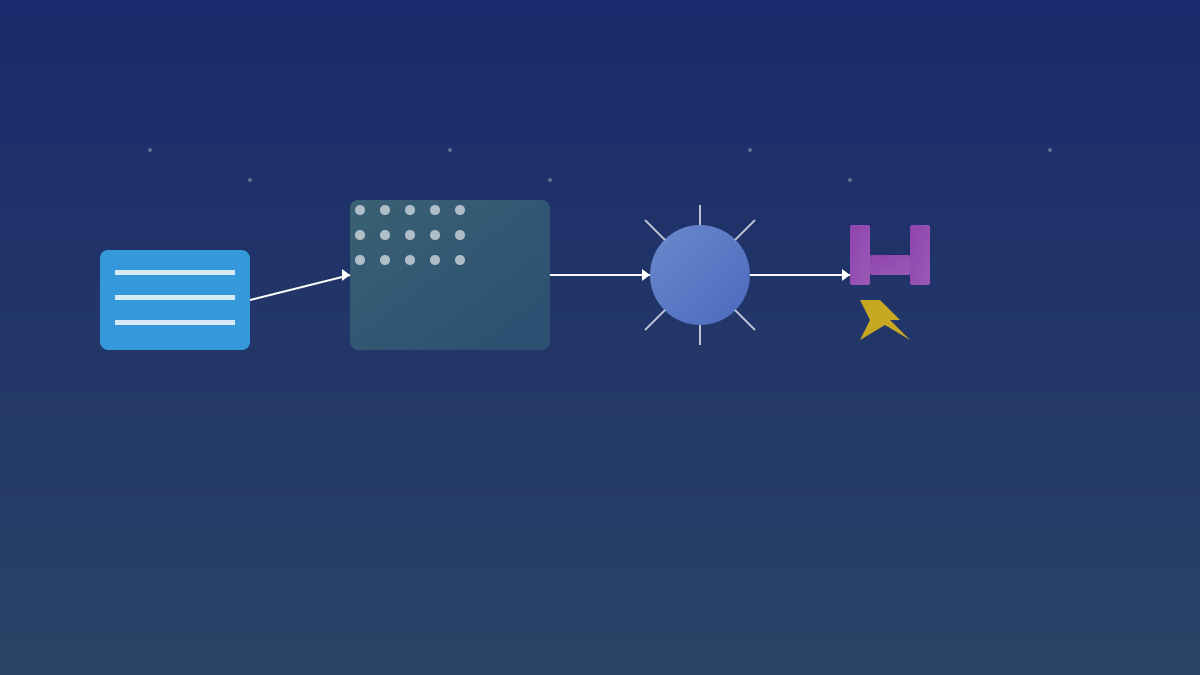
  1. Document Processing: Parse PDF text → split into ~500-word fragments → generate semantic embedding vectors → store in Qdrant.
  2. Retrieval Process: Convert user question to vector → Qdrant cosine similarity search → combine relevant fragments into context → construct prompt.
  3. Generation Process: Send prompt to Gemini API → generate content based on context → format output and add citation information.
5

Section 05

Project Status and Application Scenarios

Project Status and Application Scenarios

  • Development Phase: Phase 1 (scaffolding), Phase 2 (backend core), Phase 3 (frontend), Phase 4 (frontend-backend integration) are completed; Phase 5 (deployment) has not started.
  • Application Scenarios:
    • Students: Q&A for difficult points, quick review via summaries, quiz to test learning outcomes;
    • Teachers: Generate summaries/quizzes to save lesson preparation time, preview student questions;
    • Researchers: Literature review (based on actual paper content, no hallucinations).
6

Section 06

Technical Highlights and Future Directions

Technical Highlights and Future Directions

  • Technical Highlights: 500-word chunking balances context and semantic relevance; modern tech stack combination (Next.js+FastAPI+Qdrant+Gemini); strict RAG architecture to avoid hallucinations.
  • Future Directions: Expand multi-modal support (images/audio); add collaboration features; personalized learning recommendations; develop mobile applications.
7

Section 07

Conclusion: The Educational Technology Value of StudyMate

Conclusion

StudyMate is a typical case of the integration of educational technology and AI, demonstrating how RAG technology solves the hallucination problem of LLMs in academic scenarios. It provides an excellent reference implementation for developers, and with deployment and subsequent evolution, it is expected to become an important open-source tool in the field of educational technology.

