Zing Forum

Reading

Squad Workflows: AI Agent-Driven End-to-End Software Development Lifecycle Automation

Squad Workflows is a GitHub workflow orchestration tool for AI Agents, encapsulating the entire software development lifecycle—from requirement planning, estimation breakdown, design review to merge and release—into executable Copilot CLI commands, enabling standardization and automation of multi-Agent collaboration.

AI AgentGitHub CopilotSquad工作流自动化软件开发生命周期DevOps多 Agent 协作代码评审持续交付开源工具
Published 2026-04-30 20:44Recent activity 2026-04-30 20:48Estimated read 7 min
Squad Workflows: AI Agent-Driven End-to-End Software Development Lifecycle Automation
1

Section 01

Squad Workflows: Guide to AI Agent-Driven End-to-End Software Development Automation

Squad Workflows is a GitHub workflow orchestration tool for AI Agents, encapsulating the entire software development lifecycle (requirement planning, estimation breakdown, design review to merge and release) into executable Copilot CLI commands. It addresses the governance challenges of multi-Agent collaboration, enabling standardization and automation, and allowing AI Agents to collaborate efficiently in accordance with software engineering best practices.


2

Section 02

Background: Governance Challenges of AI Agent Collaboration

With the rise of tools like GitHub Copilot Workspace and Squad, software development is shifting to a multi-Agent collaboration paradigm. However, issues such as lack of standards and chaotic conflicts often arise when multiple Agents are involved. Traditional processes rely on human judgment and tacit understanding, but AI Agents lack implicit knowledge, requiring clear rules, verifiable checkpoints, and automated state synchronization mechanisms—these are the core problems that Squad Workflows aims to solve.

3

Section 03

Core Mechanisms and Development Phase Workflows

Development Phases

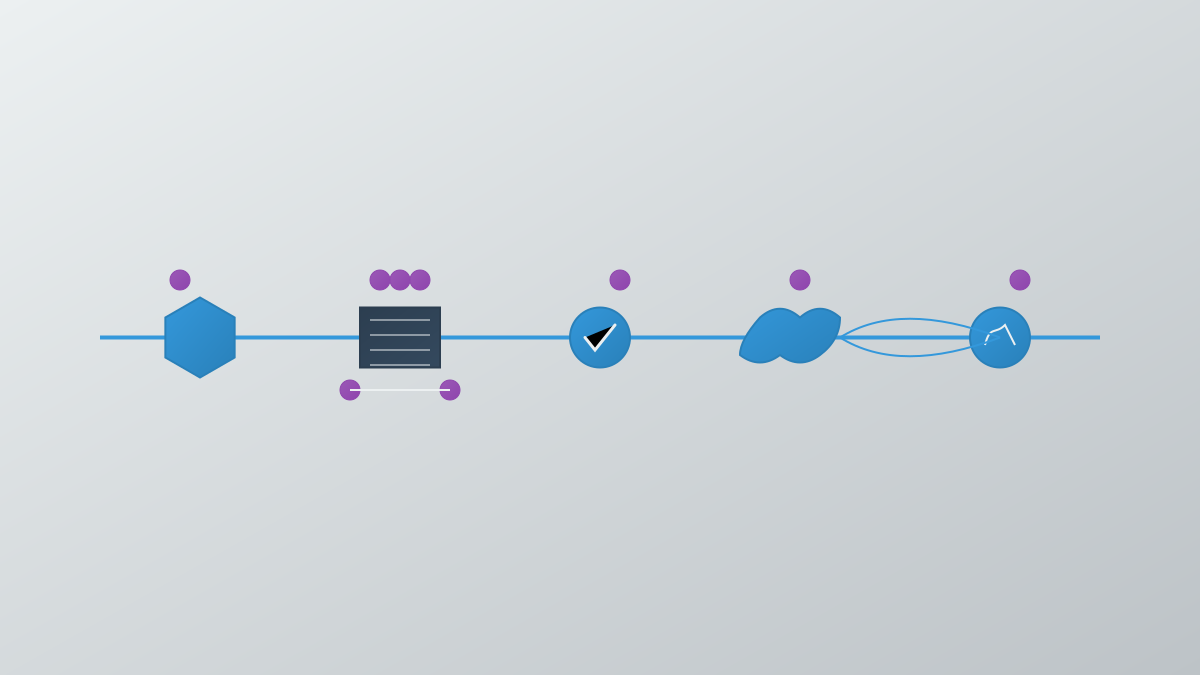
  1. Planning Phase: After an Issue is created, it automatically estimates (adds the estimate label), and large requirements are broken down into Waves (including milestones and subtasks);
  2. Design Phase: Mandatory design proposal before coding, checks for approval labels; simple tasks can skip this via Fast Lane;
  3. Review Phase: After code submission, scans for unresolved review comments and monitors CI status; only allows merging if conditions are met;
  4. Release Phase: After merging, checks Wave completion status and automatically executes version release (verifies changes, updates version, closes milestones, etc.).

Core Mechanisms

  • Wave Decomposition Model: Large features are split into independently releasable Wave units, including milestones, change sets, and demonstration standards;
  • Fast Lane: S-level small tasks or tasks with the chore-auto label skip design review;
  • Ritualized Workflows: Five key rituals—planning, design proposal, design review, PR gating, Wave completion—to standardize Agent behavior.
4

Section 04

Technical Implementation and Ecosystem Integration

Squad Workflows is distributed as an npm package (npm install -g @sabbour/squad-workflows), designed natively for GitHub (state stored in Labels/Milestones/Comments), with the configuration file at .squad/workflows/config.json (including team size, approval labels, etc.).

Synergy with the Squad ecosystem:

  • squad-identity: Robot identity governance;
  • squad-reviews: Review governance;
  • squad-workflows: Lifecycle management. The modular architecture supports on-demand integration.
5

Section 05

Practical Significance and Application Scenarios

  1. Open-source project maintenance: Automates Issue classification, PR review, and release, freeing up maintainers' energy;
  2. Enterprise AI teams: Provides compliance capabilities to meet design review, merge gating, and audit requirements in industries like finance/healthcare;
  3. Multi-Agent coordination layer: Coordinates Agents for code generation, testing, documentation, etc., avoiding conflicts and following a unified process.
6

Section 06

Limitations and Future Outlook

Limitations

  • Deeply tied to GitHub, with limited support for other platforms;
  • Wave decomposition for ultra-large projects requires more complex layering;
  • Notification and handover mechanisms need optimization when human intervention is involved.

Future Directions

  • Support for multi-platforms like GitLab, Bitbucket;
  • More intelligent automatic Wave decomposition algorithms;
  • Enhanced integration with CI/CD tools like GitHub Actions, ArgoCD;
  • Develop a visual Dashboard to monitor Agent status.
7

Section 07

Conclusion: The Next Phase of AI-Assisted Development

Squad Workflows represents the evolution of AI-assisted development from a single assistant to multi-Agent collaboration governance. It encodes software engineering best practices into machine-executable rules, enabling AI Agents to participate in development in a predictable, auditable, and scalable manner. It is not just a toolset but also a methodology, proving that AI Agents can follow standards and take responsibility. As AI capabilities grow, such workflow tools will become a development standard, marking the transition of AI-driven development from concept to practice.

