Zing Forum

Reading

SQL Report Summarizer: Automatically Convert SQL Query Results to Business Insights Using LLM

Introduces a Python open-source tool that demonstrates how to use large language models (LLMs) to automatically convert SQL query results into clear and concise business summaries, breaking down the barriers between data engineering and artificial intelligence.

SQLLLM大语言模型数据工程业务摘要自动化报告Python数据分析AI工具
Published 2026-06-02 08:42Recent activity 2026-06-02 08:48Estimated read 5 min
SQL Report Summarizer: Automatically Convert SQL Query Results to Business Insights Using LLM
1

Section 01

[Introduction] SQL Report Summarizer: Using LLM as a Bridge Between Data Engineering and Business Insights

SQL Report Summarizer Project Introduction

This project is a Python open-source tool maintained by developer Senthil2k (GitHub link: https://github.com/Senthil2k/Sql-Report-Summarizer, released on June 2, 2026). Its core function is to use large language models (LLMs) to automatically convert SQL query results into clear and concise business summaries. It aims to break down the barriers between data engineering and artificial intelligence, solving the problem that data results are difficult for business personnel to directly understand.


2

Section 02

Project Background and Motivation

Project Background and Motivation

In modern enterprises, data analysts/engineers often use SQL to obtain data, but the output table format is rigid and difficult for business personnel to understand. Traditional manual report writing is time-consuming and error-prone. With the maturity of LLM technology, this project hopes to automatically complete the conversion from data to insights through AI, building a bridge between data engineering and business decision-making.

3

Section 03

Core Working Mechanism

Core Working Mechanism

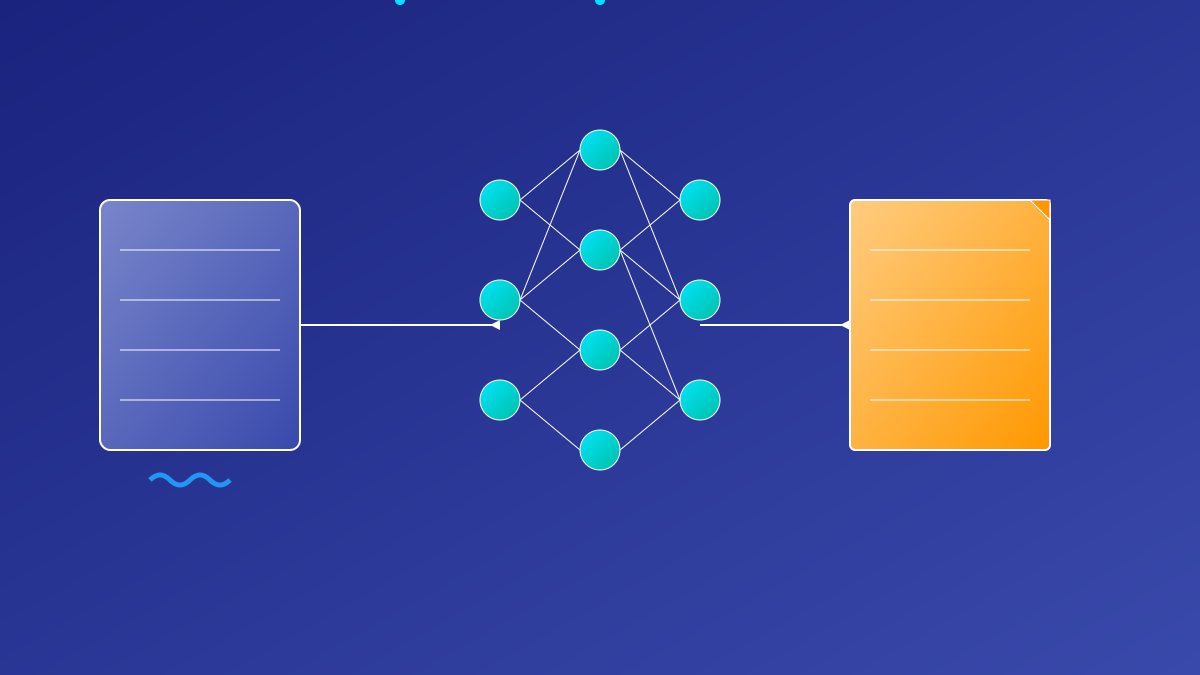
Tool workflow: 1. Connect to the database and execute SQL to get raw results; 2. Format structured data into LLM-friendly text; 3. Guide the LLM to generate natural language summaries from a business perspective through prompt engineering; 4. Output structured results (supports Markdown, plain text, JSON, etc.), with no manual intervention throughout the process.

4

Section 04

Technical Architecture and Implementation

Technical Architecture and Implementation

Built on Python with a modular design:

  1. Database connection layer: supports mainstream databases and SQL dialects;
  2. Data formatting module: handles data type conversion, structure flattening, etc.;
  3. LLM integration layer: compatible with OpenAI, Anthropic or local open-source models;
  4. Output generator: organizes LLM responses into structured formats.
5

Section 05

Application Scenarios and Value

Application Scenarios and Value

  • Data analysts: Reduce report writing time, focus on in-depth analysis;
  • Product/business personnel: No need for SQL knowledge, directly obtain business interpretations, accelerate decision-making;
  • Technical operations: Automatically monitor key indicators, generate anomaly alert summaries;
  • Management reporting: Automatically generate consistent report content.
6

Section 06

Practical Significance and Future Outlook

Practical Significance and Future Outlook

Significance: Promote the integration of data engineering and AI, let machines handle data 'translation', humans focus on high-level decision-making; promote enterprise data democratization. Outlook: Future may support multi-round conversational exploration, visual chart generation, cross-data source analysis, personalized summary customization.

7

Section 07

Project Conclusion

Project Conclusion

This project embodies the AI application innovation of the open-source community, solving the communication barrier between data and business. It is worth trying for teams that want to improve data efficiency and reduce communication costs. With the progress of LLM technology and cost reduction, such tools are expected to become standard configurations in enterprise data stacks.

