Zing Forum

Reading

Spec2TestAgent: An AI-Driven Framework from Jira Requirements to Automated Test Cases

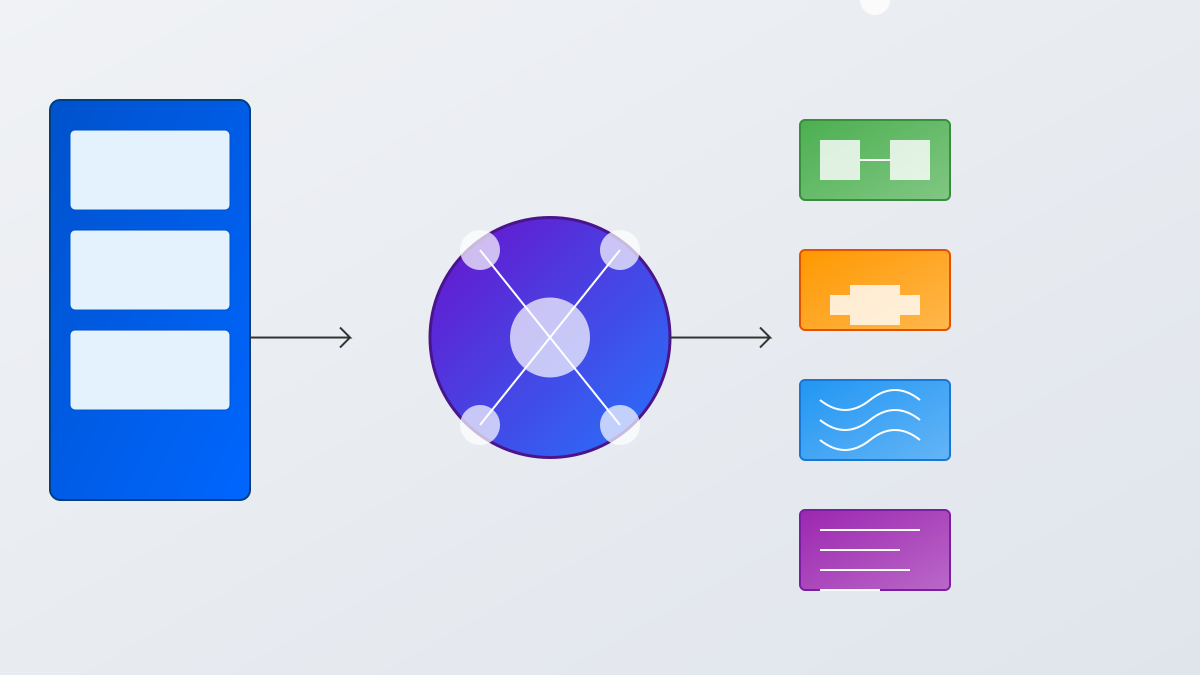
Spec2TestAgent is an enterprise-level API automation testing framework that combines Robot Framework and a data-driven architecture. It automatically generates test cases from Jira/Confluence specifications via an AI Agent while strictly adhering to the team's coding standards.

API测试Robot FrameworkAI测试生成数据驱动测试自动化测试Jira集成代码生成
Published 2026-04-03 01:45Recent activity 2026-04-03 01:53Estimated read 6 min
Spec2TestAgent: An AI-Driven Framework from Jira Requirements to Automated Test Cases
1

Section 01

[Introduction] Spec2TestAgent: AI-Driven Framework for Converting Jira Requirements to Automated Test Cases

Spec2TestAgent is an enterprise-level API automation testing framework that combines Robot Framework and a data-driven architecture. It automatically generates test cases from Jira/Confluence specifications via an AI Agent while strictly adhering to the team's coding standards. It addresses pain points such as time-consuming test case writing and maintenance, disconnect between specifications and implementation, and inconsistent coding practices.


2

Section 02

[Background] Four Core Pain Points in Test Automation

In the software development lifecycle, test case writing and maintenance face the following challenges:

  1. Scale Issue: Manual writing and maintenance are almost impossible when there are 100+ API definitions;
  2. Disconnect Between Specifications and Implementation: Test cases are hard to update promptly when requirements change;
  3. Inconsistent Coding Standards: Varying test case styles within the team increase maintenance difficulty;
  4. Repetitive Work: Manual writing of test code with similar patterns is time-wasting and error-prone.
3

Section 03

[Methodology] Architecture Design and AI Agent Workflow

Layered Architecture

  • Data Layer: Test data is stored in JSON files to separate data from logic;
  • Keyword Layer: Main keyword + sub-checker pattern for modular verification logic;
  • Test Suite Layer: Robot files serve as execution entry points, supporting data-driven testing;
  • AI Agent Layer: Five-step workflow: Read rulebook → Scan project context → Parse requirements → Generate code → Preview and confirm.
4

Section 04

[Key Features] Analysis of Three Core Advantages

  1. Data-Driven Architecture: Scalable (still clear with 100+ APIs), easy to maintain (only JSON changes needed for requirement updates), and collaboration-friendly (separation of roles between testers and developers);
  2. Context-Aware AI: Learns project directory structure, code style, and verification logic to generate code that seamlessly integrates with existing libraries;
  3. Secure Execution Mechanism: Preview gate (code is displayed first), explicit confirmation (requires developer approval), and version control-friendly.
5

Section 05

[Tech Stack] Core Dependencies and Toolchain

Spec2TestAgent is built on a mature tech stack:

  • Robot Framework: Core automation framework;
  • JSONLibrary/Collections: Data manipulation tools;
  • Google Generative AI/Gemini Copilot: Supports AI generation capabilities.
6

Section 06

[Application Scenarios] Suitable Teams and Scenarios

Especially suitable for:

  1. Large-scale API Testing: Improves efficiency when dealing with dozens or hundreds of APIs;
  2. Agile Development Teams: Quickly syncs tests when requirements change frequently;
  3. Multi-team Collaboration: Adapts to different teams' coding standards;
  4. Legacy System Testing: Supplements test coverage for existing systems.
7

Section 07

[Limitations] Usage Notes

Points to note:

  1. AI Understanding Limitations: Complex business logic may require manual supplementation;
  2. Initial Configuration Cost: Need to write rulebooks and sample code;
  3. Team Adaptation Period: Developers need to adapt to the AI collaboration workflow;
  4. Toolchain Dependency: Currently mainly supports Robot Framework.
8

Section 08

[Conclusion] Value and Direction of AI-Assisted Testing

Spec2TestAgent lets AI handle repetitive tasks, allowing developers to focus on creative work. It bridges the gap between requirements and testing, uses context awareness to ensure compliance with standards, and employs security mechanisms to safeguard control. It provides an efficient solution for large-scale API testing teams, promoting collaboration and improving software delivery quality.

