Zing Forum

Reading

spbt-skill: A Claude Code Intelligent Skill That Transforms git pull into a Structured Validation Workflow

spbt-skill is a portable intelligent skill for Claude Code and Cursor that turns simple git pull operations into a complete validation workflow, including code stashing, commit classification, test generation, and AI acceptance validation, helping development teams implement automated post-code-merge validation processes.

Claude CodeCursorGit工作流自动化测试代码验证Agent Skill持续集成软件测试开发工具SCRUM
Published 2026-04-25 02:15Recent activity 2026-04-25 02:25Estimated read 6 min
spbt-skill: A Claude Code Intelligent Skill That Transforms git pull into a Structured Validation Workflow
1

Section 01

spbt-skill: Transforming git pull into a structured validation workflow for Claude Code & Cursor

spbt-skill is a portable Claude Code and Cursor intelligent skill that converts simple git pull operations into a complete validation workflow. It addresses code merge validation pain points by automating steps like code stashing, commit classification, test generation, and AI acceptance validation, helping teams standardize post-merge verification processes.


2

Section 02

The Pain Points of Post-Code Merge Validation

In software teams, post-merge validation is critical but often overlooked. When developers run git pull, they face challenges: handling uncommitted local changes, identifying which commits need testing, ensuring new code doesn’t break existing features, and generating structured test docs. Traditional manual approaches are error-prone and hard to standardize—this is the problem spbt-skill solves.

3

Section 03

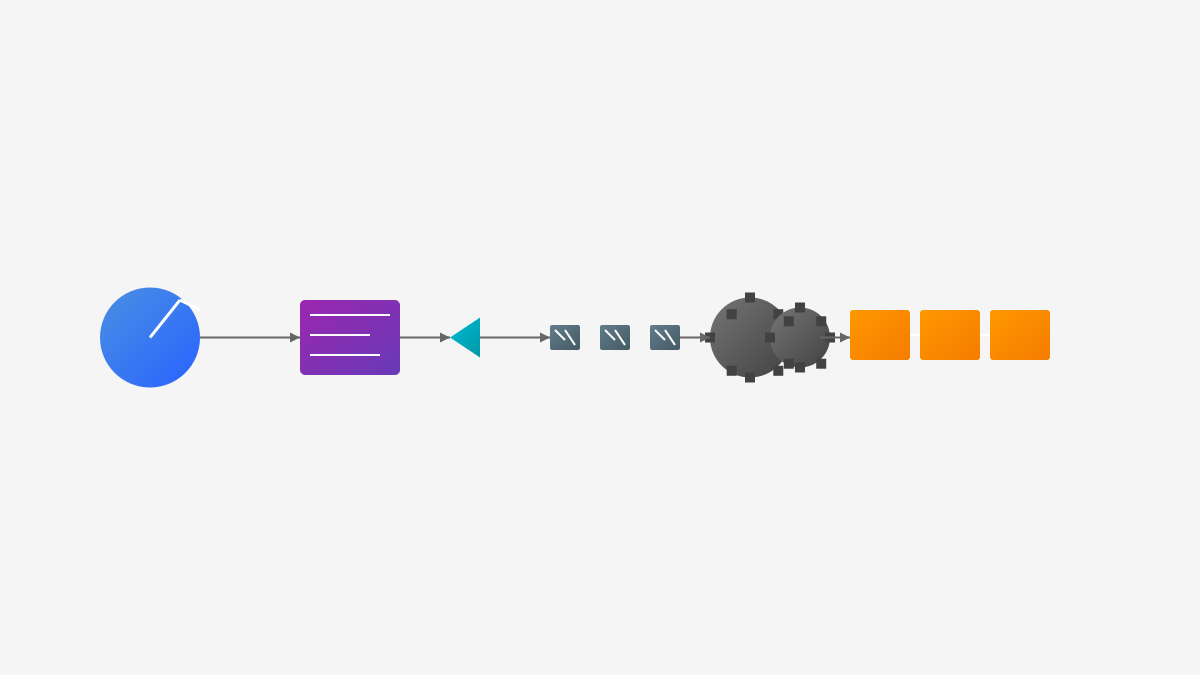
The 6-Step Structured Validation Workflow of spbt-skill

spbt-skill’s workflow includes:

  1. Safe Stash: Securely stash uncommitted changes with recorded references for recovery.
  2. Pull Updates: Execute git pull (prioritize fast-forward; stop on merge conflicts).
  3. Commit Classification: AI-powered classification into "application code changes" or "tool config changes".
  4. Interactive Selection: Let developers choose which commits to test (tool config commits default to audit records).
  5. Test Generation: Create manual checklists, security notes, Playwright/API scripts, Colab notebook units.
  6. Env Var Management: Strict naming convention (UPPER_SNAKE_CASE_SCRUM_) for per-SCRUM工单 configs.
4

Section 04

Technical Architecture & Installation of spbt-skill

spbt-skill uses Agent Skill architecture (reusable workflow modules). It supports Claude Code and Cursor:

  • Claude Code: Copy SKILL.md to .claude/skills/stash-pull-build-tests.
  • Cursor: Copy SKILL.md to .cursor/skills/stash-pull-build-tests. Installation options:
  • Project-level (recommended): ./scripts/install.sh --target <repo>.
  • User-level: ./scripts/install.sh --user.
  • Windows: Use PowerShell scripts (install.ps1 with -Target/-UserScope).
5

Section 05

Key Innovations of spbt-skill

spbt-skill’s highlights:

  1. Smart Commit Classification: Differentiates application code vs tool config changes to focus testing.
  2. Mixed Validation Modes: Combines manual checklists, automated scripts, and Colab notebooks for flexibility.
  3. AI-Assisted Validation: Uses AI for natural language triggering, targeted validation questions, and security risk identification.
6

Section 06

Practical Use Cases & Value of spbt-skill

spbt-skill benefits teams in multiple scenarios:

  • Daily Dev Sync: Automates stash, pull, commit analysis, and test generation for daily updates.
  • Code Review: Assists reviewers with commit classification, checklists, and security notes.
  • Regression Testing: Generates Playwright/API scripts and Colab notebooks for frequent validation.
  • Team Collaboration: Standardizes workflows, reduces new member learning curve, and ensures consistent test docs.
7

Section 07

Limitations & Best Practices for spbt-skill

Current Limitations:

  • Dependent on Claude Code/Cursor IDEs for full functionality.
  • Environment variable conventions require team learning.
  • Default templates may need project-specific adjustments.

Best Practices:

  • Start with small pilot projects (1-2 SCRUM工单).
  • Establish team agreements on test requirements for different commit types.
  • Regularly update validation templates based on usage.
  • Ensure sensitive env vars are not committed (use .gitignore for .env.stash-pull).
8

Section 08

The Future of Automated Validation with spbt-skill

spbt-skill represents a new direction in dev workflow automation—combining human judgment with AI to automate validation planning and execution. It frees developers from tedious prep work, letting them focus on creative tasks. As AI evolves, more such skills will emerge to simplify dev processes and boost software quality. For teams aiming to improve code quality and standardize validation, spbt-skill is a thoughtful solution.

