Zing Forum

Reading

SPARK: An Open-Source Voice-Driven AI Assistant for More Immersive Local LLM Interactions

SPARK is a Python-based voice-driven AI assistant that integrates real-time speech recognition, large language model inference, and text-to-speech capabilities. Combined with a dynamically visualized sphere GUI, it provides users with an immersive voice interaction experience.

语音助手AI助手语音识别大语言模型Python开源项目ElevenLabsGroq实时交互
Published 2026-04-17 15:44Recent activity 2026-04-17 16:22Estimated read 5 min
SPARK: An Open-Source Voice-Driven AI Assistant for More Immersive Local LLM Interactions
1

Section 01

Introduction / Main Post: SPARK: An Open-Source Voice-Driven AI Assistant for More Immersive Local LLM Interactions

SPARK is a Python-based voice-driven AI assistant that integrates real-time speech recognition, large language model inference, and text-to-speech capabilities. Combined with a dynamically visualized sphere GUI, it provides users with an immersive voice interaction experience.

2

Section 02

Project Background and Design Philosophy

The birth of SPARK stems from reflections on the interaction methods of existing AI assistants. Current AI assistants on the market either rely on text input or, while supporting voice, lack visual feedback, making it difficult for users to intuitively perceive the AI's "thinking state". SPARK's design goal is clear: to create a comprehensive voice AI assistant that can listen, think, speak, and visualize.

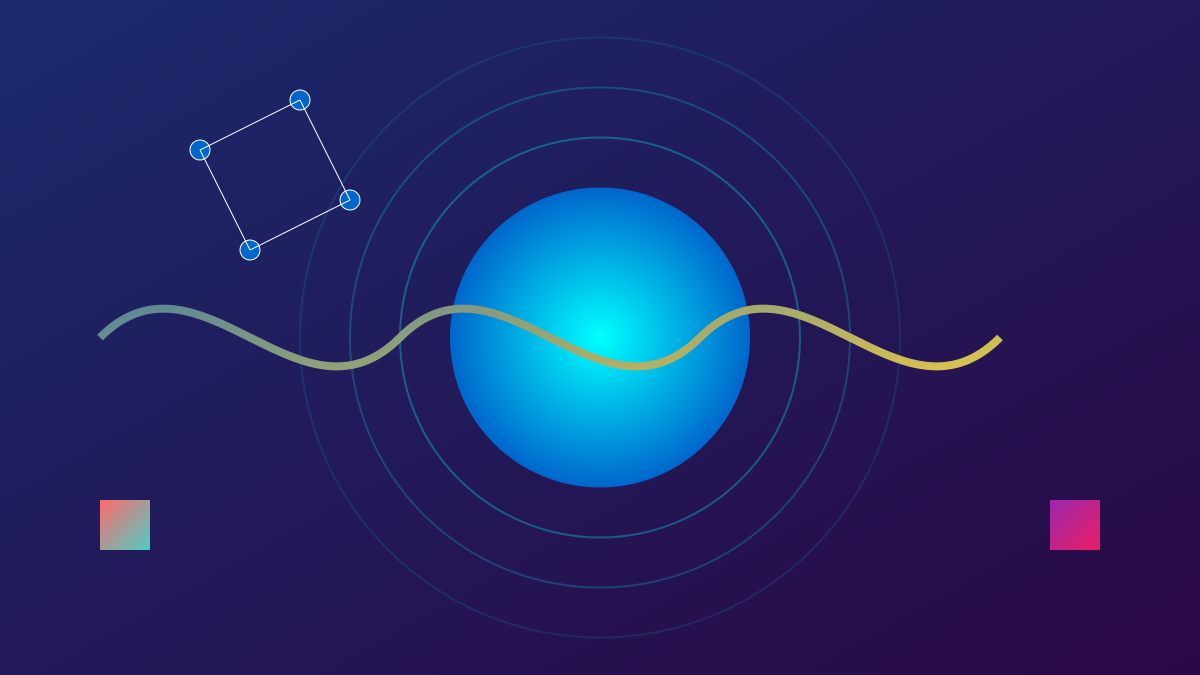
The core design philosophy of the project is embodied in its unique visualized sphere (Orb) interface. This sphere changes in real time according to the AI's different states: it pulses blue when listening to the user's voice, rotates purple when thinking, and changes shape when responding. This design allows users to intuitively perceive the AI's working state, greatly enhancing the immersion of interaction.

3

Section 03

Technical Architecture Analysis

SPARK's tech stack selection and architecture design reflect the best practices of modern AI applications. The entire system adopts a modular design, mainly divided into the following core components:

4

Section 04

1. Speech Input Layer (SpeechToText)

Continuous speech recognition is implemented based on the Google Speech Recognition API. This module runs in an independent thread, continuously monitoring microphone input, and triggers subsequent processing flows once voice input is detected. This design ensures that the assistant can respond to user wake-ups and commands at any time.

5

Section 05

2. Intelligent Routing Layer (Classifier)

This is the "brain center" of SPARK. Using Cohere AI's classification capabilities, the system can intelligently determine the intent type of the user's query and route it to the corresponding processing module. This design avoids the limitations of a single model handling all tasks, allowing each module to focus on its area of expertise.

6

Section 06

3. Dialogue Processing Engine

Based on the classification results, the query is routed to one of three main processing modules:

  • General Module: Uses the LLaMA 3.3 70B model on the Groq platform to handle daily conversations and maintain dialogue memory for more coherent interactions
  • Realtime Module: Combines DuckDuckGo search and the Groq model to provide the latest answers to questions requiring real-time information
  • Automation Module: Executes system-level operations such as opening applications, taking screenshots, and writing content in a notepad
7

Section 07

4. Speech Output Layer (TextToSpeech)

Uses ElevenLabs' text-to-speech technology to convert the AI's responses into natural and fluent voice output. Compared to traditional TTS solutions, ElevenLabs can generate more emotional and realistic voices.

8

Section 08

5. Visual Interface (GUI)

A real-time web interface built based on Flask-SocketIO, which maintains bidirectional communication with the backend via WebSocket to achieve real-time updates of the sphere's state.


