Zing Forum

Reading

SmartLLM-Router: Practice of LLM Gateway with Intelligent Routing, Semantic Caching, and Cost Optimization

This article deeply analyzes the SmartLLM-Router project, exploring how it helps enterprises achieve the optimal balance between performance and cost when using multi-model LLM infrastructure through intelligent model routing, semantic caching, and real-time cost analysis.

LLM路由语义缓存成本优化多模型架构API网关智能调度向量检索
Published 2026-04-01 06:15Recent activity 2026-04-01 06:19Estimated read 8 min
SmartLLM-Router: Practice of LLM Gateway with Intelligent Routing, Semantic Caching, and Cost Optimization
1

Section 01

[Introduction] SmartLLM-Router: An Intelligent Gateway Solution for Multi-Model LLM Infrastructure

This article introduces the open-source project SmartLLM-Router, which helps enterprises achieve the optimal balance between performance and cost in the multi-model LLM ecosystem through three core capabilities: intelligent model routing, semantic caching, and real-time cost analysis. The project aims to solve the pain point of enterprises choosing the right LLM model, providing middleware-layer dynamic decision-making, cost control, and service optimization.


2

Section 02

Architectural Challenges in the Multi-Model Era

With the flourishing of large language models from major vendors such as OpenAI GPT series, Anthropic Claude, Google Gemini, and Meta Llama, enterprises face a 'happy trouble' when building AI applications: different models have their own strengths in capabilities, speed, cost, and context window, and no single model can perform best in all scenarios. The complexity of this multi-model ecosystem has spawned the need for an intelligent routing layer. Enterprises need a middleware layer to dynamically select the most suitable model while managing costs, optimizing latency, and ensuring service quality. SmartLLM-Router is an open-source solution designed exactly for this purpose.

3

Section 03

Intelligent Routing: Data-Driven Model Selection Mechanism

One of the core capabilities of SmartLLM-Router is intelligent routing. It performs semantic analysis on request content, extracts features such as task type, complexity, and domain expertise requirements, and converts them into vector representations. At the same time, it maintains performance profiles of target models, including capability boundaries, latency characteristics, cost structures, and availability status. The routing engine uses a multi-objective optimization algorithm to select the model with the best expected performance under the premise of meeting latency budgets or cost constraints. For example, simple Q&A requests are routed to lightweight and low-cost models, while complex code reasoning tasks are routed to high-capability models.

4

Section 04

Semantic Caching: A Tool to Eliminate Redundant Computation

There are semantically repeated requests in LLM applications, which traditional exact-match caching cannot capture. SmartLLM-Router introduces semantic caching: after converting a new request into a semantic vector, it searches for similar entries in the vector database (returns cached results if cosine similarity >0.95). Key designs include: using ANN search algorithm to support large-scale concurrency; cache invalidation mechanism based on TTL and version; privacy policies for excluding sensitive requests and encrypted storage. In actual deployment, the hit rate can reach 20%-40% (60%+ in high-frequency scenarios), effectively saving costs and reducing latency.

5

Section 05

Real-Time Cost Analysis: A Transparent Financial Management Tool

SmartLLM-Router provides fine-grained real-time cost analysis, covering multi-dimensional statistics by model, application, time, and request features; generates cost optimization suggestions (such as adjusting routing strategies for simple tasks); supports budget threshold alerts and rate-limiting measures. Cost data also provides a feedback loop for routing decisions, continuously optimizing cost-performance trade-off strategies to maximize service quality under budget constraints.

6

Section 06

Architecture Design and Deployment Modes

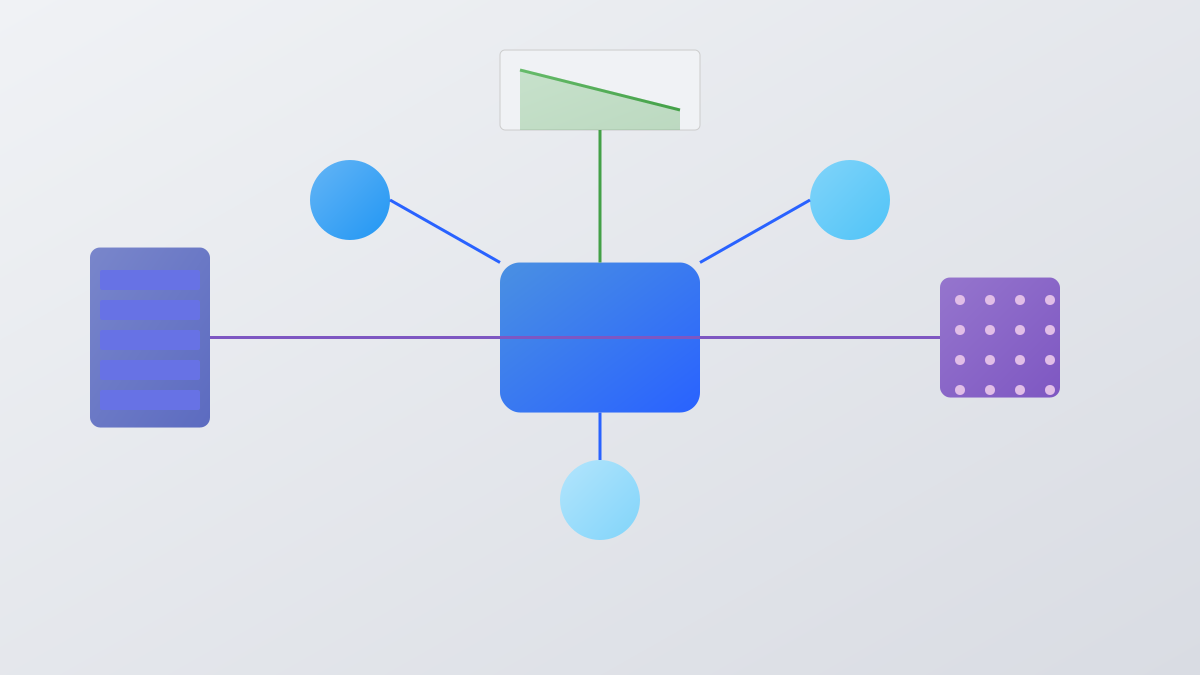
SmartLLM-Router adopts a modular architecture: the API gateway layer is compatible with OpenAI interfaces and supports streaming/synchronous responses; the routing engine supports rule-based, machine learning hybrid strategies and A/B testing; the cache layer integrates vector databases and multi-level caching; the monitoring layer provides Prometheus metrics, structured logs, and distributed tracing. Deployment modes include independent service (K8s container), sidecar mode (same Pod to reduce latency), and edge deployment (CDN nodes for low-latency access).

7

Section 07

Practical Suggestions and Best Practices

Suggestions for deploying SmartLLM-Router: 1. Progressive migration (small-scale verification, monitor cache hit rate and routing accuracy); 2. Regularly update model profiles (automated benchmark testing); 3. Optimize cache strategy (start with a high similarity threshold, monitor cache pollution); 4. Balance cost and service quality (set cost upper limits and SLOs, configure degradation strategies).

8

Section 08

Conclusion: Evolution Direction of LLM Infrastructure

SmartLLM-Router represents the evolution of LLM infrastructure from directly using a single model API to an intelligent middleware layer, realizing the automation of model selection, cache optimization, and cost control. Against the background of the continuous prosperity of the multi-model ecosystem, such routing and governance tools will become standard components of enterprise AI architectures, helping organizations efficiently utilize AI capabilities and maintain financial sustainability.

