Zing Forum

Reading

SmartChildcare Agent: Multi-Agent Architecture Reshapes the Closed Loop of Childcare Decision-Making

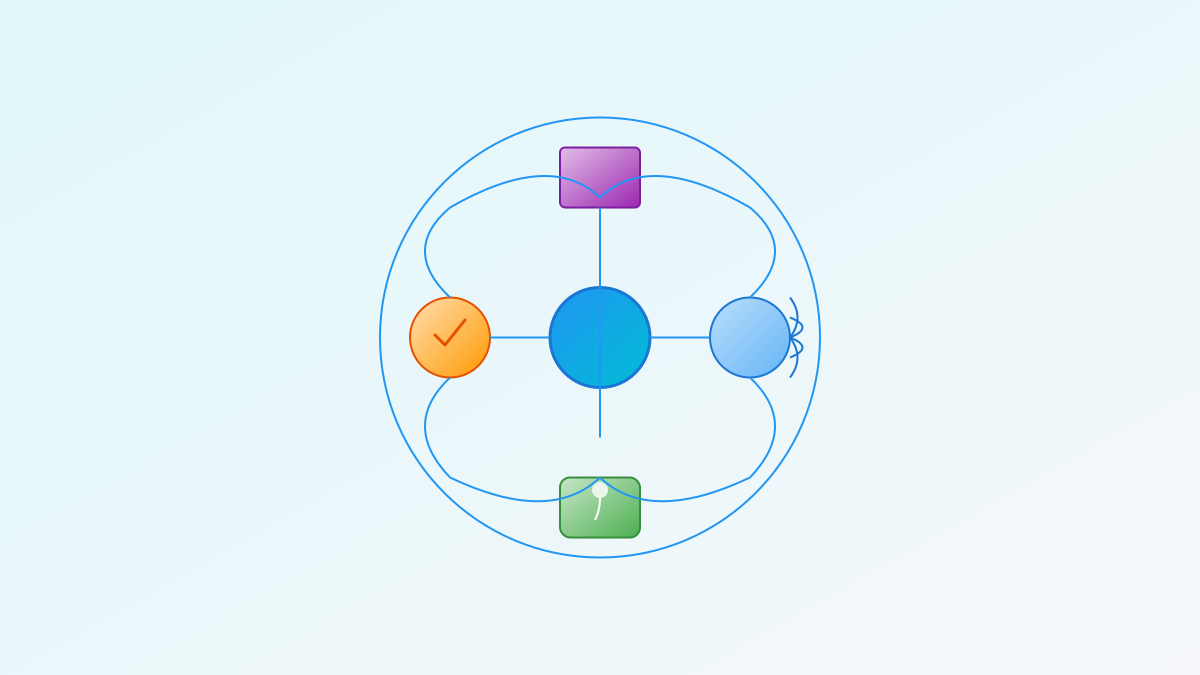
A multi-role AI agent system for childcare scenarios. Through collaboration among teachers, parents, and principals, combined with a memory hub and structured workflows, it transforms fragmented observations into continuous closed-loop decision support, creating a complete demonstration baseline for the vivo AIGC Innovation Competition.

SmartChildcaremulti-agentchildcare AIvivo AIGCeducation technologyvoice agentmemory systemdecision supportearly childhood education闭环系统
Published 2026-04-09 18:12Recent activity 2026-04-09 18:21Estimated read 6 min
SmartChildcare Agent: Multi-Agent Architecture Reshapes the Closed Loop of Childcare Decision-Making
1

Section 01

SmartChildcare Agent: Multi-Agent Architecture Reshapes the Closed Loop of Childcare Decision-Making (Introduction)

SmartChildcare Agent is a multi-role AI agent system for childcare scenarios. Through collaboration among teachers, parents, and principals, combined with a memory hub and structured workflows, it transforms fragmented observations into continuous closed-loop decision support, creating a complete demonstration baseline for the vivo AIGC Innovation Competition and addressing the core pain points of information fragmentation and decision-making disconnection in the childcare industry.


2

Section 02

AI Dilemmas and Needs in Childcare Scenarios

The childcare industry faces challenges of information fragmentation and decision-making disconnection: Teachers rely on memory/paper records, principals lack data support to identify high-risk cases, and parents can only understand their children's situation during drop-off and pick-up. Traditional systems have become mere "data entry + report display", and simple AI is limited to single-round interactions. There is a need for an intelligent decision-making system that understands context, tracks continuously, and enables multi-role collaboration.

3

Section 03

System Positioning: Core Differences from Ordinary Childcare Systems

The essential differences between SmartChildcare Agent and ordinary childcare systems:

  1. Complete intelligent agent system (autonomous planning/tool calling/memory management) vs single-point AI plug-in;
  2. Multi-role collaboration (transmitting context to form a decision chain) vs single-round Q&A;
  3. Memory hub-driven (maintaining growth records/status snapshots) vs one-time generation;
  4. Mobile-first (voice input/card output/storybook visualization) vs desktop-first.
4

Section 04

Core Decision-Making Closed Loop: Detailed Explanation of the Six-Step Process

Six-step closed-loop process:

  1. Recording: Teacher's voice recording → ASR to text → LLM extracts structured draft;
  2. Understanding: FastAPI orchestrator calls Agent for analysis, identifies risks/trends combined with historical records;
  3. Decision-Making: Principal checks the risk dashboard, high risks trigger the consultation workflow, and the system generates recommendations;
  4. Intervention: Parents receive personalized execution suggestions (including educational concepts in storybook form);
  5. Feedback: Parents feedback execution status, which is stored in the memory hub;
  6. Review: Regularly evaluate intervention effects and adjust strategies.
5

Section 05

Technical Architecture: Five-Layer Collaborative Design

Five-layer architecture:

  1. Frontend Interaction Layer: Teacher end (voice recording/consultation entry), parent end (trend query/storybook), principal end (risk dashboard/decision area);
  2. Next.js Bridge Layer: UI rendering + API forwarding, including role scaffolding and AI capability bridging;
  3. Agent Orchestration Layer: Central orchestrator coordinates dedicated Agents (voice understanding/consultation workflow, etc.);
  4. Memory Hub: Child growth records/Agent status snapshots/interaction trajectories/vector storage;
  5. vivo Capability Layer: Integrates LLM/ASR/TTS/OCR, uses on-device AI to reduce costs and improve efficiency.
6

Section 06

Competition Demonstration Path: Stable Demo Baseline

Five demonstration paths are designed for the vivo AIGC Innovation Competition. The main path is Teacher End → High-Risk Consultation → Principal End → Parent End → Storybook → Parent Agent, which fully demonstrates the closed loop. Key demonstration points:

  1. High-risk consultation (reflects intelligence level);
  2. Admin decision area (institutional-level value);
  3. Parent storybook (humanistic care).
7

Section 07

Project Value and Future Outlook

Value: Redefines childcare AI from tool to system, single point to closed loop, general to professional, and technology to humanity. Progress: 5 demonstration paths are stable, the frontend supports 36-person demos, and backend alignment is in progress. Outlook: Deeply integrate vivo capabilities, complete backend alignment, and is expected to become an industry benchmark.

