Zing Forum

Reading

Shiioo: An Agentic Enterprise Orchestration System Based on DAG Workflow and Event Sourcing

Shiioo, a virtual company operating system, provides enterprise-level Agent orchestration capabilities, supporting DAG workflow, event sourcing architecture, and MCP tool integration to enable collaborative work of AI agents.

AI代理工作流编排DAG事件溯源企业自动化MCP协议多代理协作
Published 2026-04-09 20:41Recent activity 2026-04-09 21:17Estimated read 8 min
Shiioo: An Agentic Enterprise Orchestration System Based on DAG Workflow and Event Sourcing
1

Section 01

[Introduction] Shiioo: Building a Virtual Company Operating System for AI Agent Collaboration

Shiioo (pronounced like "CO") is an open-source virtual company operating system whose core goal is to enable multiple AI agents to collaborate on complex enterprise tasks like a human team. It integrates a DAG workflow engine, event sourcing architecture, and MCP tool protocol to provide enterprise-level Agent orchestration capabilities, helping to achieve AI-driven business process automation.


2

Section 02

Project Background and Vision

Against the backdrop of rapid maturation of AI agent technology, traditional automation tools are limited by predefined rules and linear processes, making it difficult to handle complex business scenarios. Shiioo aims to solve the key problem of "how to make AI agents collaborate", adopting an Agentic architecture that treats AI as autonomous decision-making digital employees. Through flexible orchestration technology, it realizes enterprise process automation, with the vision of becoming a core platform connecting AI capabilities and business needs.

3

Section 03

Core Architecture: DAG Workflow Engine

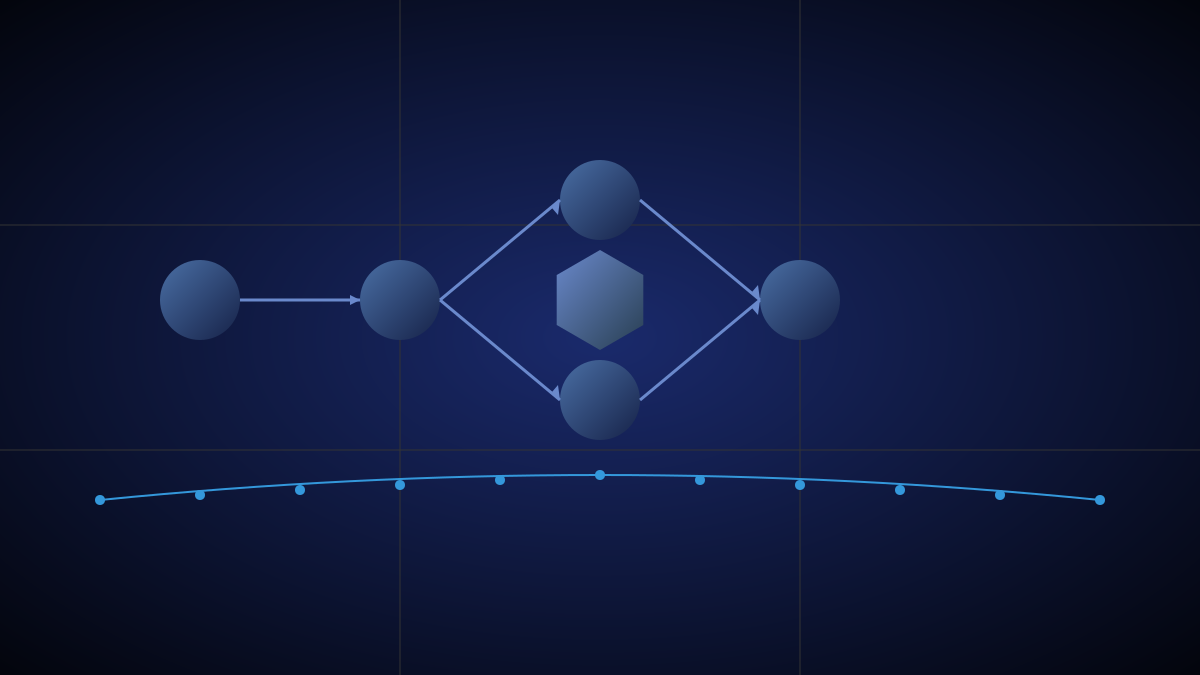
Shiioo uses DAG (Directed Acyclic Graph) as the foundation for workflow modeling:

  • Rich node types: Includes task nodes (executing business operations), decision nodes (conditional branching), agent nodes (calling AI agents), and aggregation nodes (merging results);
  • Dependency management: Natively supports complex task dependencies, ensuring sequential execution while maximizing parallel efficiency;
  • Dynamic scheduling: Paths can be adjusted according to actual conditions at runtime, supporting conditional branching, loop iteration, and exception handling.
4

Section 04

Core Architecture: Event Sourcing and MCP Integration

Event Sourcing Architecture:

  • All state changes are recorded as immutable events, enabling complete audit trails, state reconstruction at any point in time, and easy debugging;
  • Uses the CQRS pattern to optimize read-write performance: write operations via event streams, read operations via materialized views;
  • Supports event replay for testing, debugging, and data migration.

MCP Tool Integration:

  • Interacts with external systems through standardized interfaces to reduce integration complexity;
  • Dynamically discovers and loads tools, supporting hot-swapping and version management;
  • Tools run in a secure sandbox, with restricted permissions and operation logging.
5

Section 05

Enterprise-Level Features and Tech Stack Deployment

Enterprise-Level Features:

  • Multi-agent collaboration: Supports role definition (researcher, analyst, etc.), standardized communication protocols (synchronous/asynchronous), and conflict resolution mechanisms (voting, priority, manual arbitration);
  • Observability: Real-time monitoring dashboard, log aggregation and full-text search, end-to-end request tracing;
  • Security and compliance: Integrates SSO (OAuth/SAML), fine-grained RBAC permission control, and multi-tenant data isolation.

Tech Stack and Deployment:

  • Core runtime based on Rust/Go; workflow engine is a self-developed DAG scheduler; event storage supports PostgreSQL/EventStoreDB; message queue integrates NATS/RabbitMQ/Kafka; API layer provides both GraphQL and REST protocols.
  • Deployment options: Local Docker Compose, Kubernetes (Helm Chart/Operator), and upcoming official managed SaaS service.
6

Section 06

Application Scenarios and Competitor Comparison

Application Scenarios:

  1. Intelligent customer service center: Intent recognition → Knowledge retrieval → Response generation → Quality inspection;
  2. Content production pipeline: Topic selection → Research → Writing → Editing → Publishing;
  3. Financial report generation: Data collection → Ratio analysis → Anomaly insight → Visual report.

Competitor Comparison:

Feature Shiioo Temporal Airflow n8n
AI-native Yes Partial No Partial
DAG support Yes Yes Yes Yes
Event sourcing Native Optional No No
Multi-agent collaboration Built-in Need to build Need to build Need to build
MCP protocol Supported Not supported Not supported Not supported
Enterprise-level security Yes Yes Yes Partial

Shiioo has significant advantages in AI-native support, event sourcing, multi-agent collaboration, and MCP protocol support.

7

Section 07

Community Ecosystem and Future Outlook

Community and Ecosystem:

  • Template market: Community-shared workflow templates covering common scenarios;
  • Agent store: Pre-trained professional agents, supporting direct deployment or customization;
  • Integration library: Ready-made integrations with mainstream enterprise software like Salesforce, SAP, and Slack.

Summary and Outlook: Shiioo is an important attempt in the evolution of enterprise automation towards the Agentic paradigm. It provides a solid foundation for AI-driven business processes through DAG, event sourcing, and MCP protocols. As AI agent capabilities improve, such orchestration platforms will become key bridges connecting AI and business needs. It is recommended that enterprises looking to explore the potential of AI automation pay attention to and try Shiioo.

