Zing Forum

Reading

Shadow Supervisor: A Silent Fault Detection System in Multi-Agent Workflows

The Shadow_Supervisor-OpenEnv project focuses on training supervisory agents to detect silent faults in multi-agent workflows, providing an important reliability guarantee mechanism for building robust AI agent systems.

多代理系统故障检测AI可靠性监督代理开源项目GitHub
Published 2026-04-26 18:15Recent activity 2026-04-26 18:23Estimated read 5 min
Shadow Supervisor: A Silent Fault Detection System in Multi-Agent Workflows
1

Section 01

[Introduction] Shadow Supervisor: An Innovative Solution for Silent Fault Detection in Multi-Agent Systems

The Shadow_Supervisor-OpenEnv project focuses on the problem of silent fault detection in multi-agent workflows. By introducing the "Shadow Supervisor" mechanism, it trains supervisory agents to monitor system health status in real time and identify potential anomalies. This project provides important guarantees for building robust AI agent systems, and as an open-source project, it promotes research and practice in multi-agent system reliability.


2

Section 02

Problem Background: The Challenge of Silent Faults in Multi-Agent Systems

As AI agent systems evolve toward multi-agent architectures, their complexity grows exponentially. In multi-agent collaboration, abnormal behavior of a single agent may spread in a "silent" manner—without explicit errors, yet affecting the overall output quality. This type of "silent fault" is one of the core challenges in building reliable multi-agent systems, and the Shadow_Supervisor-OpenEnv project is designed specifically to address this issue.

3

Section 03

Core Concept Explanation: Shadow Supervisor and Characteristics of Silent Faults

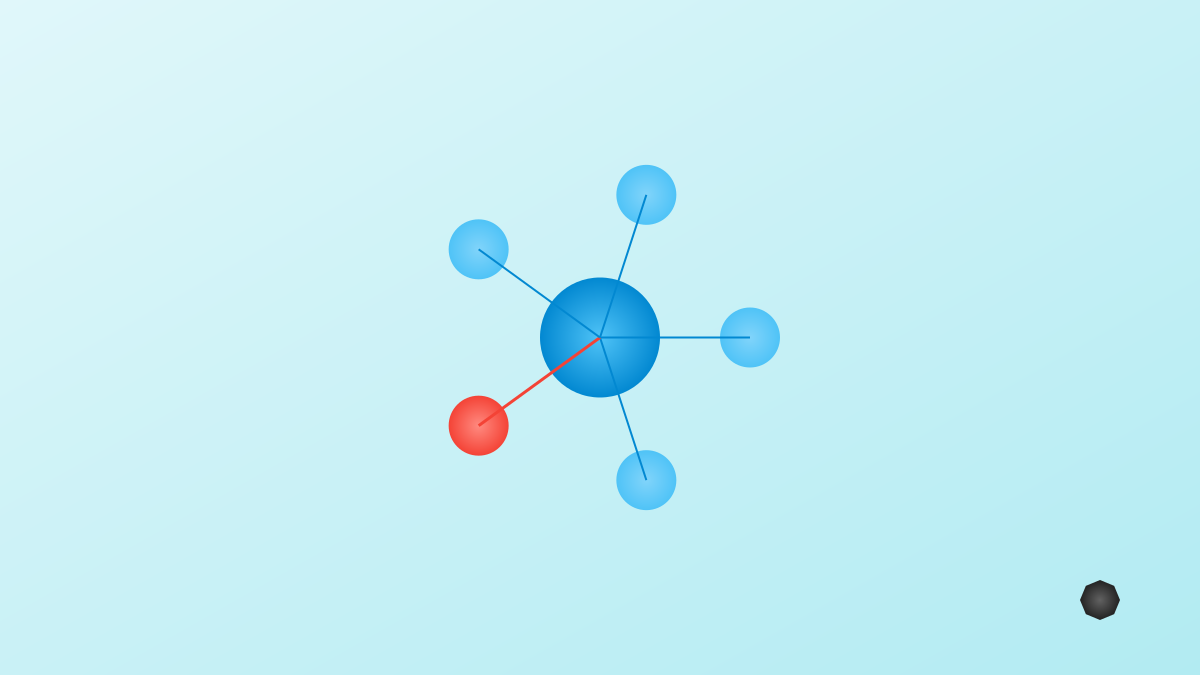
The Shadow Supervisor is a supervisory agent that runs alongside the main workflow. It does not directly participate in tasks but continuously monitors health status, drawing on the concept of "shadow traffic" from distributed systems. The characteristics that make silent faults difficult to detect include:

  • No explicit error output
  • Gradual deterioration
  • Strong context dependency
  • Cross-agent propagation
4

Section 04

Technical Implementation: OpenEnv Environment and Supervisory Agent Training Strategy

The project's OpenEnv environment can simulate/inject faults (delays, logical errors, communication failures, semantic drift) to provide data scenarios for training. The supervisory agent uses a contrastive learning strategy:

  • Collect normal trajectories (positive samples)
  • Inject faults to generate abnormal trajectories (negative samples)
  • Learn distinguishing features
  • Evaluate health status in real time It also analyzes from multiple dimensions: semantic consistency, behavior patterns, cross-agent impact, and resource usage.
5

Section 05

Application Value: Enhancing System Reliability and Optimization Efficiency

Deploying the Shadow Supervisor can significantly improve the reliability of multi-agent systems, triggering response mechanisms such as alarms and retries; the recorded monitoring data accelerates fault location and repair; long-term accumulated data supports identifying weak links and continuously optimizing collaboration mechanisms.

6

Section 06

Open-Source Significance and Future Outlook: Promoting Reliable Operation of Multi-Agent Systems

The open-source Shadow_Supervisor-OpenEnv provides infrastructure for reliability research, proposes the concept of "proactive monitoring", and promotes the evolution of systems from "able to run" to "reliable operation". In the future, it is expected to integrate with more frameworks, form standardized guarantee solutions, and provide references for production-level multi-agent systems.

