Zing Forum

Reading

Sequencer: From Dialogue to Pipeline — A New Paradigm for Local-First AI Agent Orchestration

Sequencer is a local-first AI agent workflow orchestration tool that transforms AI interactions from linear dialogues into structured pipelines via a visual canvas. It supports multi-model collaboration and privacy protection, representing a new direction for AI-assisted development.

AI智能体工作流编排本地优先多模型协作可视化隐私保护macOS自动化流水线
Published 2026-05-04 09:14Recent activity 2026-05-04 09:19Estimated read 5 min
Sequencer: From Dialogue to Pipeline — A New Paradigm for Local-First AI Agent Orchestration
1

Section 01

Introduction: Sequencer — A New Paradigm for Local-First AI Agent Orchestration

Sequencer is a local-first AI agent workflow orchestration tool that turns AI interactions from linear dialogues into structured pipelines using a visual canvas. It supports multi-model collaboration and privacy protection, representing a new direction for AI-assisted development. Its core solves the efficiency and reproducibility issues of conversational interactions in complex engineering tasks, supported by three pillars: visual orchestration, multi-agent collaboration, and local-first approach.


2

Section 02

Background: The Engineering Bottleneck of AI Conversational Interactions

Over the past two years, large models like ChatGPT have become standard tools for developers. However, conversational interactions face issues like low efficiency, difficult context management, and poor reproducibility in complex multi-step tasks (e.g., codebase analysis, test case generation, code refactoring). Sequencer was created to address this pain point.

3

Section 03

Core Philosophy: From Chat Threads to Orchestrated Pipelines

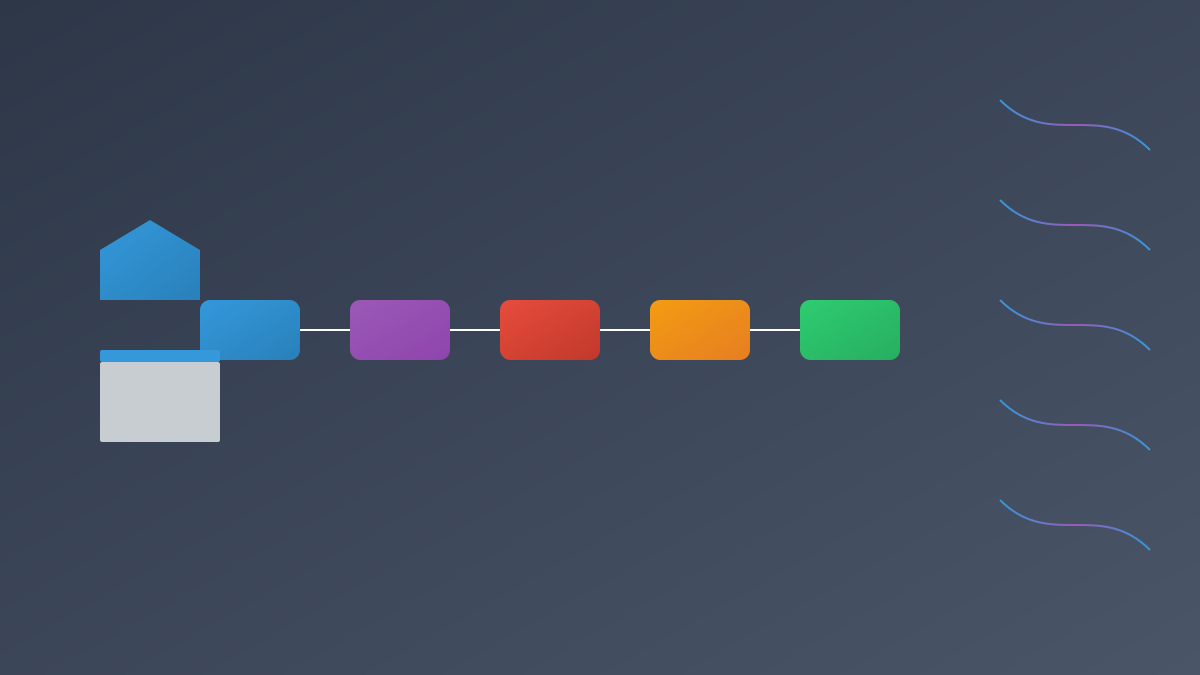
Sequencer's core philosophy is 'Stop chatting, start orchestrating'. It transforms AI interactions from single-turn dialogue mode into a factory pipeline structure: tasks are broken down into multiple stages, each handled by a dedicated agent, with automatic transitions. The process is trackable, reproducible, and optimizable.

4

Section 04

Product Architecture: Three Core Pillars

  1. Visual Orchestration: Drag-and-drop nodes on the canvas and define data flows for a WYSIWYG experience, reducing cognitive load. 2. Multi-agent Collaboration: Assign optimal models/agents to different stages (e.g., structure-savvy models for code analysis, technical writing models for documentation generation), with automatic routing and handover. 3. Local-First: The engine runs locally; code and data are not uploaded to third parties, ensuring privacy and security.
5

Section 05

Usage Flow: Build an AI Pipeline in Three Steps

  1. Design the Flow: Drag nodes and connect them on the canvas to define relationships. 2. Assign Models: Specify appropriate models for nodes (supports Claude, GPT, local open-source models, etc.). 3. Execute and Iterate: Track progress in real time, check outputs, and adjust the flow.
6

Section 06

Technical Positioning and Ecological Value

Sequencer is a general-purpose agent orchestration framework positioned at the infrastructure layer: For individual developers, it provides a systematic and reproducible way to use AI; for teams, visual workflows help preserve best practices; for AI application developers, it accelerates the transition of multi-agent systems from prototype to product.

7

Section 07

Current Status and Roadmap

Currently, Sequencer is mainly optimizing its macOS version, with Windows and Linux versions under development. The project team has a clear product positioning and narrative, accurately capturing user pain points with the slogan 'From Chat to Pipeline'.

8

Section 08

Conclusion: The Next Stage of AI Engineering

Sequencer represents the trend of AI tools evolving from 'conversational interfaces' to 'workflow systems'. It addresses the key issue of how to organize and coordinate workflows after AI capabilities have become powerful, marking a turning point for developers from 'playing with AI' to 'using AI for engineering'.