Zing Forum

Reading

Scaled CS Team: A Customer Success Automation System with Six Collaborative AI Agents

Explore how a customer success team composed of six AI agents achieves large-scale customer operations through role division, human-AI collaboration, and automated workflows

AI智能体客户成功多智能体协作Salesforce自动化人机协作客户运营规模化服务
Published 2026-05-31 07:45Recent activity 2026-05-31 07:49Estimated read 6 min
Scaled CS Team: A Customer Success Automation System with Six Collaborative AI Agents
1

Section 01

Introduction to the Scaled CS Team Project: A Customer Success Automation System with Six Collaborative AI Agents

Scaled CS Team is a virtual customer success team composed of six AI agents, designed to address the large-scale operation challenges of customer success through role division, human-AI collaboration, and automated workflows. Based on actual customer success scenarios, this project leverages the advantages of AI automation while retaining the role of humans in key decision-making, providing enterprises with a customizable open-source architecture template.


2

Section 02

Background of Large-Scale Challenges in Customer Success

In the enterprise software and service industry, customer success teams face challenges such as maintaining service quality, responding to needs in a timely manner, and preventing customer churn as the number of customers grows. Traditional manpower expansion solutions are expensive and difficult to scale, while the development of AI agent technology provides a new idea to solve this problem—breaking down workflows into specialized roles, with AI undertaking specific tasks to achieve large-scale operations without sacrificing quality.

3

Section 03

Six-Agent Collaborative Architecture and Value of Role Division

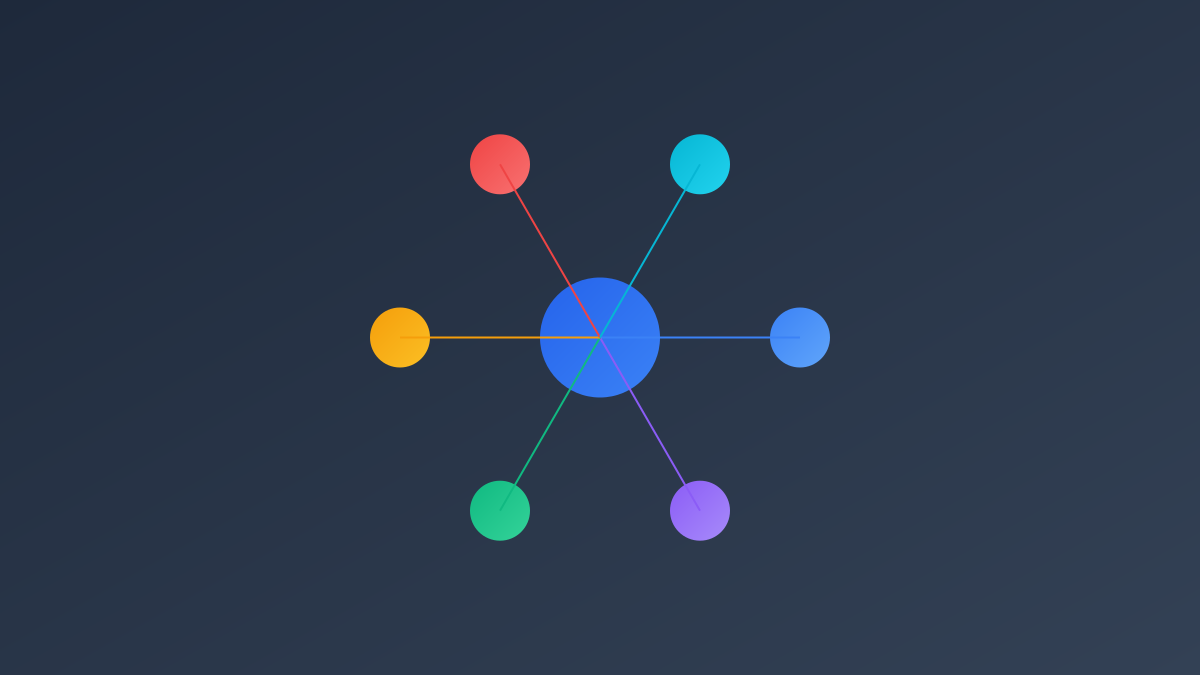
The Scaled CS Team builds a virtual team consisting of six AI agents, each with clear role boundaries and responsibilities, similar to the structure of a real customer success team. Strict role boundaries bring multiple advantages: efficiency improvement (focusing on specific tasks), maintainability (adjusting a single agent does not affect the whole), scalability (independent upgrade and replacement of roles), and security (permission restrictions reduce the impact of abnormalities).

4

Section 04

Core Functions: Integration of Automation and Intelligence

The project's core capabilities cover three areas: 1. Account health monitoring: Continuously monitor customer account usage, activity metrics, and key events to proactively identify potential risks; 2. Salesforce operation automation: Integrate with CRM systems to automatically perform operations such as data updates, task creation, and report generation to ensure timely and accurate data; 3. Customer workflow management: Automatically trigger and execute repetitive processes such as onboarding, renewal reminders, and health checks to ensure service timeliness.

5

Section 05

Human-AI Collaboration: The 'Human-in-the-Loop' Design Philosophy

The project emphasizes the 'human-in-the-loop' design concept, where AI is responsible for execution and preliminary analysis, and key decisions require human confirmation. The reasons include: Customer success involves complex business judgments and interpersonal relationships, and full automation may damage the experience; sensitive operations (such as contract changes and price adjustments) require human confirmation as a risk control measure; it frees up customer success managers to focus on high-value strategic work (in-depth consulting and relationship building).

6

Section 06

Practical Significance and Application Prospects

This project provides a reference architecture template for customer success teams exploring AI transformation, demonstrating how to integrate AI into existing processes rather than replacing humans. Its open-source nature allows enterprises to customize it (adjust role definitions, integrate different CRMs). As multi-agent technology matures, similar architectures can be extended to more business scenarios such as sales support, technical support, and project management.

7

Section 07

Conclusion: A Pragmatic Direction for Multi-Agent Collaboration

The Scaled CS Team represents an important application direction of AI in the enterprise service field—through a well-designed collaboration mechanism, multiple specialized agents work together. This model not only leverages the scale advantage of AI automation but also retains the leading role of humans in key decisions, providing a practical reference solution for enterprise digital transformation.

